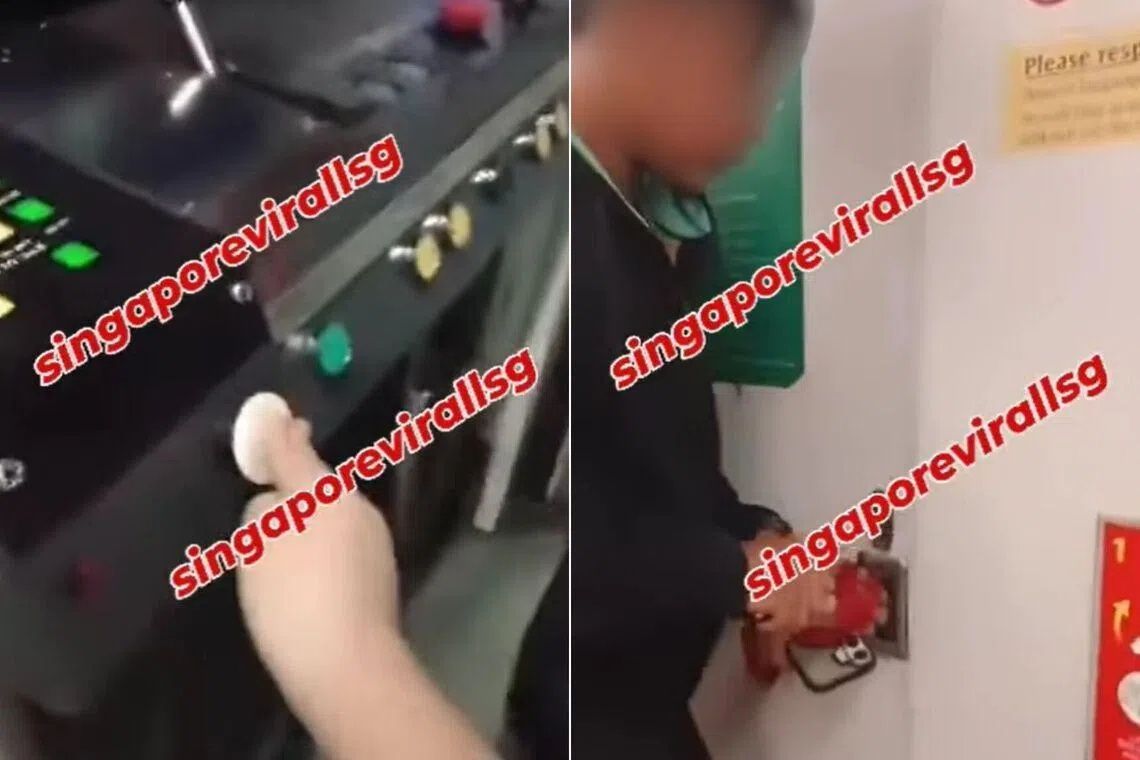
Two children have escaped formal prosecution in Singapore after breaching security on a Mass Rapid Transit train in what authorities say was a reckless stunt that posed genuine safety risks. The boys, aged 11 and 12, forced their way into the restricted driver's cabin aboard a North-South Line train on February 21, an incident that remained unreported until video footage began circulating on social media in late June. Instead of facing court charges, both received conditional warnings under the Rapid Transit System Regulations following investigations by police and consultation with the Attorney-General's Chambers.
The incident itself was caught on multiple platforms. In one viral video, the two juveniles are shown using a tool to forcibly prise open the cabin partition door, gaining entry to an area strictly off-limits to passengers. Once inside, they repeatedly pressed what appeared to be a white control button, generating an audible horn sound that can be heard in the footage. The video's reach was substantial by the time authorities released details in late June: the clip posted on the singaporevirallsg Instagram account had accumulated more than 281,000 views, attracted nearly 140 comments, and been reposted over 200 times, suggesting the incident had resonated significantly across younger online audiences in the city-state.
The breach triggered an immediate response from train operations staff. As soon as the alarm was activated inside the cabin, the train captain operating the locomotive from the front section notified SMRT's Operations Control Centre, the central hub that oversees daily rail system operations across the network. Station personnel at the next stop were then alerted to investigate when the train pulled in, and the two boys exited at that location. Officers reviewed CCTV recordings that comprehensively documented their movements and actions throughout the incident. A formal police report was lodged that same day, initiating an official investigation that would continue for several months before authorities reached a resolution.
SMRT Trains President Lam Sheau Kai underscored the seriousness with which the operator views such breaches. In his statement confirming details of the February 21 incident, Lam stressed that unauthorised access to restricted train areas creates substantial safety and security vulnerabilities. Beyond endangering the individuals involved in the breach itself, such actions risk disrupting normal train operations, potentially affecting thousands of commuters who depend on reliable rail service. The statement reflected growing concern among transport operators in Southeast Asia about juvenile intrusions into operational zones, a trend that has become more visible as social media amplifies incidents that might previously have remained localised knowledge.
The decision not to prosecute represents a deliberate choice by authorities to apply restorative rather than punitive approaches when dealing with children who commit relatively low-harm offences. Police indicated that the conditional warnings were issued following thorough investigation and careful assessment of all circumstances, with the Attorney-General's Chambers consulted throughout the decision-making process. This approach acknowledges the developmental stage of the offenders while simultaneously sending a deterrent message without permanently marking their records with criminal convictions. The conditional warning framework allows authorities to address misconduct while preserving opportunities for rehabilitation and reintegration.
Yet the incident highlights vulnerability in public transport security that extends beyond Singapore's borders, resonating with transit operators across the region facing similar challenges. Malaysia's Klang Valley Integrated Transit System and other Southeast Asian rail networks have reported comparable intrusions, often motivated by curiosity or the appeal of creating shareable online content. The viral nature of this incident—driven by social media's algorithmic amplification—suggests that young people may be increasingly motivated by the prospect of generating views and engagement rather than by any calculated intent to cause harm. This dynamic presents novel challenges for transport authorities tasked with both maintaining genuine security and responding proportionately to youthful transgressions.
The timing of the incident's public exposure is itself noteworthy. The February 21 breach remained unreported publicly for over four months before videos emerged and generated significant online traction in late June. This lag raises questions about information management and the effectiveness of traditional communication channels when competing against social media's rapid dissemination. By the time SMRT and police issued formal statements, the incident had already accumulated hundreds of thousands of views and established itself in public discourse, limiting authorities' ability to shape the narrative around what had occurred.
For Malaysian audiences, this case offers perspective on how transport security measures operate in comparable urban systems and how different jurisdictions approach juvenile offences involving infrastructure. Singapore's emphasis on consultation between law enforcement and the Attorney-General's Chambers reflects a structured prosecutorial system quite similar to Malaysia's own framework, where discretion in charging decisions extends beyond police to the public prosecutor. The conditional warning mechanism available in Singapore—grounded in the Rapid Transit System Regulations—parallels approaches available under Malaysian law, though specific applications vary by state and legislation.
The broader implications extend to considerations of how Southeast Asian cities balance security imperatives with youth engagement and education. Rather than viewing such incidents purely as criminal matters, transport authorities across the region increasingly recognise opportunities to implement targeted safety education campaigns, particularly for school-age populations who may not fully appreciate operational hazards. The incident at hand occurred during school term, suggesting a demographic pattern worth monitoring. Engaging young people through school partnerships and age-appropriate digital content about transport safety may prove more effective long-term than reactive enforcement responses alone.
SMRT's statement ultimately emphasises that maintaining operational integrity and passenger safety requires public cooperation and respect for restricted areas. The message—whether intended primarily for the two boys involved or for the broader audience that consumed their viral video—attempts to reframe boundary-pushing juvenile behaviour as genuinely dangerous rather than merely mischievous. As transport systems throughout Southeast Asia become increasingly sophisticated and technology-dependent, the stakes associated with unauthorised interference grow proportionally, making such incidents serious matters despite the youth of those involved.

