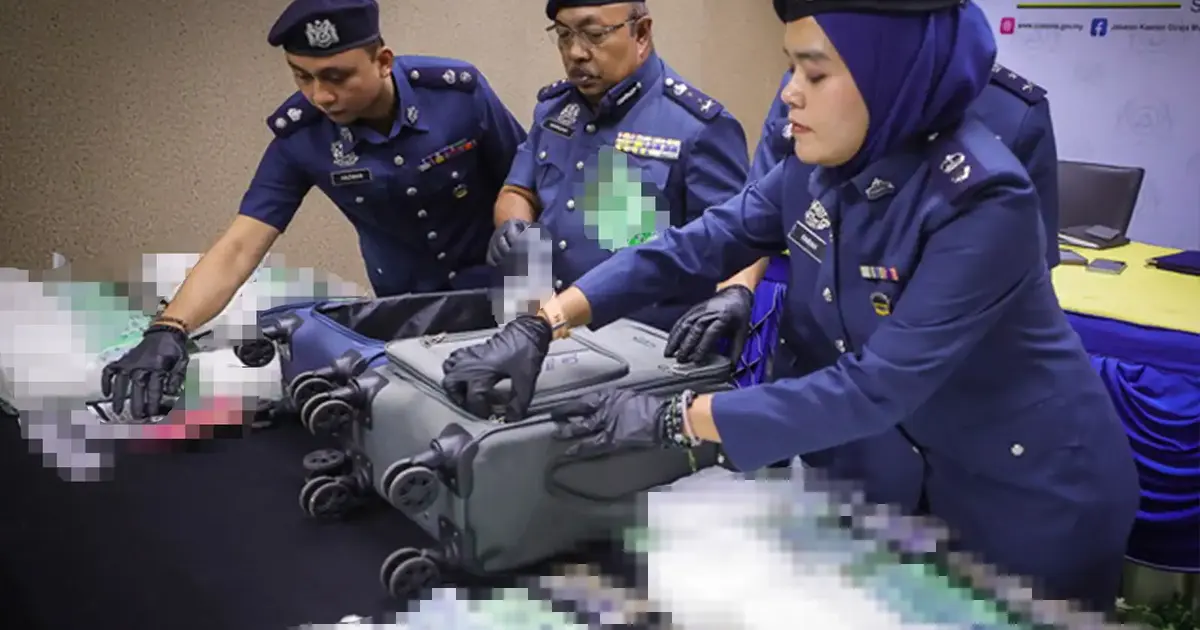
Enforcement authorities in Sarawak have successfully intercepted a major drug smuggling attempt at Kuching International Airport, leading to the arrest of two men suspected of attempting to transport controlled substances worth RM1.32 million into the state. The pair was taken into custody following their arrival on a flight originating from Johor Bahru on July 9, according to operational reports filed with customs and narcotics enforcement agencies.
The interception represents a substantial victory for law enforcement in combating the movement of illicit drugs across Malaysia's internal air routes. Drug trafficking through airport channels remains a persistent challenge for security services, particularly in routes connecting peninsular Malaysia with Sarawak and Sabah, where the potential for profit margins often exceeds those found in traditional ground-based smuggling operations. The timing and scale of this seizure underscores the vulnerability of commercial aviation networks to exploitation by organised criminal syndicates seeking to circumvent conventional border controls.
Kuching's position as Sarawak's principal gateway has made it an attractive transit point for traffickers attempting to distribute narcotics throughout East Malaysia. The airport's high passenger throughput and multiple daily connections to major peninsular cities create operational windows that criminal networks have historically sought to exploit. Enforcement agencies have progressively enhanced their detection capabilities at the facility, deploying advanced screening technologies and intelligence-driven interdiction strategies to intercept contraband before it enters state distribution networks.
The arrest of the two individuals follows a pattern observed across Malaysian airports, where couriers—often individuals with limited criminal histories—are recruited to carry narcotics on short-haul flights where luggage screening protocols may be less rigorous than those applied at international gateways. Intelligence analysts have noted that such operatives are frequently offered modest compensation relative to the street value of the substances they transport, positioning them as expendable assets within larger trafficking hierarchies. The capture of these individuals may yield valuable information regarding upstream suppliers and downstream distribution networks operating within Sarawak.
For Malaysian readers, this case carries particular significance given the nation's strict anti-narcotics legislation and the severe penalties associated with drug trafficking offences. Under the Dangerous Drugs Act 1952, individuals convicted of trafficking in quantities exceeding specified thresholds face potential mandatory death sentences, a deterrent that has not substantially reduced the prevalence of attempted smuggling operations. The persistence of such attempts, despite these severe legal consequences, reflects the extraordinary profitability of the narcotics trade and the desperation or coercion that often characterises the recruitment of low-level operatives.
Sarawak has emerged as a focal point for drug enforcement efforts across Southeast Asia, as the state's geographic position and porous borders with Indonesia create additional vulnerabilities beyond those presented by air-based trafficking routes. The state government has invested substantially in border security infrastructure and inter-agency coordination mechanisms designed to disrupt criminal logistics networks. Recent operations have yielded seizures involving synthetic drugs, heroin, and methamphetamine precursor chemicals, indicating the sophistication of trafficking organisations now operating across the region.
The successful interdiction at Kuching airport demonstrates the effectiveness of intelligence-led policing and the value of sustained coordination between customs authorities, airport security personnel, and drug enforcement agencies. Advance intelligence regarding suspicious passenger movements often provides the foundation for targeted interventions that yield results without requiring mass screening of entire passenger populations. Malaysian law enforcement agencies have steadily refined their risk assessment methodologies to identify travel patterns and behavioural indicators commonly associated with drug couriers.
For the regional context, this arrest occurs within a broader landscape of intensifying drug trafficking activity across Southeast Asia, driven by rising demand in urban centres and the prolific production of synthetic narcotics in clandestine laboratories operating throughout the region. Malaysia's role as a transit territory places particular responsibility on its enforcement agencies to prevent the consolidation and onward distribution of contraband. The successful Kuching operation reflects this commitment, though enforcement officials acknowledge that apprehending end-stage couriers represents only one component of a more comprehensive counter-narcotics strategy.
The detained individuals now face investigation and potential prosecution under Malaysia's narcotics legislation, a process that will likely generate additional intelligence regarding trafficking networks and operational methodologies. Interrogation of the suspects may reveal information about recruitment channels, compensation structures, and intended distribution targets within Sarawak. Such intelligence feeds into longer-term enforcement planning and helps authorities anticipate future trafficking attempts.
Beyond the immediate criminal justice implications, this case highlights the continued vulnerability of Malaysian transportation infrastructure to exploitation by organised crime networks. Airports, ports, and land borders collectively represent potential ingress points for narcotics destined for Malaysian consumption or regional distribution. Sustained investment in detection capabilities, personnel training, and inter-agency information sharing remains essential for maintaining enforcement effectiveness as trafficking organisations continuously adapt their operational methods to circumvent security measures.

