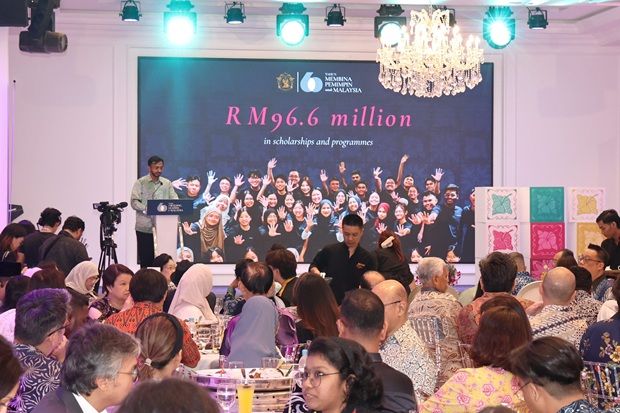
The Tunku Abdul Rahman Foundation (YTAR) reached a significant milestone this month with celebrations marking six decades of service to Malaysian youth and nation-building. The commemorative event held on August 13 at Bangunan Sultan Abdul Samad brought together stakeholders, alumni and supporters to reflect on the institution's enduring impact on higher education access across the country. What began as a grassroots initiative honouring Malaysia's first Prime Minister has evolved into one of the nation's most influential scholarship-awarding bodies, testament to the power of collective vision and sustained commitment to human capital development.
The foundation's origins trace back to a remarkably democratic endeavour that would be unusual by today's standards. When officials proposed establishing an education fund to commemorate Tunku Abdul Rahman Putra al-Haj, the initiative was crowd-funded by the public through Utusan Melayu on the statesman's birthday. This spontaneous expression of national gratitude raised more than M$60,170.20 at the time—equivalent to approximately RM380,000 in contemporary currency values. The grassroots momentum impressed policymakers sufficiently that Education Minister Tan Sri Mohamed Khir Johari championed the cause with the Federal Government. Parliament subsequently enacted the Tunku Abdul Rahman Foundation Fund Act 1966 (Act 43), formally establishing YTAR as a national institution with a constitutional mandate to expand higher education opportunities for deserving Malaysians.
The timing of YTAR's establishment coincided precisely with Malaysia's critical early years of independence and nation-building. The newly formed government recognised that developing human capital through higher education would prove essential for economic growth and social cohesion. By positioning education as a fundamental national priority and creating a dedicated institutional mechanism to finance studies both domestically and abroad, Malaysia demonstrated strategic foresight. Many of the youths supported in those formative decades returned home with advanced qualifications and international exposure, directly contributing to the nation's professional workforce and institutional development across civil service, academia, healthcare, law and commerce.
Over the past 60 years, YTAR has extended support to more than 12,000 Malaysian youths irrespective of racial, religious or socioeconomic background, embodying the inclusive vision articulated by Tunku Abdul Rahman himself. The foundation has disbursed a cumulative total of RM96.6 million through scholarships, study loans, financial assistance grants and employability development programmes. National Unity Minister Datuk Aaron Ago Dagang, who addressed the anniversary ceremony, underscored how YTAR's evolution reflects changing national needs. Beyond merely providing financial support, the foundation now serves as a talent identification mechanism, opportunity broker and youth development partner capable of equipping high-potential individuals with skills, values and networks necessary for meaningful contribution to society and economy.
Aaron Ago extended a pointed appeal to Malaysia's corporate sector, urging business leaders to integrate education and talent development more substantively into their corporate social responsibility strategies. By partnering with established foundations like YTAR, companies can channel investment in human capital development while supporting national priorities. This collaborative approach would amplify the impact of existing scholarship programmes and create additional pathways for disadvantaged but capable youth to access quality higher education—a critical need given Malaysia's evolving economic structure and increasing global competition for skilled professionals.
The foundation's governance structure and continuity deserve particular attention. YTAR chief executive officer Kularetnam Vijayakumar articulated a philosophy that the institution has never depended on any single individual or generation. Instead, it represents an accumulated deposit of trust and stewardship by successive cohorts of Malaysians who have guarded and advanced its mission. This institutional resilience—the ability to adapt programmes and priorities while maintaining core values—explains how YTAR has remained relevant across multiple decades of profound social and economic transformation. The contemporary emphasis on talent identification and skills development reflects recognition that scholarship financing alone proves insufficient in a knowledge-intensive economy requiring multidimensional youth empowerment.
Datin Sri Sharifah Menyalara Syed Hussein, granddaughter of the nation's first Prime Minister and current YTAR chairperson, provided poignant reflection on her grandfather's foundational philosophy. Tunku Abdul Rahman consistently emphasised that sustainable progress must begin with robust educational infrastructure grounded in character development, not merely academic credentials. This conception of education as character formation—equipping young people to discover their purpose and contribute meaningfully to community—remains strikingly relevant amid contemporary concerns about credentialism and graduate unemployment. By maintaining this holistic approach to youth development across six decades, YTAR has positioned itself not merely as a financial provider but as an institution invested in producing leaders and engaged citizens capable of addressing Malaysia's complex challenges.
The anniversary ceremony featured recognition of Dr Zakaria Ali and Ch'ng Kim See, pioneering scholarship recipients whose subsequent contributions to Malaysian society exemplify YTAR's transformative impact. Ch'ng Kim See, who received her scholarship in 1967 during acute financial hardship, proceeded to become one of Malaysia's most distinguished librarians and a regional authority on Southeast Asian history and library science. Her gratitude manifested not in passive appreciation but in active commitment to supporting others, embodying a multiplier effect where assisted youth become future supporters of emerging generations. Dr Zakaria Ali's trajectory proves equally remarkable—from processing assistant whose American instructor's intercession ultimately secured his education abroad, he evolved into a pioneering figure in Malaysia's fine arts establishment serving as painter, academic and cultural authority.
These individual stories illuminate broader patterns in YTAR's alumni base. Scholarship recipients have distributed themselves across virtually every sector of Malaysian nation-building—education, civil service, law, medicine, business, military service and community leadership. Bound together by shared experience of transformation through educational opportunity, these individuals collectively constitute a network advancing the foundation's underlying mission of producing leaders committed to national development. The diversity of their career paths and contributions suggests that YTAR's greatest achievement may not be the aggregate RM96.6 million disbursed but rather the quality and calibre of human beings developed and positioned to shape Malaysia's future across multiple domains.
Government recognition of YTAR's importance manifested in the announcement of enhanced opportunities for the 2026 Pingat Tunku Award, beginning with nomination calls from August 31 to September 30. Significantly, self-nomination became available for the first time, widening access to recognition and potentially identifying exceptional individuals who might otherwise remain invisible to conventional nomination networks. This procedural innovation reflects evolving understanding that talent and achievement often exist in margins and peripheral spaces, not exclusively within formal institutional hierarchies. The broadened nomination pathway acknowledges that true merit identification requires multiple access points and deliberate efforts to reach beyond traditional gatekeepers.
As Malaysia confronts evolving economic requirements, demographic shifts and global competitiveness pressures, the relevance of YTAR's mission only intensifies. The nation requires continuous pipeline of educated, skilled and ethically grounded professionals capable of navigating Fourth Industrial Revolution challenges and maintaining social cohesion across diverse population. YTAR's 60-year track record demonstrates institutional capacity to identify, develop and deploy human capital effectively. Building on this foundation, the institution faces both opportunity and responsibility to scale impact, adapt methodologies to contemporary needs, and ensure that geographic location, family background or economic circumstance never become determinative barriers preventing talented Malaysians from fulfilling their potential. The foundation's anniversary celebration ultimately represents not culmination but inflection point—commemoration of past achievements serving as springboard for expanded future contribution to national development through education.

