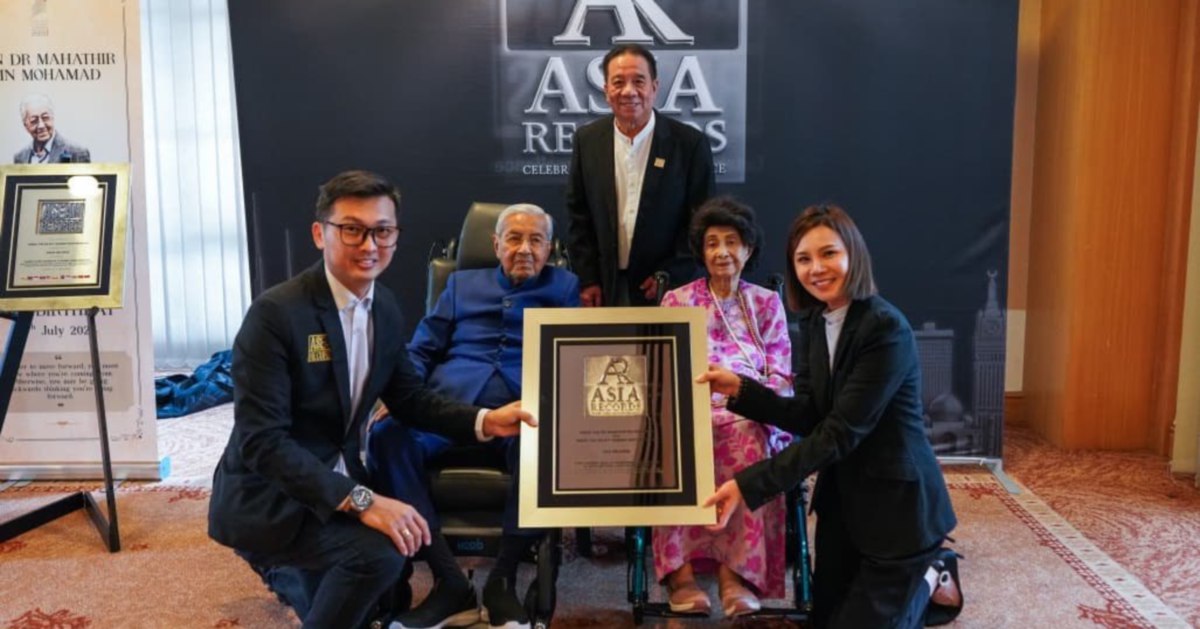
Former prime minister Tun Dr Mahathir Mohamad and his wife, Tun Dr Siti Hasmah Mohd Ali, have etched their names into the annals of Malaysian history by becoming the first centenarian couple to receive official recognition for their extraordinary longevity and achievements. The prestigious accolade, which comprised three separate record designations, represents a rare milestone that speaks to both their individual endurance and their collective significance in the nation's historical narrative.
The recognition ceremony underscores a growing global fascination with centenarians and their capacity to maintain relevance and influence across multiple generations. For Malaysia, the achievement holds particular resonance, as both individuals have spent the better part of a century witnessing and shaping the nation's transformation from colonial territory to independent nation-state. Their dual recognition as a couple rather than individuals marks a departure from conventional record-keeping, reflecting their interdependence and shared journey through nearly a century of personal and national change.
Tun Dr Mahathir, who served as Malaysia's prime minister across two distinct periods in recent history, has long been a figure of intense national debate and scrutiny. His political career spanned decades and left indelible marks on the country's economic policy, infrastructure development, and international relations. Meanwhile, Tun Dr Siti Hasmah has maintained a quieter but equally significant public presence, championing causes related to public health, women's welfare, and humanitarian work throughout her adult life. Their complementary roles within Malaysian society have created a partnership that extends far beyond the personal sphere into the realm of national institution-building.
The three official records recognising their achievement represent a carefully calibrated acknowledgment of their status within the contemporary Malaysian context. Such records typically encompass measures of individual longevity, joint spousal lifespan, and contributions to national life—metrics that underscore how the couple's significance transcends simple biological fact. The recognition serves as testimony to the quality of life standards available to Malaysians of their generation and the medical advances that have extended human lifespan considerably since their births in the early twentieth century.
From a demographic perspective, this milestone illuminates the broader phenomenon of ageing populations across Southeast Asia. Malaysia, alongside regional neighbours, faces mounting pressures on healthcare systems, retirement security, and social services as life expectancy continues to climb. The celebration of Tun Dr Mahathir and Tun Dr Siti Hasmah's longevity, while deeply personal, also prompts important public conversation about how societies must adapt to accommodate citizens living progressively longer lives. Their sustained cognitive and physical capacity serves as a reference point, though experts caution against generalising from individual cases to broader population health trends.
The couple's ability to maintain public engagement and social relevance into their centennial years distinguishes them from many others who reach similar chronological milestones. Tun Dr Mahathir, in particular, has continued to comment on national affairs and political developments, demonstrating intellectual vitality that surprises younger observers. This continued participation in public discourse—however controversial or contested—demonstrates that advanced age need not mean withdrawal from civic engagement. For Malaysian society, their example challenges stereotypes about the ageing process and the presumed diminishment that comes with reaching one's nineties or beyond.
The recognition also carries subtle implications for how Malaysian institutions value and preserve historical memory. By formally recording the achievements of a couple who lived through such transformative national periods, authorities acknowledge the importance of personal testimony and biographical continuity in understanding recent history. Tun Dr Mahathir and Tun Dr Siti Hasmah represent living bridges to Malaysia's pre-independence and early post-colonial eras, periods that younger citizens know only through textbooks and family narratives. Their longevity offers rare opportunity for direct intergenerational dialogue about historical events and national development trajectories.
The reception of such accolades reflects evolving attitudes towards elder citizens within contemporary Malaysian society. Whereas traditional cultures have historically venerated age and wisdom, modern societies sometimes marginalise the elderly or reduce them to nostalgic figures divorced from present relevance. The formal recognition of Tun Dr Mahathir and Tun Dr Siti Hasmah's achievements counters such trends by asserting that long life, particularly when coupled with sustained contribution and influence, merits public celebration and institutional acknowledgment. This positioning potentially influences how other Malaysians approaching their own advanced years contemplate their future roles and possibilities.
The three records themselves likely encompass various categories reflecting different dimensions of their exceptional status. Longevity records measure purely chronological achievement, while others might recognise their joint spousal years or specific historical contributions. Such differentiated recognition suggests sophisticated understanding of how contemporary life-milestones operate across multiple registers—biological, relational, and social. For Malaysia, which possesses rich traditions of honouring significant figures through formal recognition and ceremonial acknowledgment, this approach aligns with established practices while adapting them to the specific context of a centenarian partnership.
Beyond the immediate family and immediate Malaysian observers, the recognition holds regional significance. Southeast Asia increasingly positions itself as a centre for gerontological research and healthcare innovation, with several nations experiencing rapid population ageing. The achievement of Tun Dr Mahathir and Tun Dr Siti Hasmah provides a high-profile illustration of longevity within an Asian context, challenging predominantly Western narratives about centenarian populations. Their story circulates within regional and international networks of gerontologists, demographers, and policy-makers concerned with understanding healthy ageing across diverse populations and cultural contexts.
Looking forward, the recognition may stimulate deeper institutional engagement with preservation of personal and historical records from Malaysia's most senior citizens. As contemporary society becomes increasingly conscious of intangible cultural heritage and oral history, capturing the experiences and insights of individuals like Tun Dr Mahathir and Tun Dr Siti Hasmah takes on new urgency. Their centennial milestone, marked through official recognition, potentially catalyses broader efforts to document the lived experiences of Malaysians whose lifespans encompass the nation's most formative and contested periods.

