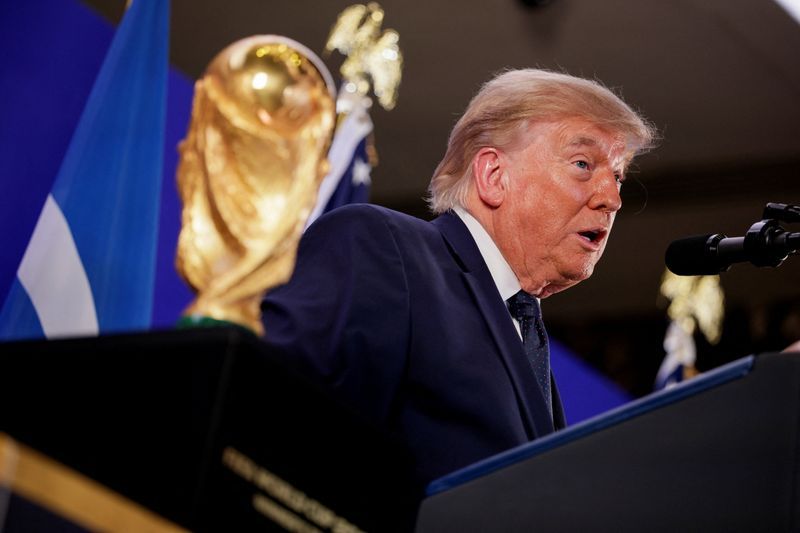
U.S. President Donald Trump will return to centre stage at Sunday's World Cup final between Argentina and Spain at New York/New Jersey Stadium, where he is set to present the trophy to the winners. The appearance marks another high-profile sports engagement for Trump, who has increasingly sought the spotlight of major sporting events over the past 18 months, even as his approval ratings have faced headwinds during his second term in office.
FIFA President Gianni Infantino confirmed that Trump will sit alongside him throughout the match, capitalising on a growing political alliance between the two figures that has flourished amid record-breaking attendance figures for the tournament. The partnership between the American president and football's governing body has become one of the tournament's defining narratives, with Infantino particularly keen to showcase the success of the expanded World Cup format across North America.
Trump's high-profile involvement in the tournament has not been without controversy. The president recently confirmed that he had personally asked Infantino to review a red card decision against U.S. striker Folarin Balogun, an intervention that immediately ignited concerns among football observers about the integrity of officiating and the appropriate boundaries between political leadership and sporting governance. The revelation that Trump had wielded his influence to challenge a match official's decision sent shockwaves through the tournament, raising uncomfortable questions about whether political pressure was being applied to football's decision-making processes.
The two leaders demonstrated their close relationship at a lavish reception held within Trump Tower in Manhattan on Friday, where Infantino publicly credited the American president with the tournament's exceptional success. Speaking before an audience of approximately 300 guests that included Brazilian football legend Ronaldo and various FIFA officials, Infantino declared that the World Cup would not have achieved such prosperity without Trump's stewardship and political backing. Trump reciprocated the praise, noting with evident satisfaction that the tournament had demonstrated America's genuine appetite for soccer, a sentiment he has repeated during his frequent White House meetings with Infantino.
The pair have navigated multiple controversies together throughout the tournament's preparation and execution phases, which has been jointly hosted by Canada and Mexico alongside the United States. A year before the tournament began, U.S. cities grappled with serious concerns about reassuring international spectators who harboured apprehensions regarding Trump's stringent immigration policies and visa restrictions affecting several countries. The political climate created by these policies threatened to undermine the tournament's international appeal and fan attendance across American venues.
As the tournament approached, Trump escalated tensions by threatening to relocate matches from cities controlled by Democratic administrations, a proposal that FIFA firmly rejected, asserting that any such decisions remained outside the president's purview. Despite this friction, the tournament ultimately proceeded successfully across all scheduled venues, defying predictions that political divisions might impair the sporting spectacle. On Friday, Trump suggested that America should host the tournament again in the future, but notably added a contentious caveat: that Mexico and Canada should be excluded from any future hosting arrangement, a comment that underscored the nationalist tenor of his sports diplomacy.
Trump's strategic deployment of sports events reflects a calculated political strategy aimed at reaching his core constituency during a period when his broader popularity metrics have remained challenging. His attendance at last year's Ryder Cup on Long Island generated enthusiastic responses from American golf spectators, demonstrating his ability to command crowds within predominantly friendly environments. However, his reception at other sporting events has been decidedly mixed, illustrating the polarising nature of his public profile across different sporting communities and demographics.
The president faced audible boos at Game 3 of the NBA Finals last month, while his attendance at the U.S. Open men's tennis final at Flushing Meadows last year created logistical chaos that frustrated spectators denied entry due to presidential security protocols. These episodes underscore the complex challenge that Trump's prominence poses for sports broadcasters and organisers, who must navigate the reality that his appearance simultaneously energises his supporters whilst provoking antipathy among critics.
Fox Sports faces particularly acute broadcasting challenges given that the World Cup final will be produced using a FIFA-controlled world feed, meaning that the network exercises no editorial control over camera selections and cutaway decisions. Play-by-play announcer John Strong acknowledged this constraint, noting that whether Trump receives televised prominence during the match lies entirely beyond his production team's discretion. The uncertainty surrounding the extent of Trump's on-screen visibility creates genuine anxiety for broadcasters seeking to serve an ideologically heterogeneous audience with conflicting preferences regarding the president's television presence.
Strong articulated the fundamental tension confronting the broadcast, observing that Trump generates no neutral responses among viewers—his appearance will simultaneously delight his enthusiastic supporters whilst alienating those who view his involvement as an inappropriate politicisation of sport. The challenge for Fox Sports lies in managing this polarisation whilst maintaining journalistic integrity and editorial control over coverage decisions that ultimately rest with FIFA's production apparatus, not the American broadcaster.
Trump secured the World Cup hosting arrangement for North America during his first presidential term in 2018, a milestone he has repeatedly invoked as evidence of his administrative accomplishments and his personal influence within international sporting governance. The 2038 tournament, should America successfully bid to host it again, represents another opportunity for Trump to leverage his political standing within FIFA to secure additional sporting prestige and to reinforce his narrative of revitalising American interest in soccer. His suggestion to exclude Mexico and Canada from any future co-hosting arrangement, however, threatens to resurrect the diplomatic complications that characterised the tournament's preparation phase and raises questions about whether his nationalist instincts might ultimately undermine America's future hosting prospects.

