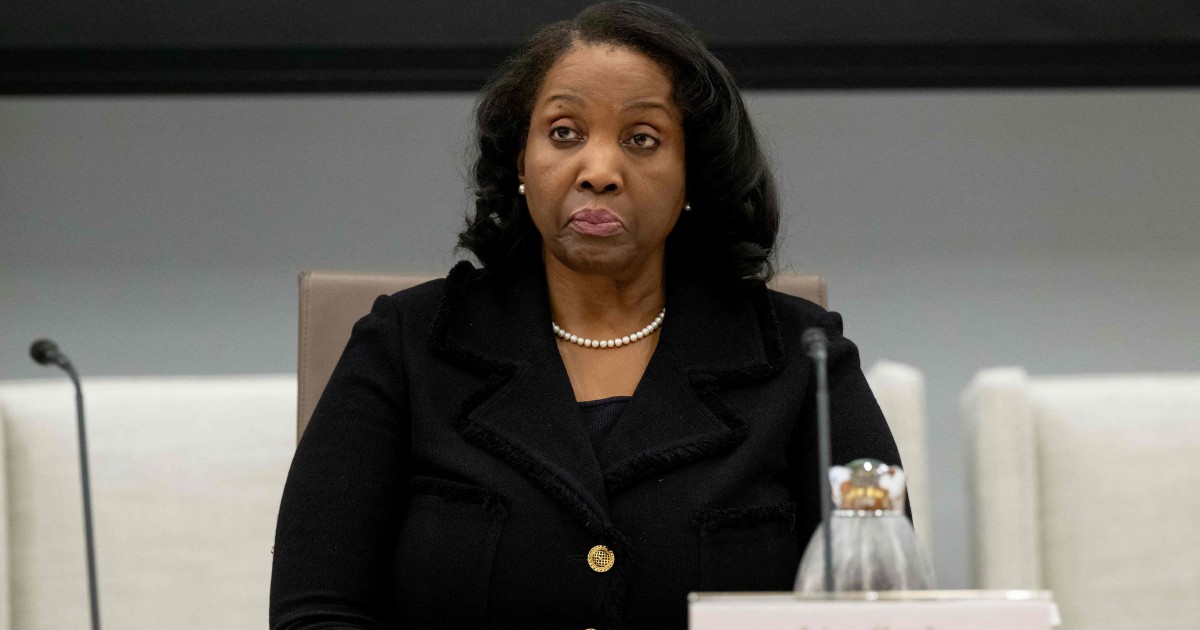
US President Donald Trump has resumed efforts to remove Federal Reserve Governor Lisa Cook, citing mortgage fraud allegations against her. A White House letter reviewed by AFP on Friday indicates the administration's determination to pursue the dismissal after the Supreme Court rejected a similar attempt in June, signalling an escalation in tensions between the executive branch and the central banking institution.
The timing of Trump's renewed push reveals the political sensitivities surrounding personnel decisions at the Federal Reserve, America's most powerful economic institution. Cook's position as a governor places her among the policymakers who influence interest rates, inflation targets, and financial stability measures that ripple across global markets. Malaysia and other regional economies remain highly dependent on US monetary policy shifts, making internal disputes within the Federal Reserve system relevant to Southeast Asian financial markets and policymakers.
Lisa Cook, who took office in September 2022, became the first Black woman to serve as a Federal Reserve governor. Her appointment represented a symbolic breakthrough in central banking leadership, though her tenure has been marked by controversy. The mortgage fraud allegations that Trump references relate to questions about Cook's past business dealings, though she has maintained her innocence and the charges have never resulted in formal legal action against her.
The Supreme Court's June decision effectively blocked Trump's previous removal attempt, establishing legal boundaries around presidential power to dismiss Federal Reserve governors. These governors serve fixed terms specifically designed to insulate the institution from political pressure and ensure independence in monetary policymaking. The court's stance reflected longstanding constitutional protections for the Fed's autonomy, a principle that underpins confidence in American monetary institutions worldwide.
Trump's persistence in pursuing Cook's removal demonstrates his willingness to challenge institutional norms and legal precedent. Critics argue that targeting a sitting Fed governor undermines the independence crucial to effective central banking. Such independence allows the Federal Reserve to make unpopular decisions—raising interest rates, for example—without fear of political retaliation. Conversely, Trump's supporters contend that presidential oversight of government officials remains legitimate, even at quasi-independent agencies.
The implications for regional economies extend beyond symbolic concerns about Fed autonomy. If Trump successfully pressures the Federal Reserve to become more politically responsive, the institution might adjust policy to favour short-term economic gains over long-term stability. Such shifts could alter inflation trajectories, exchange rates, and capital flows affecting Malaysian businesses, investors, and households. The ringgit's performance against the dollar, for instance, responds sensitively to expectations about US monetary policy.
Cook's record at the Federal Reserve focuses primarily on financial inclusion and the impact of monetary policy on low-income communities. She has advocated for examining how policy decisions affect different demographic groups, a perspective that has occasionally put her at odds with a more traditional central banking approach. Her removal would shift the institution's internal balance, potentially limiting voices emphasising equity considerations in policymaking.
The renewed effort also reflects broader Trump administration strategies regarding federal agencies. Throughout his previous term and the current one, Trump has sought to replace officials he views as obstacles to his agenda. The Federal Reserve, however, presents unique legal challenges because statutory protections make removal of governors considerably more difficult than in other cabinet positions. Previous courts have upheld these protections as constitutionally sound.
Cook's case highlights how global monetary governance increasingly intersects with domestic political controversy. Emerging market economies like Malaysia must navigate a system where the world's reserve currency issuer experiences internal institutional conflicts. The unpredictability introduced by such disputes can increase volatility in foreign exchange markets and complicate central bank planning across the region.
The White House letter indicates specific allegations and arguments Trump intends to marshal in this renewed effort, though the precise legal and political strategy remains unclear. Whether Congress will become involved in this dispute, or whether it remains an executive-Federal Reserve matter, could determine outcomes. Some lawmakers may view Trump's actions as appropriate oversight, while others may rally to defend Fed independence as essential to economic credibility.
Regional policymakers in Southeast Asia closely monitor Federal Reserve leadership dynamics because US monetary policy effectively functions as an external constraint on smaller economies' policy choices. Capital flows, interest rate differentials, and currency values all respond to perceptions about Fed direction and leadership stability. Internal conflicts at the Fed create uncertainty that typically prompts defensive measures by emerging market central banks.
The broader significance extends to questions about institutional resilience and the rule of law in democracies. Whether institutions can resist political pressure while remaining accountable to elected officials represents a fundamental governance challenge. Cook's case becomes a test of whether the Federal Reserve can maintain its independence against determined executive pressure, or whether such protections prove insufficient against sustained political assault.

