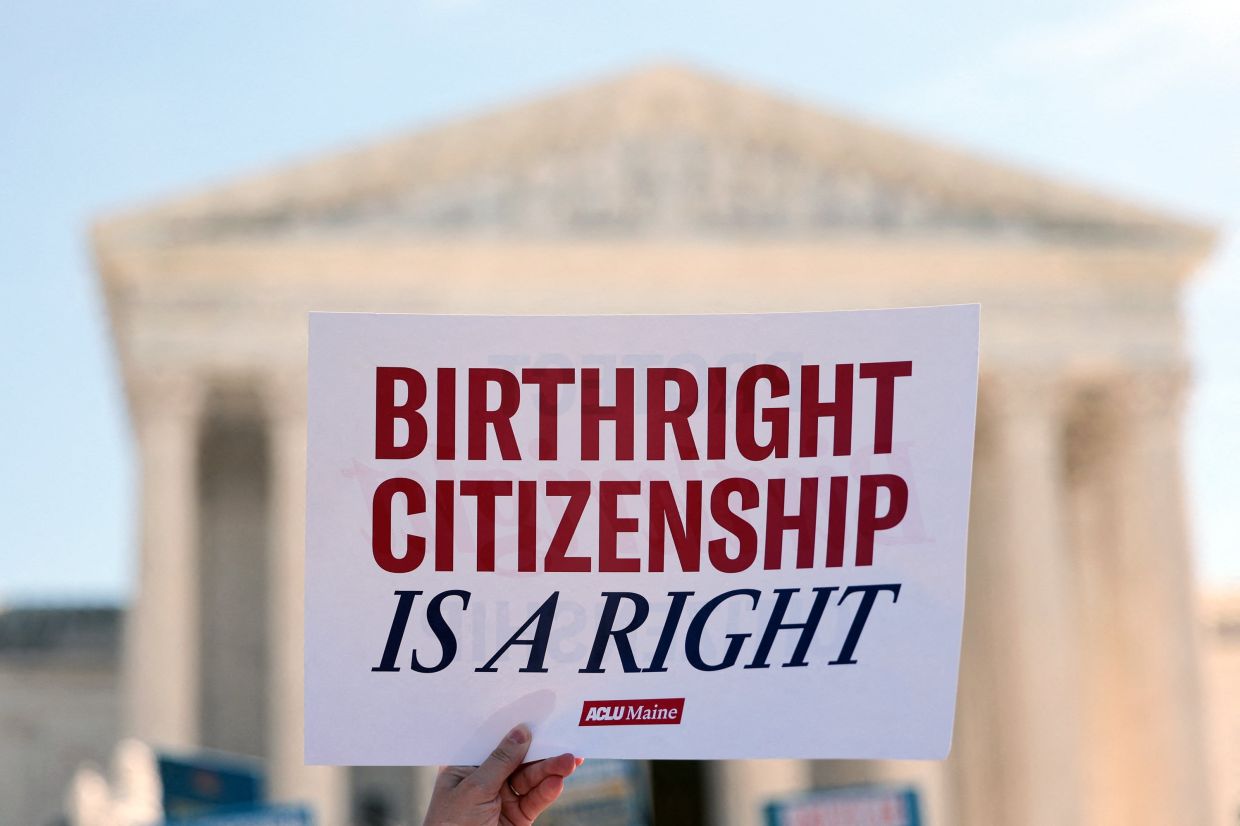
The Trump administration's legal setback on birthright citizenship has prompted a strategic reorientation toward enforcement action, with China positioned prominently in the renewed immigration battle. Following the Supreme Court's rejection of an executive order that would have denied citizenship to children born in the United States to undocumented or temporarily-visa-holding parents, the administration swiftly pivoted. Within hours of the ruling, the Department of Justice tasked federal prosecutors with prioritising investigations into birth tourism arrangements, while House Speaker Mike Johnson signalled that lawmakers were drafting legislation targeting women who travel to give birth on American soil.
The administration's public messaging reveals the calculated nature of this pivot. Trump's social media posts congratulating China on a "massive Birthright Citizenship WIN" served as sarcasm masking a more serious policy shift. The rhetoric frames birth tourism as a sovereignty issue tied to foreign adversaries rather than simply an immigration enforcement matter. This framing proved consequential, as Republican congressional allies, including Congressman Chip Roy, began invoking national security language—warning that allowing the practice enables the Chinese Communist Party to "gain influence within our borders."
Yet the factual foundation underlying this aggressive posture remains contested and incomplete. The federal government maintains no comprehensive database measuring how many women enter the United States specifically to give birth, creating an information vacuum that proponents and critics alike exploit. This absence of clear data has not deterred the administration from pursuing prosecutions based on alleged visa fraud and conspiracy charges, which form the legal basis for so-called birth tourism cases. The Justice Department, through Colin McDonald of the National Fraud Enforcement Division, has described these schemes as systematic exploitation of the immigration system, claiming "thousands of foreigners" enter under false pretences.
Actual documented cases provide the administration's most concrete evidence of organised activity. A 2020 case involving Chao "Edwin" Chen demonstrated the mechanics of one such operation—Chen allegedly operated a birth tourism business claiming a 100-person team based in China and boasting more than 500 cases served across the United States. The 37-month prison sentence imposed on Chen, though in absentia, illustrates how prosecutors construct charges around travel fraud rather than the act of giving birth itself, which remains legal. This distinction matters: simply arriving pregnant on a valid visa constitutes no criminal offence under current law, compelling prosecutors to prove deliberate misrepresentation during visa applications or fraud in supporting arrangements.
The evidentiary gap becomes more striking when examining actual statistics. The National Centre for Health Statistics recorded merely 113 births to non-US residents from China in 2023 out of 3.7 million total American births—a figure that declined from 267 cases in 2018. Among all foreign-born mothers, Chinese nationals accounted for 27,476 births in 2023, representing roughly 0.74 percent of total births. Even in the Northern Mariana Islands, a territory frequently cited as a birth tourism hotspot, only two births were recorded to foreign-resident mothers in 2023 out of 581 total births. These figures suggest the phenomenon, while real in isolated cases, operates at a scale vastly smaller than the administration's rhetoric implies.
Peter Schweizer, president of the Government Accountability Institute, has made perhaps the most expansive claim, asserting that roughly one million US citizens are being raised in China today following birth tourism. Legal scholars have described this figure as "wildly inflated," with American expert Peter Spiro characterising the actual scale as having risen to become "a non-trivial phenomenon" only in recent decades—language that acknowledges visibility without supporting the assertion of widespread abuse. The distinction between documented cases and rhetorical alarm reflects a consistent pattern in the administration's framing: elevated concern disconnected from proportional evidence.
For Malaysian and Southeast Asian observers, this development carries particular relevance. The administration's targeting of birth tourism, while rhetorically centred on China, implicates enforcement patterns potentially affecting nationals from multiple countries. Historical prosecutions have involved Turkish, Russian, and Mexican nationals, yet these nations receive minimal mention in current congressional discourse. The emphasis on China appears driven partly by broader geopolitical positioning rather than epidemiological evidence of greater involvement in birth tourism schemes. This selective enforcement language warrants careful observation, as similar targeting could extend regionally if birth tourism prosecution becomes a sustained enforcement priority.
The legal pathway forward remains uncertain. Immigration lawyers, including Joseph Kwon, warn that routine questioning of pregnant travellers regarding their intentions, even without formal charges, produces real harm through stigmatisation and discriminatory profiling. The memo directing federal prosecutors to prioritise these investigations lacks the legislative foundation of a comprehensive birth tourism statute, meaning prosecutors must continue constructing cases around peripheral offences—visa fraud, conspiracy, money laundering—rather than birth tourism itself. House Speaker Johnson's indicated intent to draft legislation suggests the administration recognises this prosecutorial limitation and seeks statutory authority.
The Trump administration's shift from constitutional challenge to prosecutorial enforcement reflects pragmatic recalibration following judicial defeat. Yet the strategic elevation of China within this debate, combined with statistically modest evidence of large-scale activity, suggests the birth tourism framing serves multiple political purposes beyond immigration restriction. The narrative permits rhetorical criticism of foreign adversaries, justifies enforcement action through fraud allegations avoiding direct citizenship challenges, and generates legislative opportunities. For the broader region, understanding that the prosecutorial focus may outlast the factual predicate proves important for anticipating potential enforcement impacts on travelling pregnant nationals from multiple countries.
The administration's approach also raises questions about enforcement consistency and political selectivity. If birth tourism constitutes systematic abuse warranting prosecution priority and legislative action, the targeting should reflect proportional evidence rather than geopolitical emphasis. The statistically documented cases involve multiple nationalities, yet the congressional and executive rhetoric concentrates overwhelmingly on China. This discrepancy suggests that birth tourism prosecution may serve as a policy vehicle for broader anti-China messaging rather than responding proportionally to documented immigration system abuse. Understanding this distinction becomes crucial for assessing which nations' citizens might face elevated scrutiny and potential legal exposure during American travel.

