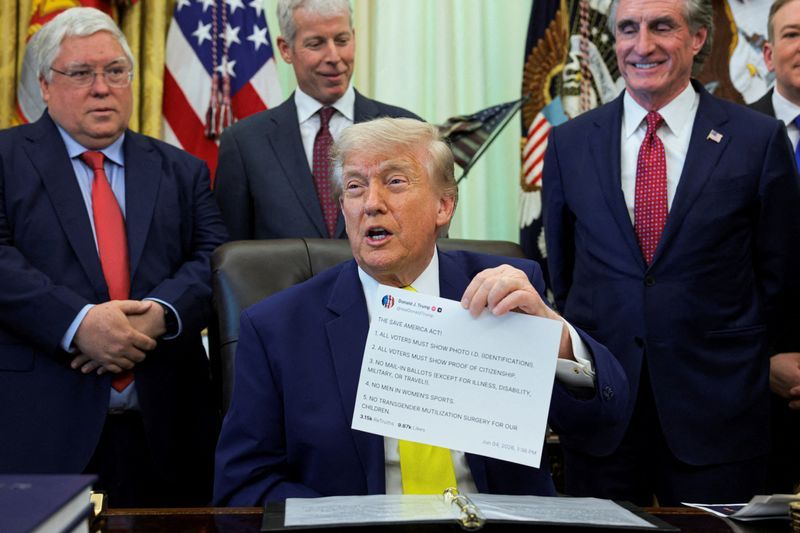
Donald Trump faces a significant legal challenge to one of his newest commercial ventures, with a pair of prominent media organisations filing suit in Manhattan federal court this week to dismantle Truth API, a subscription feed offering premium access to posts from the U.S. president and other high-ranking officials on his Truth Social platform. The Intercept and the Freedom of the Press Foundation launched their complaint on Wednesday, targeting a service that charges subscribers as much as $100,000 per month for priority viewing of content from ten influential accounts, including Trump's own, before it reaches the general public.
Truth API began operations on August 1, just days after Democratic senators Elizabeth Warren of Massachusetts and Adam Schiff of California urged the Securities and Exchange Commission to investigate whether the venture posed risks to financial market stability. Their concerns centered on the potential for selected subscribers to gain unfair advantages when Trump and other officials disclose information affecting stocks, commodities and currency markets—a practice the president has employed repeatedly during his second term to announce policies on tariffs, military actions and economic initiatives. The lawsuit represents an escalation of these regulatory concerns into the judicial arena, with plaintiffs arguing the arrangement violates fundamental constitutional principles and threatens the public interest.
At the heart of the dispute lies a conflict of interest that the plaintiffs consider indefensible. The complaint characterises Truth API as "profoundly corrupt" because Trump himself stands to profit directly when subscribers purchase access to his announcements. Trump Media & Technology Group, which operates the platform and Truth API, has Trump as its largest shareholder with a 41.3 percent stake worth approximately $950 million held through his Donald J. Trump Revocable Trust. This financial stake means the president gains personal enrichment each time the company generates revenue from the service, creating what civil rights advocates view as an unprecedented blending of presidential authority with private commercial interest. His oldest son, Donald Trump Jr., serves as a Trump Media director and oversees the trust arrangement, adding another layer to family control over these operations.
The legal strategy employed by the plaintiffs centres on First Amendment protections and the principle of equal access to government information. Their argument contends that citizens possess a constitutional right to receive presidential announcements simultaneously and without financial barriers. By establishing a two-tiered system where paying subscribers receive information before the broader public, the plaintiffs assert, the administration effectively restricts press freedom and discriminates against media outlets and citizens unable to afford the substantial monthly fees. The complaint further challenges the White House's authority to post official government announcements exclusively through Truth Social while the paid feed remains operational, arguing there exists no legitimate governmental interest in monetising public statements in this manner.
Documentation within the complaint reveals the scale of Trump's Truth Social activity during his second term, noting that between 9,000 and 11,000 posts and reposts have appeared on the platform. Notably, many of these messages lack subsequent official White House statements released through traditional channels, suggesting Truth Social functions as his primary communication mechanism. This shift in how a sitting U.S. president disseminates information has profound implications for press access, market efficiency and the integrity of democratic information distribution. When important policy announcements reach financial subscribers first, it creates opportunities for insider trading and unfair market advantages that regulatory bodies have long sought to prevent.
The Trump Media response dismisses these concerns as partisan censorship, claiming that numerous platforms and news organisations already operate subscription-based feeds disseminating Trump's statements. A company spokesperson characterised the lawsuit as an attempt by "left-wing activists" to weaponise courts against the president and harm shareholders. During a recent earnings call, Kevin McGurn, Trump Media's interim Chief Executive, defended Truth API by suggesting it merely provides subscribers access to information "fractionally faster" than others, framing the advantage as minimal rather than substantial. However, in financial markets where milliseconds determine trading outcomes, such fractional advantages can translate into significant profits for early-access subscribers.
The service extends beyond Trump's personal account, offering early access to posts from Vice President JD Vance, Health and Human Services Secretary Robert F. Kennedy Jr., FBI Director Kash Patel, and official White House accounts. This broader integration into the federal government's communication infrastructure elevates concerns beyond Trump's commercial interests to questions about how multiple executive branch officials now participate in a system generating private profit from government information. The inclusion of the FBI Director's account particularly raises national security considerations, as intelligence-related announcements could theoretically provide advance warning to financially connected individuals.
The regulatory environment adds another dimension to this dispute. The Securities and Exchange Commission, which oversees markets and investigates potential manipulation, currently has three commissioners who are Republicans. This composition affects the likelihood of aggressive SEC action against a Republican president's commercial venture, even if market integrity concerns seem evident. The judicial challenge therefore becomes crucial, as courts may prove more willing than Republican-controlled regulatory bodies to address the underlying conflicts of interest and potential market manipulation implications. The outcome could set important precedents for how presidential commercial interests intersect with government authority and financial markets.
For Malaysian and Southeast Asian observers, this case illustrates tensions between commercial innovation and democratic governance that resonate globally. As political leaders worldwide develop closer ties to technology platforms and digital commerce, questions about information access, market fairness and the separation between private profit and public service grow increasingly urgent. The Truth API controversy suggests that without clear regulatory guardrails, the convergence of political power and commercial interest can create troubling opportunities for market manipulation and inequality in information access that transcend national boundaries.

