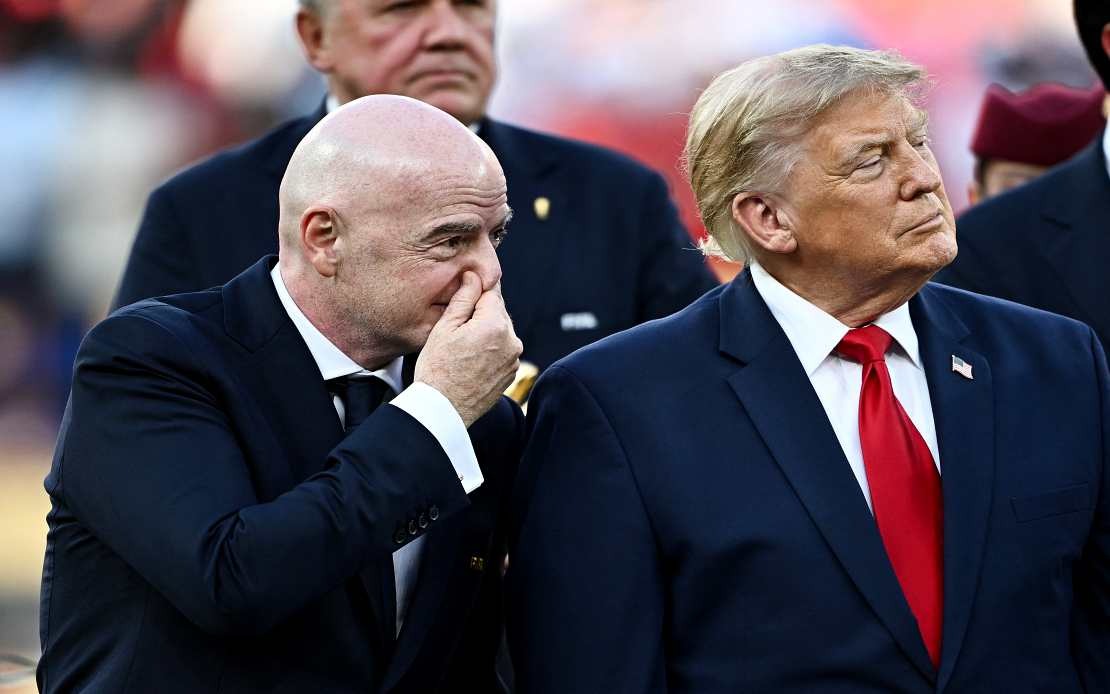
United States President Donald Trump has thrown his political weight behind FIFA President Gianni Infantino, describing him as an outstanding and irreplaceable leader of international football at a moment when the sport's governance faces serious scrutiny. The intervention represents a notable show of support for the embattled FIFA chief, who has faced coordinated criticism from three of world football's most influential regional bodies over his handling of a major commercial restructuring proposal.
The controversy centres on FIFA's plan to raise approximately US$4.2 billion by divesting roughly 20 per cent of a newly created commercial entity to private investors. This vehicle would have taken control of FIFA's media and commercial rights, encompassing the lucrative World Cup broadcasting and sponsorship arrangements that form the backbone of the organisation's financial operations. Media speculation linked potential acquisition of the shares to a foundation controlled by Joshua Kushner, brother of Jared Kushner, Trump's son-in-law—a connection that lends additional weight to Trump's public endorsement.
The coordinated resistance from major football confederations represents an unprecedented challenge to Infantino's authority. The Union of European Football Associations (UEFA), the Asian Football Confederation (AFC), and the Confederation of North, Central American and Caribbean Football (CONCACAF) jointly published an open letter demanding an independent investigation into the commercial rights transaction. UEFA subsequently escalated the pressure by announcing that all its member nations would boycott FIFA competitions unless the proposal was completely shelved. For Southeast Asian football, represented through the AFC, such a stance carries enormous significance given the region's growing investment in the sport and the importance of international competitions to football development.
Trump's defence of Infantino on his Truth Social platform focused on the FIFA president's record in staging what the US leader called the most successful World Cup ever presented, suggesting that success was quantified by financial metrics and that revenue generation had quadrupled under Infantino's stewardship. The former and current president warned that FIFA would suffer irreparable damage if it elected to remove Infantino, claiming that the organisation would never again achieve comparable commercial success or profitability. This argument prioritises financial performance as the measure of administrative competence, sidestepping the governance and transparency questions that animated the confederations' complaint.
The immediate backdrop to the current crisis involved an emergency meeting Infantino convened with FIFA's top leadership in early August. Rather than becoming a forum for serious examination of the governance concerns raised by the confederations, the gathering largely functioned as a show of support, with FIFA leadership collectively backing the president. Infantino offered an apology for what he characterised as mistakes associated with the FIFA Forward Enterprise project, the commercial initiative at the heart of the controversy. The gesture appeared designed to manage the optics of the situation without substantively addressing the underlying questions about decision-making processes and transparency.
The FIFA Forward Enterprise initiative had been positioned as a modernisation of the organisation's financial model, potentially unlocking capital for distribution to national federations and regional confederations through FIFA's development programmes. Yet the manner in which the proposal emerged and advanced—without apparent consultation with major stakeholders—triggered alarm among confederations concerned about FIFA's governance trajectory. The plan to place FIFA's most valuable commercial assets under private management raised fundamental questions about control, accountability, and the proper stewardship of global football's institutional infrastructure.
UEFA's decision to orchestrate a membership-wide boycott of FIFA competitions represents one of the strongest challenges to FIFA authority in recent memory. European football commands enormous financial and political influence within the global game, and the explicit threat to withdraw all members from FIFA competitions struck at the legitimacy of international football's governing body. This tactical escalation forced a genuine recalibration of the dispute's trajectory, transforming what initially appeared as a management disagreement into a constitutional crisis for FIFA.
Infantino's subsequent announcement that FIFA had abandoned the commercial rights sale plan represented a significant retreat, though one carefully framed as a decision made voluntarily rather than capitulation to external pressure. The language surrounding the withdrawal acknowledged the controversy while attempting to preserve the president's decision-making authority and leadership credibility. For Malaysian and Southeast Asian football observers, the episode demonstrated how regional confederations could collectively exercise influence over global football governance, though only through coordinated and forceful action.
The trajectory of this dispute carries implications for how FIFA might structure future commercial initiatives and how it engages with major regional confederations on matters affecting the global game's financial architecture. The governance questions raised by the three confederations—regarding transparency, stakeholder consultation, and independent oversight of major commercial decisions—remain relevant even after the specific proposal's withdrawal. Whether FIFA will meaningfully reform its decision-making processes to incorporate greater consultation and transparency, or whether the organisation will simply proceed more cautiously with future initiatives while maintaining centralised executive authority, remains unclear.
Trump's endorsement, while politically supportive, did not address the substantive governance concerns that motivated the confederations' action. The focus on financial success metrics and the implicit suggestion that commercial performance validates leadership reflected one perspective on how international sports organisations should be evaluated. The confederations' insistence on investigation and transparency reflected alternative priorities—institutional accountability, stakeholder voice, and proper stewardship of shared assets. These competing visions of what FIFA should prioritise will likely shape internal football politics for months ahead.
For Southeast Asian football, represented through the AFC, the episode highlighted both the potential power of regional confederation action and the ongoing tension between FIFA's centralised authority and the legitimate interests of member confederations. The AFC's participation in the unified opposition to the commercial rights proposal demonstrated the confederation's willingness to stake political capital on governance principles. As global football continues evolving commercially and politically, how FIFA responds to these governance questions will substantially influence the organisation's legitimacy and effectiveness in the eyes of regional stakeholders across Asia and beyond.

