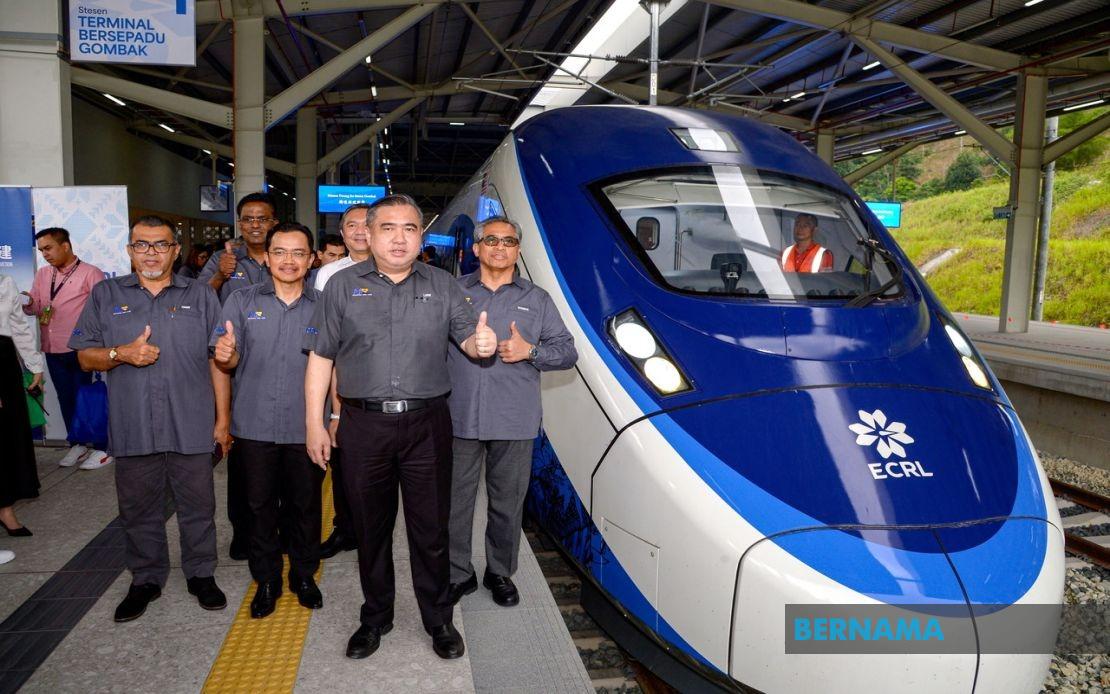
Transport Minister Anthony Loke Siew Fook has announced an ambitious new target to launch the first phase of the East Coast Rail Link between Kota Bharu and Gombak as early as December this year, marking a significant compression of the project's original January 2027 completion date. The announcement, made during the launch of comprehensive testing initiatives at the Gombak Integrated Terminal Station, signals renewed momentum in Malaysia's efforts to deliver this critical cross-country rail infrastructure linking Kelantan to Selangor.
The acceleration hinges entirely on the successful completion of rigorous testing and commissioning protocols without any dilution of safety standards. Loke emphasised that Malaysia Rail Link Sdn Bhd and the primary contractor China Communications Construction Company Ltd must intensify their work coordination to achieve this compressed timeline. The ministry's approach reflects a determination to deliver tangible benefits to the public, yet the Transport Minister was careful to stress that expediting the project does not translate into cutting corners on essential safety procedures.
Two critical testing phases will determine whether the December target proves feasible. System Integration Testing, which commenced this month, will evaluate how all major infrastructure components—including electrical and signalling systems—function together as a cohesive unit. Following this, Fault-Free Run testing scheduled for September will subject the first train set and E-Loco to 8,000 kilometres of operation under real-world conditions, albeit without passenger loading. These milestones are supervised by the Land Public Transport Agency to guarantee that operational standards meet Malaysian legal requirements and safety benchmarks.
The compression of the testing timeline represents a strategic push by the Transport Ministry to streamline bureaucratic processes. Loke noted that certification and approval procedures typically consume two to three months, and the ministry is working with APAD to explore ways to compress this window without compromising thoroughness. This indicates recognition that delays in approval mechanisms—rather than construction deficiencies—may have been constraining the project's progress. However, the minister's repeated emphasis on safety concerns suggests awareness that public confidence hinges on avoiding any perception of rushed procedures.
The rationale for acceleration partly derives from confidence in pre-delivery testing conducted in China. The trains underwent comprehensive factory assessments before shipment to Malaysia, providing ministry officials with a degree of assurance that major systemic problems have already been identified and resolved. This prior testing regime provides some justification for attempting to compress the Malaysian testing phase, though it does not eliminate the necessity for rigorous local validation under operational conditions specific to Malaysian geography and climate.
Phase 1 has now reached 95.08 per cent completion as of July, according to ministry figures, indicating that construction itself is substantially finished. The remaining effort concentrates on verification and certification rather than physical rail construction. This distinction is important for Malaysian stakeholders: the infrastructure exists, but regulatory approval mechanisms must confirm its readiness for commercial deployment. The emphasis on testing processes rather than ongoing construction underscores how far the project has progressed toward realisation.
The broader ECRL programme encompasses two distinct phases with separate timelines. Phase 2, which will extend the rail line from Gombak to Port Klang, is targeted for completion by December 2027, with operational commencement anticipated in January 2028. This sequencing allows the ministry to gain operational experience with the northern segment while completing the southern extension. For Malaysian stakeholders, this staggered approach means that benefits from improved east-west connectivity will arrive incrementally rather than simultaneously across the entire route.
The significance of the Kota Bharu-Gombak segment extends beyond mere transportation. This railway link addresses longstanding regional disparities by providing Kelantan and other east coast states with direct rail access to Selangor's commercial and industrial heartland. Currently, freight and passenger traffic between these regions must utilise highways or longer rail routes through other states. A functioning ECRL promises to reduce journey times substantially, lower transportation costs for businesses, and integrate eastern Malaysia more fully into the national economic framework.
For Southeast Asian readers, the ECRL's development carries implications for regional supply chain connectivity. The rail link eventually connects to port facilities, positioning it as potential infrastructure supporting enhanced trade flows across the region. China's substantial involvement through CCCC reflects broader patterns of Chinese infrastructure investment throughout Southeast Asia. The project's successful completion—or conversely, any operational complications—will inform assessments of similar Chinese-backed transport initiatives throughout the region.
Transport infrastructure timelines carry political dimensions in Malaysia. Successive governments have made competing announcements regarding ECRL's progress, creating public expectations that have sometimes been disappointed. Loke's December target, if achieved, would represent a tangible policy success worth several percentage points in public perception. Conversely, if December passes without operational commencement, scepticism regarding government infrastructure promises may deepen. This political dimension does not suggest that safety would be compromised, but rather that delivery dates assume heightened significance in the Malaysian political context.
The involvement of high-level officials at the testing launch—including Chief Secretary to the Government Tan Sri Shamsul Azri Abu Bakar, Chinese Ambassador Ouyang Yujing, and other cabinet-level figures—indicates that both Malaysian and Chinese governments view this project's success as strategically important. The diplomatic dimensions reflect Malaysia's broader balancing act between Chinese infrastructure partnerships and domestic political accountability. Public confidence that testing proceeds rigorously, overseen by Malaysian authorities, requires visible high-level Malaysian engagement.
For ordinary Malaysians contemplating future rail travel, the December timeline remains conditional rather than certain. Loke's repeated safety caveats suggest that if testing reveals any significant deficiencies, the launch would be postponed rather than proceeded with under potentially unsafe conditions. The minister's statement that "we are more afraid than you if there is a risk" attempts to reassure the public that safety considerations will override political pressure for early completion. This messaging balance—conveying confidence in the project while emphasising that safety cannot be negotiated—will be crucial in maintaining public trust as testing phases unfold.

