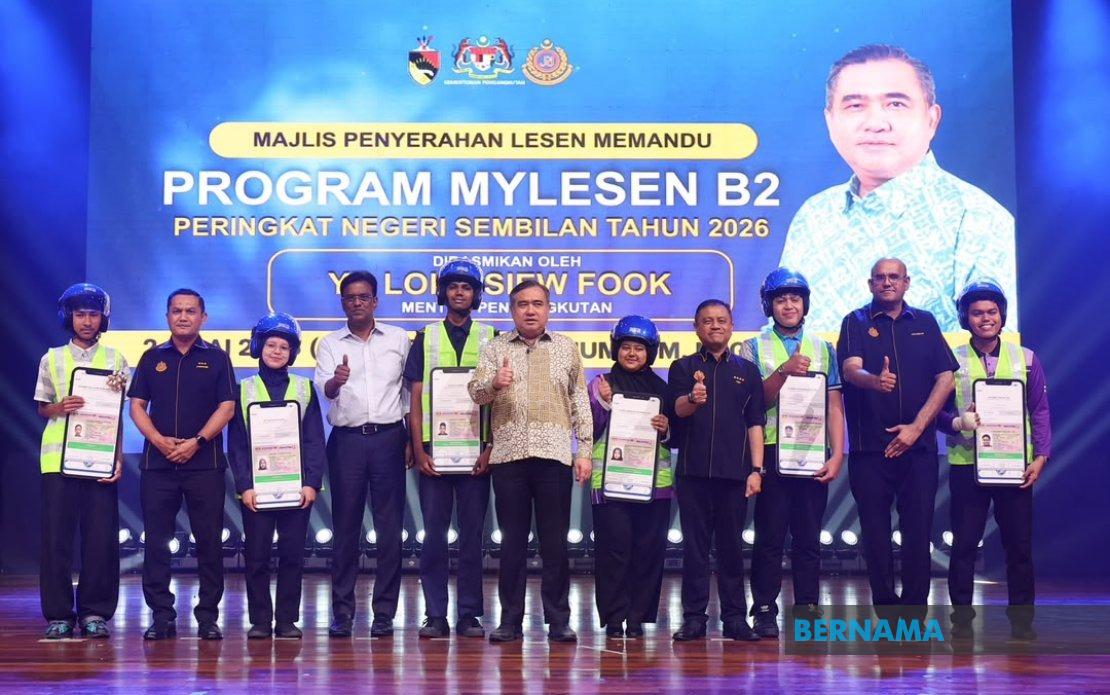
Transport Minister Anthony Loke has issued a firm reminder to young Malaysians receiving motorcycle licences through the MyLesen B2 Programme that their qualification represents a legal obligation to ride safely and observe traffic rules, rather than permission to engage in reckless or illegal behaviour on public roads.
Loke made the appeal during a ceremony in Seremban where driving licences were distributed to programme participants in Negeri Sembilan. He emphasised that the free provision of these credentials should inspire recipients to demonstrate mature judgment behind the handlebars and prioritise their own safety alongside that of other road users.
The statistics underlying his warning are sobering. The transport minister highlighted that approximately 60 per cent of fatal road accidents in Malaysia each year involve motorcycle riders and passengers, with the majority of casualties being individuals under 30 years of age. This pattern underscores a critical public health challenge that road authorities and government agencies are attempting to address through both education and enforcement.
Loke framed the licence not as an achievement to celebrate with reckless weekend rides, but as a tool enabling legitimate mobility and access to opportunities. He stressed that participants should view their qualification as enabling them to commute safely to school and return home without incident, rather than as a gateway to participate in informal street racing or other illegal activities that put themselves and others at serious risk.
The Negeri Sembilan programme has expanded considerably, with the quota increasing from 1,000 participants in the previous year to 2,300 this year, demonstrating growing government commitment to the initiative. As of the ceremony date, 1,979 individuals had already obtained their Learner's Driving Licence, whilst 1,879 had progressed further to complete training and pass the competency assessment required for the Probationary Driving Licence.
Nationwide, the MyLesen B2 Programme has distributed licences to more than 100,000 recipients since its launch in 2023, representing one of the government's flagship initiatives to broaden access to legal mobility among young Malaysians. The scheme is designed not merely to issue credentials, but to open pathways toward employment, tertiary education, and improved economic prospects through safe and lawful transportation options.
The timing of Loke's admonition carries particular weight given recent legislative action. Parliament has now passed the Road Transport (Amendment) Bill 2026, which introduces substantially harsher penalties for illegal racing and unauthorised speed testing across all vehicle categories. Individuals apprehended by the Road Transport Department or police engaging in such activity now face not only financial fines but potential imprisonment, elevating the legal consequences considerably beyond previous frameworks.
The graduated enforcement approach signals the government's determination to change behaviour through escalating consequences. By combining educational campaigns like Loke's public statements with tightened legal frameworks carrying custodial sentences, authorities are attempting to create multiple disincentives against the illegal street racing culture that has long posed dangers to young riders and their communities.
Beyond the immediate message about responsible riding, Loke articulated a broader vision for the MyLesen B2 Programme's role within Malaysia's transport ecosystem. He positioned the initiative as integral to the government's wider ambitions in road safety enhancement, expanded mobility and accessibility for all Malaysians, and creation of more sustainable transport infrastructure. The programme thus functions simultaneously as a social equity measure, a road safety intervention, and an economic development tool.
The Transport Ministry and Road Transport Department committed to strengthening implementation of the MyLesen B2 scheme as part of their sustained push toward comprehensive transport outcomes. This represents continuity in a policy area where demographic pressures—Malaysia's youthful population increasingly seeking independent mobility—intersect with persistent safety challenges requiring coordinated government action.
For licence recipients, the practical guidance was explicit. All new holders were urged to comply scrupulously with road traffic ordinances, adopt defensive riding practices, and ensure consistent use of SIRIM-certified protective helmets whether riding independently or travelling as pillion passengers. These foundational safety practices, Loke suggested, represent the minimum standard expected of programme beneficiaries.
The initiative underscores a recognition within government that blanket prohibition of youth motorcycle use is neither feasible nor desirable in the Malaysian context, where motorcycles remain primary transport for many economically disadvantaged communities. Rather, the strategy involves channelling that inevitable demand through structured licensing, mandatory training, and intensive messaging about responsible operation, whilst deploying heightened legal penalties as backstop enforcement for those who disregard safety imperatives.

