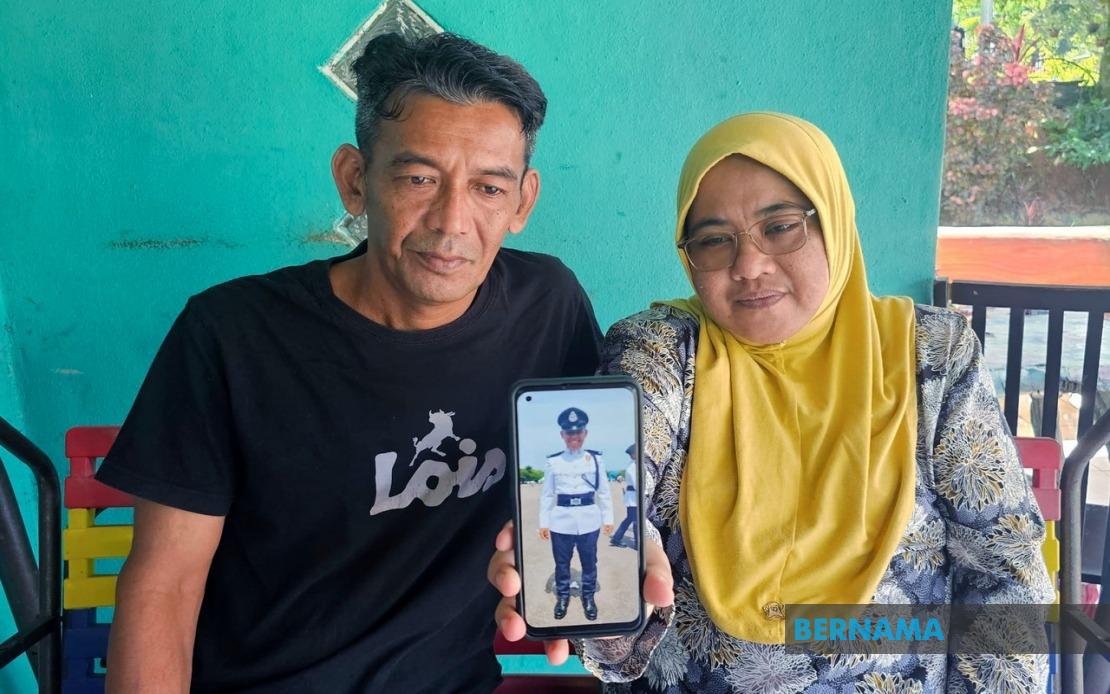
The unexpected death of Constable Muhammad Raimi Ismarubee has transformed what should have been a joyful family reunion into overwhelming grief for his parents in Terengganu. The 26-year-old officer, who worked at Weston Police Station in Beaufort, Sabah, perished in an electrocution incident on August 6, leaving his family reeling from shock at how quickly circumstances can change. His father, Ismarubee Ismail, 51, and mother, Nor Azila Zakaria, 46, had been counting down the days until their son could take leave and return to their home in Felda Kerteh 2, Dungun, for a long-awaited holiday later in the month.
The circumstances surrounding Muhammad Raimi's death underscore the inherent dangers that law enforcement personnel face in their daily duties. At approximately 6 pm on August 6, while engaged in what should have been routine work, he came into contact with a live electrical source while assisting in moving a metal pole designed for harvesting coconuts outside the police station premises near Sekolah Kebangsaan Weston. The incident proved immediately fatal, highlighting how workplace hazards can manifest unexpectedly, even in supposedly controlled environments such as police facilities. What makes this tragedy particularly poignant is the timing — just hours earlier, at 2 pm, Muhammad Raimi had sent a WhatsApp message to his parents proudly sharing news of a successful drug arrest operation, demonstrating his commitment to his police work.
The loss of Muhammad Raimi formed part of a larger catastrophe that claimed three lives simultaneously. Two of his colleagues also perished in the same electrocution incident: Corporal Chiu Teck Siong, 40, and Lance Corporal Mohamad Nur Hafiz Ibrahim, 29. The deaths of three uniformed personnel in a single accident raise serious questions about workplace safety protocols and equipment handling procedures at police stations across Malaysia's more remote outposts. The incident at Weston Police Station underscores vulnerability in operational safety standards that deserves urgent review and remedial action to prevent similar tragedies from recurring.
Muhammad Raimi had embarked on his police career relatively recently, joining the force in September 2024 at Weston Police Station. Despite his brief tenure, he had clearly distinguished himself as a dedicated and conscientious officer who took pride in his work. His last visit home occurred in January, making his planned August return particularly significant for his family, who had come to rely on his regular communication and financial support. The long stretches between his homecomings, necessitated by his posting in the distant Sabah state, had made the prospect of his imminent holiday all the more precious to his parents and siblings.
For his mother Nor Azila, Muhammad Raimi embodied the qualities of a devoted son who understood family responsibility and prioritized his siblings' welfare over personal indulgence. She recalled how he consistently purchased items needed for his siblings' education, including expensive equipment such as laptops, and maintained a disciplined habit of sending money to support the household nearly every month. These gestures demonstrated financial maturity and familial devotion that extended beyond typical duty, reflecting deep personal values instilled during his upbringing. His generosity and sense of obligation to his family painted a portrait of a young man with substantial character who recognized that his police salary represented not merely personal income but shared family resources.
Beyond his responsibilities to his immediate family, Muhammad Raimi harbored personal aspirations that underscored a forward-looking approach to life. He had expressed intentions to become engaged to a woman from Sabah and had begun planning for marriage in the coming year. However, his mother emphasized that he had consciously decided to defer these plans until his youngest sibling completed the Sijil Pelajaran Malaysia (SPM) examination, demonstrating a remarkable capacity to subordinate personal milestones to family needs. This decision revealed a maturity uncommon in individuals of his age and reflected his determination to ensure that family members could focus on education without distraction during crucial academic periods. The engagement and eventual marriage represented dreams that now remain forever unrealized.
The return of Muhammad Raimi's remains to his family in Terengganu had been coordinated by his police station, allowing his parents to accord him a proper Islamic funeral and burial. On the day following the incident, his body was laid to rest at the Felda Kerteh 2 Muslim Cemetery, allowing his community and family to pay final respects and ensure he received dignified treatment in death. The funeral service provided an opportunity for his village community to mourn collectively and recognize the sacrifice inherent in police service, reminding Malaysians of the operational risks that personnel in uniform routinely undertake in public service.
This tragedy illuminates broader concerns regarding workplace safety culture within the Royal Malaysia Police and related uniformed services. The fatal incident involving equipment that should have been handled with appropriate safeguards raises questions about whether standard operating procedures existed, whether personnel received adequate training in electrical hazard awareness, and whether the specific equipment had been properly maintained and inspected. For families across Malaysia whose relatives serve in law enforcement, the incident at Weston Police Station serves as a sobering reminder that dangers extend beyond criminal confrontations to encompass occupational hazards that can prove equally lethal if not managed with rigorous attention to detail.
The impact of Muhammad Raimi's death reverberates through multiple layers of consequence. For his parents and siblings, it represents the permanent loss of a provider, supporter, and source of stability in their modest household. For the Weston Police Station, it means the sudden absence of a recently recruited officer who had invested himself in his work with evident enthusiasm and dedication. For the wider police service and the nation, it serves as a catalyst for reflection on whether current safety standards adequately protect personnel engaged in routine operational tasks. The convergence of three fatalities in a single incident suggests systemic failures rather than isolated mistakes, demanding comprehensive investigation and corrective measures that prioritize officer welfare alongside operational demands.

