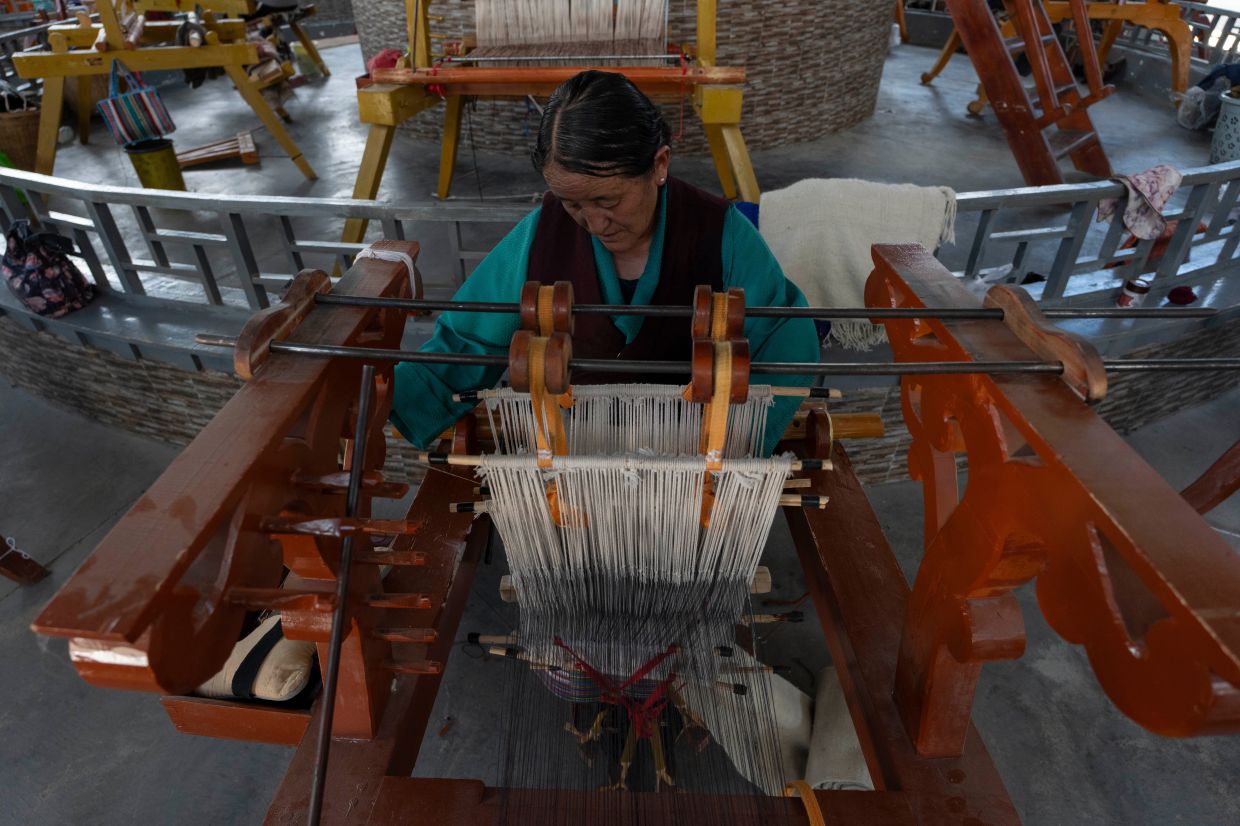
In a high-altitude workshop nestled on the Tibetan plateau, skilled weavers continue a craft that has clothed mountain communities for more than a thousand years. At the Ethnic Huaji Handwoven Cooperative in Shannan, workers sit methodically at wooden looms, their hands moving in practiced rhythms as they weave Pulu, a traditional woolen fabric that remains central to Tibetan material culture. The repetitive motion of shuttle through yarn, the careful tension of each thread, reflects skills transmitted across generations and a determination to prevent this heritage from vanishing into history.
Founded in 2008 by Tibetan artisan Pasang, the cooperative has become an unexpected economic lifeline for the region, employing more than 100 residents across an environment where formal employment opportunities remain scarce. What distinguishes this enterprise from a conventional manufacturing operation is its deliberate mission to revive knowledge that had fallen perilously close to extinction. When Pasang first established the workshop, fewer than ten people in the entire area possessed the expertise to weave Zeter, the finest variety of Pulu made from the softest wool harvested from the necks and backs of high-altitude sheep. His decision to formalize training and create sustainable employment has transformed the cooperative into both an economic institution and a cultural guardian.
The cooperative's inclusivity reflects broader social priorities, as it actively recruits workers with disabilities alongside able-bodied residents, demonstrating that cultural preservation need not exclude the vulnerable. This approach provides dignity through meaningful work to populations often marginalised in labour markets. For elderly residents like the 80-year-old Tsering Yangchen, who relocated from another county specifically to join the workshop after struggling to find employment, the cooperative offers both financial independence and continued social participation. Her seven-year tenure illustrates how traditional crafts can sustain not merely cultural identity but also human dignity and economic security in remote highland communities.
The distinction between ordinary Pulu and the finer Zeter variety reveals the technical sophistication embedded within what outsiders might dismiss as simple handweaving. Zeter's production demands exceptional skill because the premium wool, chosen for its delicate properties, proves substantially more challenging to spin into yarn than the material used for standard Pulu. This technical difficulty explains why Zeter commanded such high regard historically; during the Ming dynasty, the fabric's exceptional quality earned it selection as a tribute gift from Tibet to the Chinese imperial court. The preservation of Zeter techniques therefore represents the conservation of specialized knowledge that cannot be easily replicated by industrial processes, knowledge that distinguishes human craftsmanship from mechanical production.
The physical setting of the workshop encodes layers of historical meaning that resonate throughout the Tibetan weaving tradition. Statues of the seventh-century King Songtsen Gampo and his Chinese bride Princess Wencheng occupy pride of place within the workspace, surrounded by the wooden looms where daily labor occurs. According to local tradition, weaving itself arrived on the Tibetan plateau through Princess Wencheng's introduction of techniques from China, a narrative that positions this craft at the intersection of cultural exchange and dynastic alliance. Pasang himself references this historical foundation when explaining how Pulu represents a synthesis of Tibetan and Chinese cultural elements, acknowledging that the fabric's origins embody broader patterns of cultural integration across the Himalayan region.
Recognition as part of China's national intangible cultural heritage has provided the cooperative with official sanction and, implicitly, greater security for its continued operation. This designation reflects a growing acknowledgement that traditional crafts merit protection and active promotion as expressions of cultural diversity within the nation-state. For Southeast Asian observers, this example demonstrates how governments across the region increasingly frame cultural preservation not as a nostalgic retreat from modernity but as a legitimate development strategy, particularly in remote areas where conventional industries struggle to establish viable operations. The cooperative model proves that heritage-based employment can generate income while resisting the homogenizing pressures of globalized mass production.
The cooperative's commercial operations extend beyond symbolic preservation into genuine market activity. A small showroom adjacent to the production floor displays scarves, shawls, jackets, bags and other finished products manufactured from both Pulu and Zeter. While most sales remain concentrated within Tibet itself, the cooperative has begun attracting customers from elsewhere in China, suggesting potential for expansion beyond its immediate regional market. This modest but growing commercial success proves that consumers will pay premium prices for handmade products featuring authentic cultural provenance, provided they can access reliable supply chains and consistent quality standards. For similar cooperatives throughout Southeast Asia seeking to commercialize traditional textiles, the Shannan model offers both inspiration and practical lessons about market positioning.
The geographical particularity of Shannan—situated at approximately 3,700 metres above sea level—fundamentally shapes the cooperative's operations and product characteristics. The high-altitude environment produces sheep that yield the exceptionally soft wool essential for premium Pulu production. This geographic specificity cannot be replicated elsewhere, meaning that authentic Pulu and Zeter possess genuine terroir comparable to specialized agricultural products. Such geographical anchoring provides protection against competition from industrial imitations, as the unique properties of highland-raised wool cannot be artificially reproduced. This represents an advantage for the cooperative that transcends mere marketing rhetoric; the material reality of high-altitude animal husbandry creates objective barriers to competitive displacement.
Passang's personal trajectory from learning weaving as a child from his parents to establishing a cooperative employing over one hundred workers illustrates the transformation possible when cultural knowledge meets entrepreneurial initiative. He operated within an environment where the craft faced existential threat—a situation common to numerous traditional practices across Asia as younger generations pursue urban migration and formal education. Rather than accepting inevitable decline, Pasang chose to formalize and commercialize the practice, investing his knowledge and effort into creating institutional structures that could transmit skills to new cohorts of workers. His success demonstrates that cultural preservation need not depend upon romantic nostalgia or state subsidy alone; properly structured, traditional crafts can generate genuine employment while maintaining authenticity.
The cooperative's approach to labour training and skill transmission represents a model worthy of emulation across regions concerned with intergenerational knowledge transfer. Rather than restricting access to an exclusive guild or limiting instruction to family members, the cooperative systematically teaches younger Tibetans and adult workers who lack prior experience. This democratization of knowledge accelerates the pace of skill acquisition and expands the population capable of sustaining the tradition. Pasang's explicit concern that Zeter weaving was disappearing reflects awareness that closed knowledge systems prove vulnerable to sudden extinction when practitioners age without successors. By opening instruction to motivated learners regardless of background, the cooperative has created redundancy within the knowledge network, reducing fragility.
For Tsering Yangchen and fellow workers, Pulu extends beyond mere economic commodity. She emphasized that the fabric represents lived experience and practical utility—workers typically wear garments made from the pure wool they produce, integrating the manufactured product into daily life rather than treating it as detached output. This integration of production and consumption patterns preserves use-value alongside market-value, connecting workers emotionally to their output in ways that industrial manufacturing often severs. Such connections reinforce cultural meaning and provide intrinsic motivation beyond wage compensation, factors that developmental economists increasingly recognize as crucial for sustaining craft-based livelihoods across economically marginal regions.
The cooperative's trajectory illuminates broader patterns across the Himalayan and Southeast Asian region where communities seek economic development pathways that respect cultural continuity rather than demanding its sacrifice. As global markets demonstrate increasing appetite for authenticated handmade goods, regions possessing genuine heritage crafts possess potential comparative advantages that pure labor-cost competition cannot provide. The Ethnic Huaji Handwoven Cooperative proves that with appropriate institutional frameworks, strategic marketing, and respect for both workers and tradition, heritage preservation and economic development need not remain opposed. This integration of culture and commerce, executed with integrity and community investment, may offer alternatives to the extraction-dependent models that have historically marginalized mountain communities across Asia.

