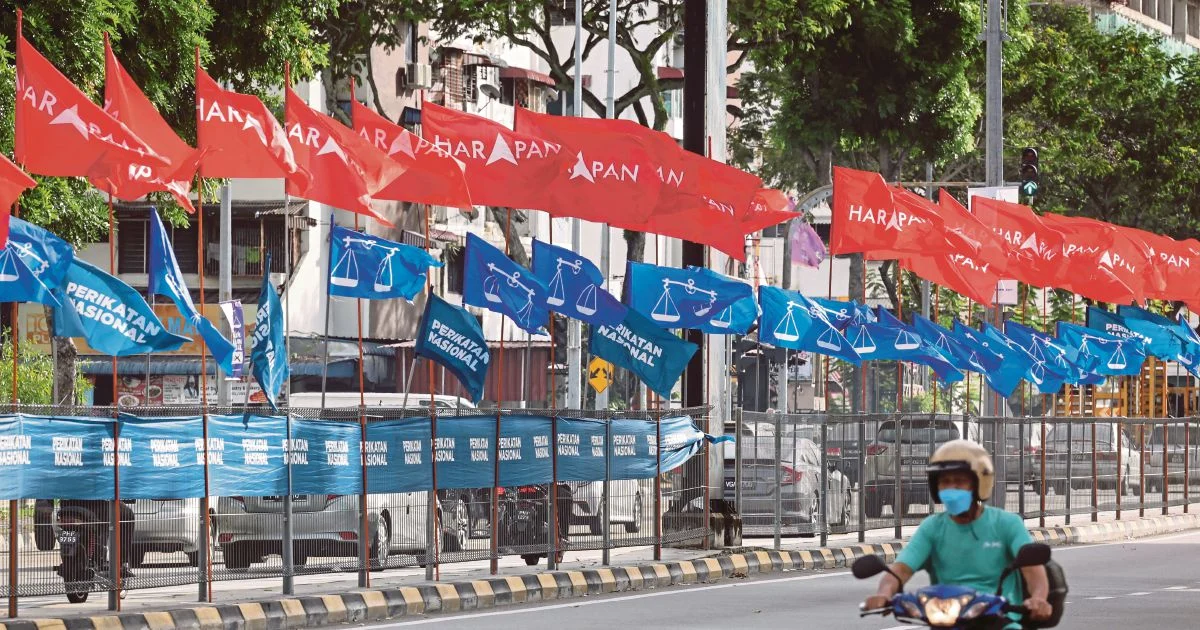
The forthcoming Johor state election is shaping up as a genuinely competitive three-way fight, with Barisan Nasional, Pakatan Harapan and Perikatan Nasional all poised to challenge one another across a substantial portion of the electoral map. With direct contests between all three coalitions expected in 33 of the 56 available state seats, the race demonstrates the extent to which Malaysia's political landscape has fragmented since the 2018 general election, creating new dynamics that will test each coalition's electoral machinery and voter appeal.
The concentration of three-way battles in more than half the constituencies underscores just how evenly matched these political forces have become across much of the state. This pattern differs markedly from earlier electoral cycles when bipolar contests typically dominated state and federal elections. The emergence of viable third-force competition reflects shifting voter preferences, changing coalition alignments at both state and national levels, and the willingness of several constituencies to entertain genuine alternatives to previously dominant parties.
For Barisan Nasional, traditionally the establishment force in Johor politics, these three-way contests present both opportunity and vulnerability. The coalition retains institutional advantages, organisational depth, and historical support bases across rural constituencies and among older demographics. However, splitting the vote in so many seats raises questions about whether BN can maintain its dominance without a simple binary choice favouring the incumbent administration. The party's ability to consolidate its traditional support will be critical in constituencies where opposition votes are divided.
Pakatan Harapan enters the contest riding the momentum of its surprise 2018 federal election breakthrough and subsequent state-level gains across Malaysia. Yet the coalition's performance in Johor specifically has proven uneven, and the presence of three-way contests rather than straightforward contests with BN complicates its path to victory. PH's support among urban and younger voters remains relatively strong, but translating this into seat gains against two other major contenders requires both targeted campaigning and some degree of tactical coordination that the coalition has not always achieved seamlessly.
Perikatan Nasional, the relative newcomer to three-way contests at this scale, brings the wild-card element to Johor's electoral equation. The coalition's combination of Islamic-focused messaging and promises of alternative governance has resonated with certain voter segments, particularly in constituencies with strong religious voting patterns. However, PN's track record in state-level administration and its limited organisational presence compared to BN or PH mean that its ability to convert voter interest into actual seat wins remains uncertain across much of Johor.
The preponderance of three-way battles also reflects the geographical and demographic diversity of Johor itself. Some constituencies naturally lean toward one coalition or another based on historical voting patterns and demographic composition, but a substantial middle tier of genuinely competitive seats has emerged where the outcome cannot be predicted with confidence. This competitive uncertainty is likely to keep campaigns focused and voter engagement relatively high, as neither incumbent nor opposition forces can take any constituency for granted.
For Malaysian politics more broadly, the Johor election serves as a crucial bellwether for the trajectory of three-way competition at the national level. If BN, PH and PN can all sustain significant vote shares simultaneously, it would signal a structural shift toward multipolarity in Malaysian elections rather than a temporary aberration. Conversely, if one coalition emerges with decisive gains while others retreat, it would suggest that while three-way contests exist on paper, voter behaviour continues to cluster around fewer genuine alternatives.
The 33 three-way contests also complicate traditional seat allocation models and polling predictions. Electoral analysts accustomed to binary contests face substantially greater difficulty forecasting results when three substantial forces compete for each vote. Voting efficiency—how effectively each coalition converts votes into seats—becomes even more critical than usual. A coalition winning 40 per cent of the statewide vote in a three-way environment could win either a majority of seats or fall far short, depending on how its votes distribute across constituencies relative to its competitors.
Tactical decisions by each coalition regarding candidate nomination and campaign resource allocation will therefore prove decisive. Concentrating resources in winnable three-way contests while conceding others might prove more effective than attempting uniform presence across all constituencies. Some parties may also attempt quiet coordination with other groups to prevent vote-splitting in particular seats, though explicit alliances seem unlikely given the coalitions' fundamental opposition to one another.
Voter behaviour in such a fragmented environment typically becomes more volatile and less predictable than in traditional contests. Tactical voting—where voters choose candidates primarily to block their least-preferred outcome rather than express genuine preference—tends to increase. This dynamic could particularly favour BN among voters opposed to change, or PH among those seeking to displace the incumbent administration, depending on how constituencies frame the choice.
As campaigns intensify across Johor's 56 constituencies over the coming weeks, the importance of understanding these 33 three-way contests cannot be overstated. They represent the true battleground of the election, where momentum can swing rapidly and where ground-level organisation, candidate selection and messaging discipline will determine whether Johor continues under one coalition's administration or shifts to new leadership.

