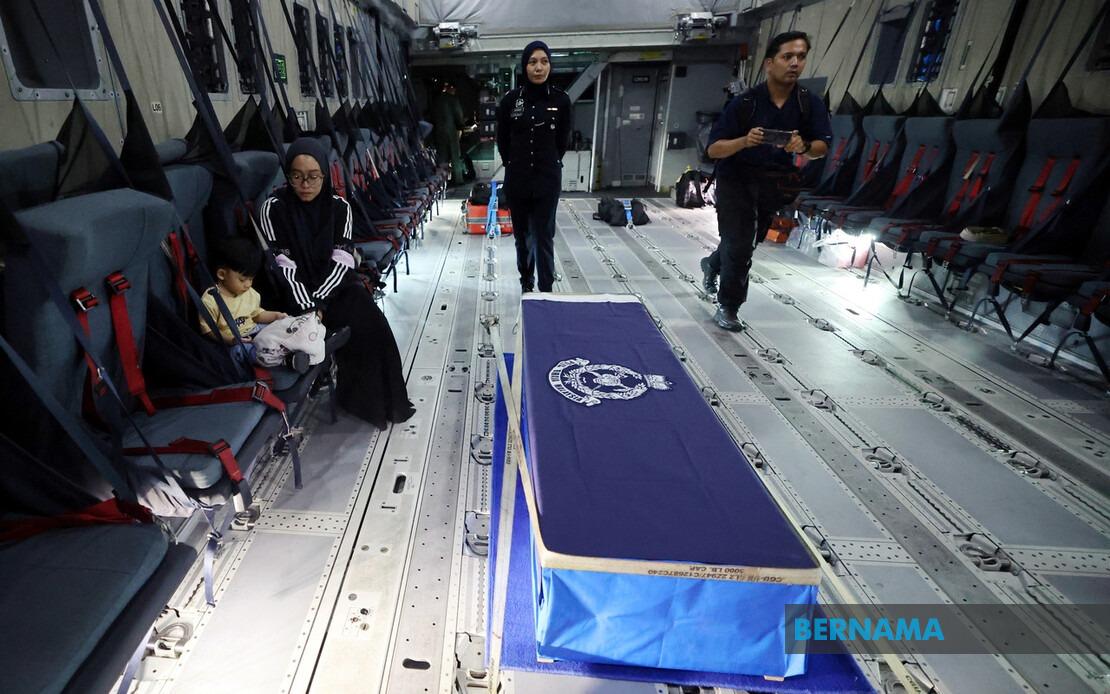
The bodies of three Royal Malaysia Police (RMP) officers who perished in an electrocution tragedy outside Weston Police Station in Beaufort were transported to their respective hometowns on August 7, marking the conclusion of initial procedures following the fatal incident. The three personnel—Corporal Mohamad Nur Hafiz Ibrahim, Constable Muhammad Raimi Ismarubee, and Corporal Chiu Teck Siong—lost their lives in the incident that occurred at approximately 5.50 pm on August 6, shocking the law enforcement community across Sabah and beyond.
The repatriation operation unfolded in coordinated fashion, with both Royal Malaysian Air Force (RMAF) and Royal Malaysia Police Air Operations Force (PGU) aircraft deployed to transport the deceased officers. An RMAF aircraft departed Kota Kinabalu International Airport at 7.10 pm carrying Mohamad Nur Hafiz, aged 29 from Kelantan, and Muhammad Raimi, aged 26 from Terengganu. The flight path took the aircraft first to RMAF Air Base in Kuantan before continuing onward to RMAF Air Base in Gong Kedak, Terengganu, where final arrangements would be made for the officers' families.
The case of Corporal Chiu Teck Siong, aged 40 and hailing from Sarawak, followed a different transport route. His remains were first conveyed to the RMP PGU base in Kota Kinabalu, from where a dedicated police aircraft transported him across to Sarawak. This logistical coordination underscores the extent to which such tragedies mobilise institutional resources across multiple states and security forces, reflecting both the gravity of the incident and the established protocols for honouring fallen officers.
Prior to repatriation, all three bodies underwent post-mortem examinations conducted at the Forensics Department of Queen Elizabeth Hospital in Kota Kinabalu at midday on August 7. The medical procedures concluded by approximately 2.56 pm, after which the bodies were formally released to their respective families and transported to the airport facilities for the final leg of their journeys home. Post-mortem examinations in cases of sudden or unexplained death serve not only to establish cause but also to provide documentation that supports subsequent investigations into workplace safety and circumstances surrounding the incident.
The electrocution incident at Beaufort represents a stark reminder of the occupational hazards that personnel in law enforcement can encounter, even in routine circumstances. While details of precisely how the three officers came into contact with live electrical current remain under investigation, such tragedies typically prompt reviews of workplace safety protocols at police stations nationwide. The incident occurred outside the police station premises rather than within the building itself, suggesting that the hazard may have been related to external infrastructure or temporary installations that officers would not necessarily have been trained to recognise as dangerous.
Sabah, where the incident took place, has witnessed several occupational fatalities in recent years affecting both civil servants and emergency personnel. The geographic isolation of some police stations in the state, combined with sometimes aging infrastructure and varying standards of electrical safety compliance, creates conditions where such accidents can occur with limited warning. The Beaufort station's location in the southwestern region of Sabah, along the coast, places it within an area where maintenance of facilities can sometimes lag behind urban centres.
The loss of three trained officers simultaneously represents a significant personnel impact for the RMP, particularly at a district level. These officers would have accumulated years of operational experience and contributed to community policing efforts across their respective postings. Their deaths will ripple through the departments where they served, affecting colleagues who worked alongside them and potentially impacting service delivery in their respective jurisdictions.
For the three families affected, the repatriation process represents the beginning of a profound grieving period. The coordination of transport and the involvement of senior law enforcement authorities in overseeing the officers' return home reflects institutional recognition of their service and sacrifice. In Malaysian police culture, the death of officers in the line of duty—however it occurs—typically triggers formal recognition and memorial ceremonies that honour their contribution to public safety.
The incident will likely spark discussions within the RMP about electrical safety audits at police facilities throughout the country, particularly in older buildings or those where infrastructure maintenance may not have been regularly updated. Workplace safety in government institutions remains an area where compliance and enforcement can be inconsistent, and tragic incidents often serve as catalysts for overdue safety reviews and upgrades. The timing of this incident may prompt the police force to commission assessments of similar facilities in Sabah and other states.
Investigations into the precise circumstances surrounding the electrocution will continue in parallel with the grieving and repatriation process. Authorities in Beaufort and Kota Kinabalu will be documenting the electrical conditions at the location where the officers died, examining maintenance records, and determining whether any equipment or installations were defective or improperly installed. Such investigations typically take several weeks to complete and may inform future policy regarding facility safety standards across the police force.
The incident underscores how accidents in the workplace, even those not directly related to policing duties, can claim lives and alter institutional operations. For Malaysian citizens and policymakers alike, the tragedy serves as a reminder that occupational safety—whether in law enforcement, utilities, construction, or other sectors—demands consistent attention, regular maintenance, and a culture of hazard awareness that extends beyond formal training into daily operational practice at every facility.

