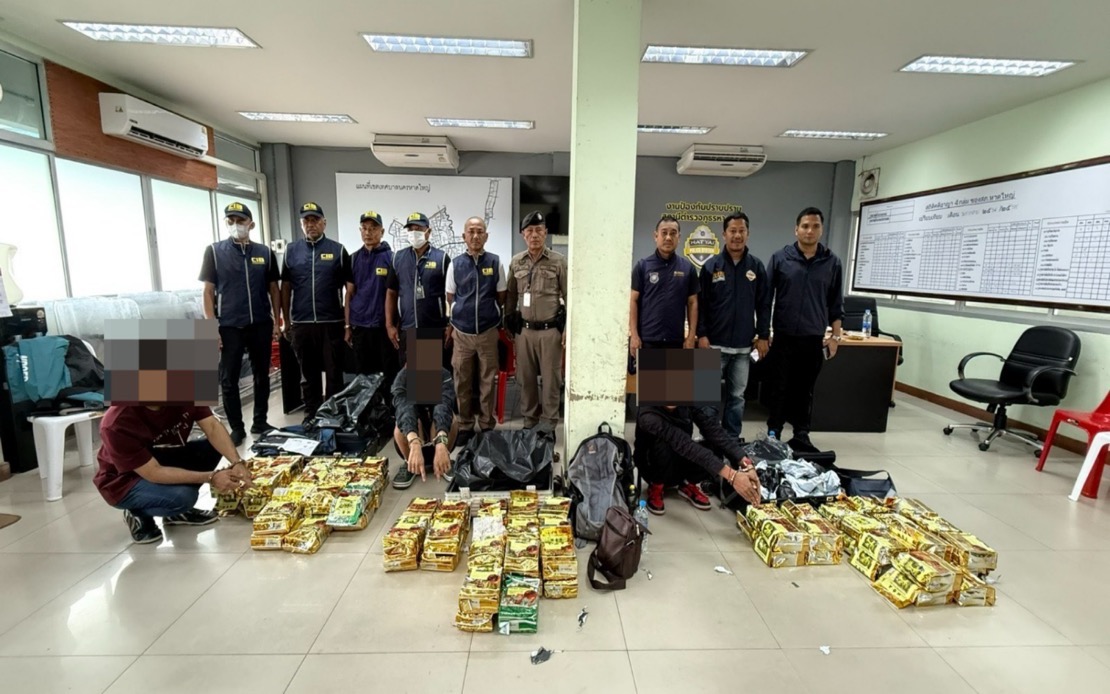
Three Malaysian nationals were taken into custody at Hat Yai Railway Station in Songkhla province on July 31 following an operation targeting a significant methamphetamine trafficking attempt. The men had concealed 87 kilograms of crystal methamphetamine—commonly known locally as "ice"—across three wheeled suitcases and three backpacks, according to authorities overseeing the multi-agency investigation.
The arrest resulted from coordinated enforcement efforts involving multiple Thai law enforcement agencies. The Tawan Hat Yai unit, in partnership with railway police, the Crime Suppression Division, the Anti-Trafficking in Persons Division, tourist police, the Narcotics Suppression Bureau, and the Region 9 Office of the Narcotics Control Board, intercepted the suspects upon their arrival at the station. Ratchapon Palakul, director of the ONCB's Region 9 Office, confirmed the apprehension and outlined details of the operation during a statement released on Tuesday.
The three men had travelled aboard a train departing from Bangkok with Hat Yai as their stated destination, placing them directly within the operational focus of Thai authorities who have intensified border security measures. Their interception at the railway station, a critical transit point for cross-border movement, highlighted ongoing vigilance against narcotics trafficking networks seeking to move bulk quantities of drugs from Thailand into Malaysia and potentially beyond.
Initial questioning of the detained individuals revealed that each had been recruited and offered RM8,000 to participate in the smuggling operation by members of what authorities describe as an organised syndicate. This financial incentive suggests the men may have served as couriers or transporters rather than as major players within the trafficking network, a common operational structure used by sophisticated drug organisations to insulate leadership from direct involvement in high-risk logistics.
The charges filed against all three suspects reflect the gravity of their alleged conduct. They face joint accusations of possessing and trafficking Category 1 narcotics with intent to distribute, offences that carry severe penalties under Thai law. Upon conviction, each defendant faces potential imprisonment for up to 15 years coupled with financial penalties reaching 1.5 million baht, equivalent to approximately RM183,000. These sanctions underscore Thailand's stringent approach to major drug trafficking cases and serve as a deterrent to potential smugglers.
The 87-kilogram seizure represents a substantial quantity of methamphetamine destined for Malaysian and regional markets, where demand remains persistently high despite enforcement efforts across Southeast Asia. Crystal methamphetamine trafficking has emerged as a critical regional concern, with production facilities concentrated in areas bordering Thailand and Myanmar. The drug commands premium prices in consumer markets, particularly among urban populations in Malaysia, Singapore, and other developed economies within the region, creating powerful financial incentives for smuggling networks to expand their operations.
Thailand's strategic geography positions it as a crucial conduit for drug movements flowing toward Malaysia and beyond. The nation's porous borders, extensive transportation networks, and permissive regulatory environment in certain transit zones have historically attracted trafficking organisations seeking efficient routes. The Hat Yai Railway Station, serving as a major international transport hub connecting Bangkok to Malaysia via the Southern Line, represents a high-value interception point where vigilant enforcement can disrupt major shipments before they cross international boundaries.
For Malaysia, this arrest underscores the persistent threats posed by organised drug syndicates operating across the region. The recruitment of Malaysian nationals as couriers reflects a calculated strategy by trafficking organisations to exploit familiarity with Malaysian border procedures and reduce detection risks. The RM8,000 incentive offered to each courier, while substantial for lower-income individuals, represents a calculated business expense for syndicates handling multi-kilogram quantities of high-value narcotics destined for profitable street-level distribution.
Thai authorities have prioritised identifying the mastermind and additional accomplices within the smuggling network, recognising that the three detained men likely represent only operational components of a larger infrastructure. Intelligence gathered from interrogations and physical evidence may yield leads regarding supply sources, distribution networks, financial arrangements, and other trafficking cells operating within the region. Such investigations frequently uncover connections spanning multiple jurisdictions, necessitating international cooperation and intelligence sharing among Southeast Asian law enforcement agencies.
The incident carries implications for bilateral cooperation between Malaysian and Thai authorities, who maintain established channels for narcotics intelligence and joint enforcement operations. Enhanced coordination at border crossings, railway stations, and other transit points continues to disrupt trafficking flows, though the persistent volume of interdictions suggests demand-driven markets continue attracting substantial smuggling attempts. The ongoing challenge facing regional governments involves disrupting financial incentives and supply chains that make courier recruitment viable for trafficking organisations.
This case illustrates the systematic nature of regional drug trafficking, wherein established syndicates maintain recruitment pipelines, transportation logistics, and distribution networks spanning multiple countries. The sophistication demonstrated by concealment techniques—distributing drugs across multiple pieces of luggage—reflects operational discipline and experience within trafficking hierarchies. Such professionalism makes enforcement increasingly challenging and underscores the need for sustained, coordinated regional responses combining border security, intelligence sharing, and intelligence-led policing strategies.

