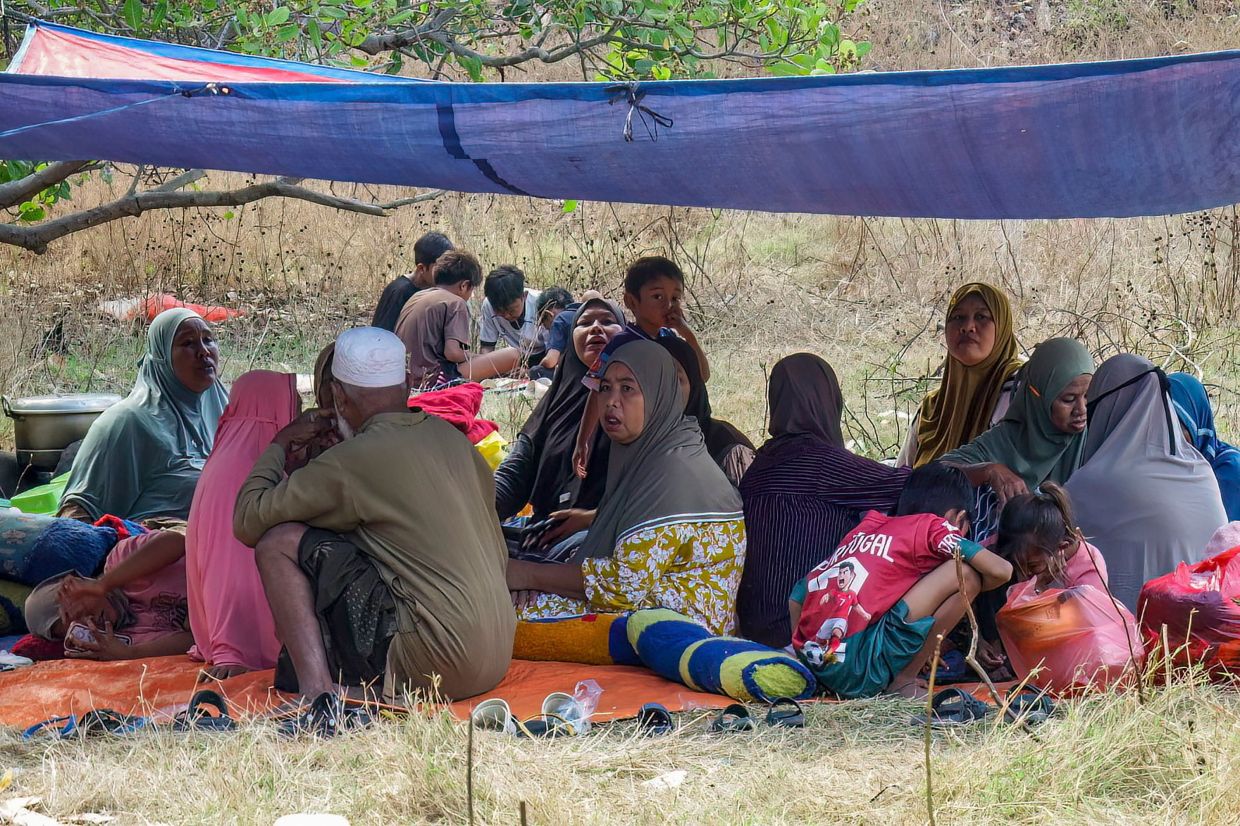
Thousands of survivors remained stranded on hillsides across Indonesia's Flores island on Sunday, anxiously awaiting emergency assistance following a catastrophic 7.7 magnitude earthquake that claimed at least 48 lives and left vast tracts of the region in ruins. The tremor struck early Saturday morning, with the epicentre located just offshore from the island's northern coast, unleashing a cascade of 341 aftershocks that terrorised residents already traumatised by memories of a similarly devastating 1992 quake that killed approximately 2,500 people. The scale of displacement has been staggering: roughly 5,000 evacuees fled their homes in panic, according to Berton Suar Pelita Panjaitan, a spokesman for Indonesia's BNPB national disaster agency, many still too frightened to return despite assurances from search and rescue teams that no people remain trapped beneath rubble.
The immediate humanitarian crisis has taken on urgent dimensions as communities scattered across the northern and southern coasts of Flores grapple with shortages of the most basic necessities. Residents like Umri, a 55-year-old from Nangahale village on the island's north coast, have spent days sheltering on elevated terrain with extended family members, pleading for food, drinking water, medicines and infant supplies. The psychological toll compounds the physical devastation: Nurhidayati, also a resident of the affected areas, described spending the night on a mat alongside strangers, her mind unable to escape the trauma of the 1992 disaster and the terrifying sensation of Saturday's violent ground movements. Her fear reflects a deeper reality—Flores sits in one of the world's most seismically active regions, leaving survivors perpetually vulnerable to nature's unpredictable fury.
Infrastructure across significant portions of the island has been severely compromised. The BNPB recorded at least 914 houses sustaining severe structural damage, with hundreds more sustaining moderate to severe harm that renders them uninhabitable. Beyond residential properties, critical public infrastructure has been devastated: 93 educational facilities, 36 health centres, and 38 government administrative offices have been either destroyed or rendered non-functional. The damage has effectively paralysed normal activities across affected communities, with electricity networks severed and telecommunications largely non-functional in outlying areas. At least one vital emergency access road remains completely inaccessible, severely hampering the delivery of supplies and the movement of rescue personnel between isolated communities.
The immediate response from Indonesian authorities has mobilised significant resources, though the scale of need remains daunting. The government rapidly dispatched 50,000 aid packages totalling 275 tonnes to Flores, representing one of the most substantial initial relief efforts. The East Nusa Tenggara provincial government, which encompasses Flores, has initiated bureaucratic procedures to establish an emergency response status lasting a minimum of fourteen days, a designation that enables accelerated resource allocation and streamlined decision-making. Officials have identified critical shortages requiring urgent attention: emergency tents, food provisions, medical supplies, blankets, camp beds, mats, potable water supplies and electricity generators rank foremost among required materials. At least 101 residents have sustained injuries requiring ongoing medical attention, straining the limited healthcare capacity of a region where 36 health facilities themselves require repair or reconstruction.
International support has begun flowing toward the disaster zone, reflecting the global community's recognition of Indonesia's vulnerability to seismic events. The International Federation of Red Cross and Red Crescent Societies commenced preparations Saturday to transport aid supplies to thousands sheltering in temporary evacuation sites. European Union leadership has also mobilised resources: Ursula von der Leyen, the EU's chief executive, publicly pledged support through the bloc's Copernicus Earth observation satellite system, offering sophisticated remote sensing capabilities to enhance search and rescue operations. Such technological assistance proves invaluable in disaster response scenarios, enabling authorities to identify previously undetected pockets of survivors, assess structural integrity of damaged buildings, and coordinate supply distribution more efficiently across challenging terrain.
The natural hazards triggered by the earthquake extended beyond ground motion itself. Coastal communities experienced genuine tsunami threats when the sea receded dramatically following the initial tremor—a phenomenon that typically signals an approaching wave surge. Residents across multiple villages rushed inland toward elevated terrain, fearing inundation from waves generated by offshore seismic activity. Although waves measuring up to 1.6 metres did reach coastal regions according to Indonesia's BMKG geological agency, the tsunami warning was subsequently lifted, preventing what could have transformed an already catastrophic disaster into an even deadlier catastrophe. Authorities nevertheless maintained warnings urging residents against re-entering damaged structures, recognising that powerful aftershocks could destabilise buildings already compromised by Saturday's initial violent movement.
The Flores earthquake underscores Indonesia's precarious geographical position within the Pacific Ring of Fire, an extensive arc of extraordinarily intense seismic and volcanic activity that encompasses Japan, traverses the Southeast Asian archipelago, and extends across the Pacific basin. This geological reality renders Indonesia perpetually vulnerable to earthquakes and tsunami events of potentially devastating magnitude. The 2004 Indian Ocean earthquake—measuring 9.1 magnitude—catastrophically demonstrated this vulnerability when submarine rupturing off Sumatra's coast generated a tsunami that claimed approximately 220,000 lives across the entire region, with roughly 170,000 fatalities concentrated in Indonesia itself. That disaster ranked among humanity's deadliest natural catastrophes in recorded history, and its legacy continues shaping how Indonesian policymakers approach disaster preparedness and response protocols.
The recovery trajectory for Flores will necessarily involve multi-phase reconstruction efforts extending far beyond the immediate emergency response period. Beyond restoring critical infrastructure—roads, utilities, communications networks and healthcare facilities—authorities must address the profound psychological and economic dimensions of the disaster. Residents whose livelihoods depended upon agriculture, fishing or small commerce have lost productive assets and income sources, creating long-term vulnerability requiring sustained intervention. Children's educational progression has been disrupted by the destruction of schools, perpetuating disadvantage that may have generational implications. The provincial emergency response designation provides a crucial framework enabling accelerated decision-making and resource mobilisation, yet successful recovery ultimately depends upon sustained political will and adequately funded reconstruction programmes extending throughout the coming months and years.
For Malaysian observers, the Flores earthquake carries sobering implications regarding regional vulnerability to similar seismic events. While Malaysia occupies a comparatively more stable tectonic setting than Indonesia, the region nonetheless experiences periodic earthquake activity and remains within extended tsunami risk zones generated by offshore submarine ruptures. The Indonesian disaster provides a timely reminder of the critical importance of robust disaster preparedness infrastructure, early warning systems, and coordinated international assistance mechanisms. Malaysia's closer geographic proximity to Southeast Asian seismic zones means that lessons learned from Flores—regarding building standards in earthquake-prone regions, evacuation protocols, emergency supply stockpiling, and coordination between government and humanitarian agencies—hold direct relevance for Malaysian disaster management planning.
The human dimension of the Flores catastrophe extends beyond statistics regarding deaths and injuries. Individual testimonies from survivors reveal the profound psychological trauma accompanying natural disasters of such magnitude. The fear persisting among residents like Nurhidayati reflects not merely immediate anxiety regarding aftershock risks, but deeper existential dread rooted in community memory of the 1992 disaster. Such collective trauma shapes how affected populations respond to relief efforts, reconstruction initiatives, and broader community resilience-building activities. Recognition that survivors often require psychological and social support equivalent to material assistance represents an increasingly sophisticated understanding of comprehensive disaster response. As reconstruction proceeds across Flores, humanitarian agencies operating in the region must weave mental health support and trauma-informed assistance protocols throughout their interventions, acknowledging that genuine recovery encompasses restoration of both physical infrastructure and psychological wellbeing.

