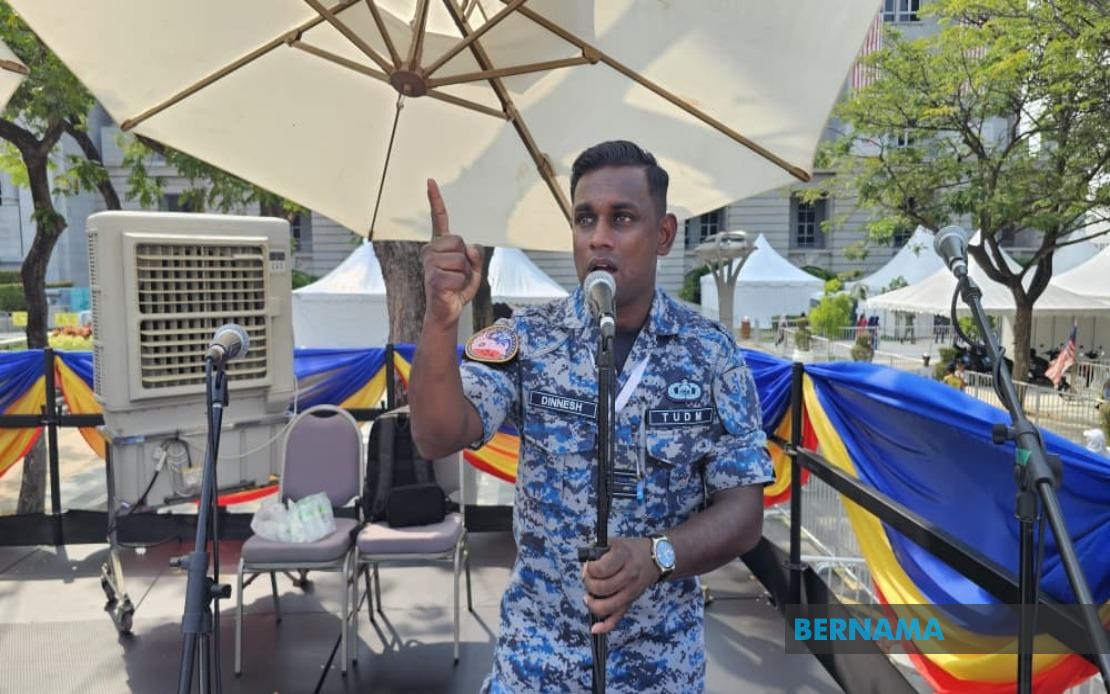
When fighter jets streaked across Putrajaya's skies on National Day, a voice rose above their roar to transform raw aviation displays into a vivid narrative for thousands watching below. That voice belonged to Major Dinnesh Nicolas Rene, a 34-year-old Royal Malaysian Air Force officer whose role as air show commentator demands far more than simply reading prepared remarks into a microphone. For the 2026 National Day parade, Dinnesh worked alongside Major Neny Suhaida Ab Suki and Captain Muhammad Iqbal Nasrudin to provide real-time commentary that connected spectators—including the King and Prime Minister—with every precision manoeuvre unfolding overhead.
The journey to this specialized position began in 2019 when Dinnesh was selected as a commentator for the Langkawi International Maritime and Aerospace Exhibition, a prestigious showcase that provided his entry point into the field. That opportunity led to additional assignments during RMAF anniversary celebrations and eventually to his prominent role during Malaysia's most significant annual ceremony. Currently serving in the RMAF Air Defence Control Division, Dinnesh's background offers him a distinctly informed perspective on the operational nuances that audiences need to understand, yet even his years of military aviation experience cannot diminish the preparation required for each assignment.
Successfully executing air show commentary rests on a foundation of exhaustive technical knowledge. Commentators must familiarize themselves with aircraft specifications, pilot identities, squadron mottos, formation patterns, and the precise sequence of every intended manoeuvre. This information gathering begins months before the actual event through coordinated meetings with ground control teams and the pilots themselves. Dinnesh emphasizes that this coordination extends beyond simply knowing what will happen in the sky; commentators must align their narration with security protocols, timing cues, and the ceremonial requirements of state-level events, where the presence of national leadership adds layers of formal constraint to every spoken word.
The complexity of commentary at a National Day celebration presents particular challenges that distinguish it from commercial air shows or routine military demonstrations. Unlike less formal venues, national ceremonies demand absolute precision in protocol observance. Commentators must possess an intuitive understanding of what can be articulated, what must remain unspoken, and the optimal moment for each piece of information to maximise impact while respecting security and diplomatic sensibilities. This balancing act requires not merely technical knowledge but sophisticated judgment developed through experience and close collaboration with protocol officers and military hierarchy.
Beyond the intellectual demands lies a physical challenge that many observers overlook: vocal endurance under extreme conditions. Unlike masters of ceremonies who work indoors with controlled acoustics, air show commentators must project powerful, clear voices that penetrate the deafening noise of multiple fighter jets executing simultaneous manoeuvres. The risk of vocal strain is substantial, and losing voice capacity—even partially—before or during an event represents a genuine professional hazard. Dinnesh identifies voice preservation as perhaps the most critical challenge, requiring rigorous management throughout rehearsals and on the performance day itself. This necessitates specific techniques, vocal discipline, and sometimes medical support to maintain the instrument through intensive preparation and delivery.
The psychological dimension of commentary also warrants recognition. Dinnesh operates on a principle that commentators must authentically embody and feel the excitement they convey to audiences. This is not mere performance technique; rather, it reflects an understanding that genuine enthusiasm and wonder translate through vocal tone, pacing, and inflection in ways that technical proficiency alone cannot achieve. Despite witnessing fighter jet operations regularly throughout his military career, Dinnesh maintains an undiminished sense of awe toward aerial displays. This capacity to sustain genuine excitement, even after years of exposure to these spectacular manoeuvres, forms the emotional bedrock that transforms competent commentary into compelling narrative.
The coordination required for National Day air shows illuminates the intricate planning behind Malaysia's most visible state ceremonies. Major Dinnesh's role represents just one specialized component within a vast apparatus involving pilots, ground crews, security personnel, protocol officers, and civilian organizers. The seamless execution that spectators witness from the ground results from countless hours of coordination, rehearsal, and contingency planning conducted in advance. Each element—including the commentary—must function with precision to create the coherent, meaningful experience that reinforces national identity and pride during this annual observance.
For Southeast Asian audiences, the prominence of air force capability during National Day celebrations reflects regional military modernization and the centrality of defence posturing within national narratives. Malaysia's RMAF has undergone significant development, and showcasing this capability through coordinated aerial displays serves both domestic and regional audiences. The sophistication required to narrate these displays—as demonstrated through Dinnesh's methodical approach—indicates the professionalization of Malaysia's military institutions and their commitment to public engagement and transparency regarding defence capabilities.
The evolution of Dinnesh's role also suggests broader trends in how modern militaries communicate with civilian populations. Rather than maintaining distance or secrecy, contemporary defence forces increasingly recognize the value of explanation and narrative, using commentary to educate citizens about military operations and foster understanding. This approach serves multiple purposes: it enhances public appreciation for military personnel and resources, demystifies aviation operations that many civilians rarely encounter directly, and strengthens the social contract between armed forces and the societies they serve. Dinnesh's meticulous preparation and professional dedication exemplify this modern military ethos.
Looking forward, the demand for highly skilled air show commentators may increase as nations across Southeast Asia expand their military capabilities and invest in enhanced public communication strategies. The role combines technical expertise, vocal performance, protocol awareness, and emotional intelligence in ways that few other positions demand. Officers like Major Dinnesh represent a specialized cadre of professionals whose contributions remain largely invisible to audiences who remember the spectacle without necessarily recognizing the individual expertise that made it comprehensible and emotionally resonant. As Malaysia continues to develop its defence capabilities and refine its national ceremonies, the role of thoughtful, knowledgeable commentary will remain essential to connecting military power with public understanding and national pride.

