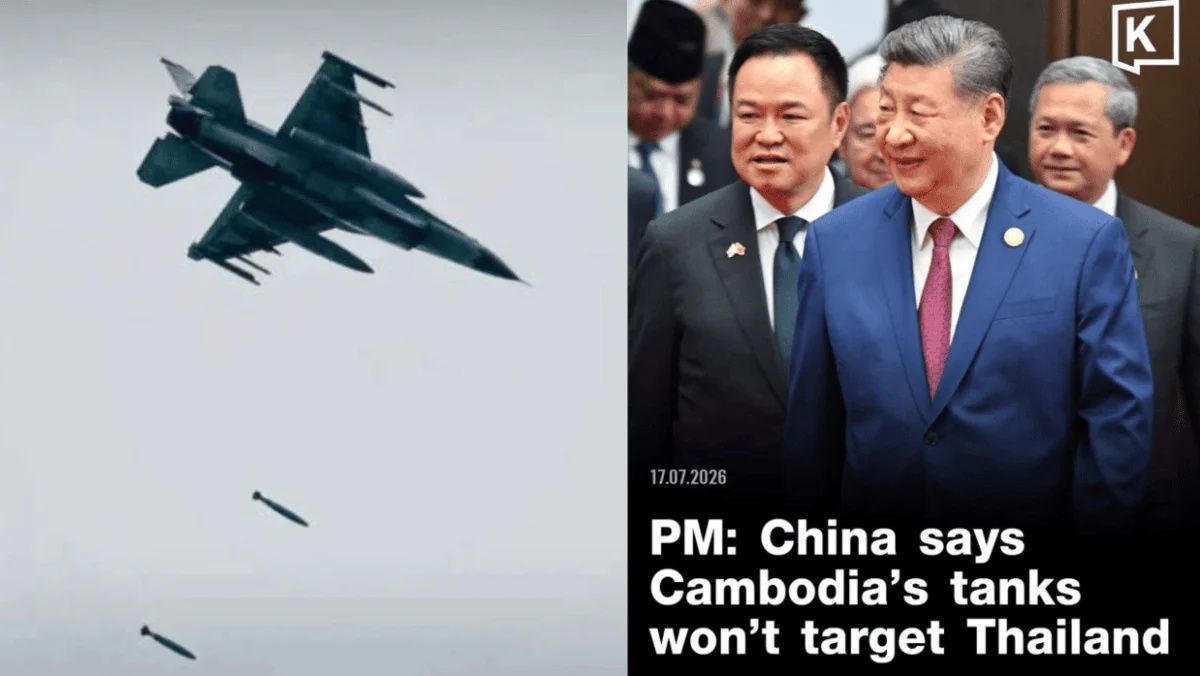
Thailand's expressed concern over Chinese-made tanks supplied to Cambodia has become a focal point in recent regional security discussions, but the anxiety reveals more about Bangkok's strategic calculations than any realistic threat assessment. Prime Minister Anutin Charnvirakul claimed that China provided reassurance regarding the tanks, yet Beijing's official statement made no mention of such restrictions, instead calling for peaceful dialogue between the two nations. This discrepancy between Thai claims and Chinese public positions underscores how security narratives can be constructed differently by different actors, raising questions about whether the tank delivery genuinely represents a military concern or serves other political purposes.
The contradiction at the heart of Thailand's position becomes stark when examined against the backdrop of Bangkok's own military posture. Thailand maintains significantly superior military capabilities across personnel, equipment, and technological sophistication compared to its neighbour. The Royal Thai military possesses F-16 and Gripen fighter aircraft with all-weather combat capabilities, sophisticated surveillance systems, and substantially larger ground forces. Despite this overwhelming advantage, Thai authorities have consistently portrayed Cambodia's comparatively limited defensive acquisitions as imminent strategic threats requiring urgent response measures. This asymmetry in how each nation's military actions are interpreted suggests that perceptions of threat are shaped less by objective military balance and more by political considerations about regional influence.
Thai military announcements in 2026 demonstrated the extent to which Bangkok actively publicised its defensive readiness in ways that mirror or exceed Cambodia's procurement efforts. The Thai Joint Information Centre announced continuous intelligence monitoring, ground patrols, and aerial surveillance operations along the border, while emphasising that response measures existed for every conceivable level of confrontation. The Royal Thai Air Force subsequently publicised nighttime F-16 operations near the Cambodian frontier as exercises demonstrating round-the-clock operational capacity. These announcements, coupled with what Thailand's defence ministry termed increased military area-control measures, represented an explicit display of military preparedness that goes well beyond passive defence.
The pattern of Thai military rhetoric and action extends back further than the recent tank deliveries. In June 2025, the Thai military publicly declared its readiness to conduct high-level military operations, with army, navy, and air force units increasing combat readiness in a move that signalled escalatory intentions to neighbouring states. This rhetoric was not merely symbolic; it was followed by concrete military action. In December 2025, the Royal Thai Air Force confirmed conducting deep strikes against a weapons facility in Cambodia's Battambang province, justifying the airstrikes as necessary to reduce Cambodia's military capability. Such operations represent not defensive posturing but offensive military action targeting facilities deep within another nation's territory.
The sequence of events during both 2025 armed confrontations reveals a troubling pattern: the Thai military initiated fighting after deliberately provoking border tensions. Thailand did not merely display its advanced military arsenal through exercises and announcements; it moved from threatened action to actual warfare, conducting airstrikes that violated Cambodian airspace and territorial integrity. This escalatory history provides crucial context for evaluating current Thai concerns about Cambodian tanks. The anxieties expressed by Bangkok appear not as responses to unexpected military buildups but as reactions to Cambodia's attempts to acquire sufficient defensive capability to make military coercion more costly or difficult. This distinction between fearing invasion and fearing effective deterrence is crucial to understanding the real drivers of Thai security concerns.
The fundamental problem with Thailand's position lies in its application of different standards to its own military activities and those of Cambodia. Bangkok characterises its fighter aircraft operations, surveillance missions, military reinforcements, and area-control exercises as routine national defence measures appropriate for a sovereign state. Simultaneously, Thai officials and media present every Cambodian acquisition—including tanks designed primarily for territorial defence—as evidence of aggressive intent or external interference. This inconsistency cannot be reconciled with principles of equal treatment under international law. Security concerns cannot legitimately operate according to one standard that permits Thailand unlimited military preparedness while demanding that Cambodia justify every piece of defensive equipment it acquires or maintains.
Cambodia's situation reflects the vulnerability of smaller states in regional power dynamics. As a sovereign nation under the UN Charter, Cambodia possesses inherent rights equal to those of its larger neighbours, including the right to modernise its armed forces and acquire equipment necessary for national defence. International law does not measure aggression by counting tanks or calculating military inventory ratios; rather, it focuses on whether force has been threatened or used, whether territorial integrity has been violated, whether ceasefire obligations are honoured, and whether disputes are addressed through peaceful mechanisms. By these standards, Cambodia's arms procurement stands on fundamentally different legal and moral ground from Thailand's conduct of actual airstrikes and military occupation of border areas.
China's role in this dynamic warrants careful consideration. Beijing's reported agreement to supply tanks to Cambodia predated recent conflicts, and delivery was only temporarily delayed due to fighting before the contract was fulfilled. This represented the completion of an existing commercial arrangement rather than a new arms race initiative. China's official statements emphasised the importance of peaceful settlement through dialogue and offered constructive assistance, notably refraining from public restrictions on Cambodia's use of the equipment. The absence of such restrictions in China's public statements contrasts sharply with Thai claims about private assurances, suggesting that Beijing may not view Cambodia's military modernisation as inherently destabilising in the way Bangkok does.
The strategic implications of Thailand's position extend beyond bilateral relations to affect regional stability more broadly. If smaller or weaker states cannot acquire defensive capabilities without triggering military responses from more powerful neighbours, the principle of sovereign equality becomes hollow. Thailand's insistence on maintaining overwhelming military superiority, while simultaneously expressing anxiety about Cambodia's efforts to achieve basic defensive capacity, sets a problematic precedent for Southeast Asia. Other nations in the region might conclude that military preparedness at Thailand's level is acceptable while equivalent efforts by neighbours constitute threats requiring military response. This asymmetrical application of security logic undermines the foundation for peaceful coexistence based on mutual respect and international law.
The broader implications for Malaysia and other Southeast Asian nations are significant. Thailand's approach to Cambodia's military modernisation exemplifies how military power can be weaponised rhetorically to maintain strategic advantage. By continually framing Cambodia's defensive acquisitions as threatening while publicising its own offensive capabilities, Bangkok creates a narrative that justifies continued military superiority while delegitimising neighbours' defence efforts. This dynamic could influence how regional disputes are perceived and resolved, with military power rather than legal principles determining outcomes. For Malaysia and other ASEAN members, understanding these mechanisms of power assertion disguised as security concerns becomes essential for protecting national interests and promoting genuine regional stability based on law rather than force.
Moving forward, the international community would benefit from applying consistent standards to all nations' military activities. Sovereignty and self-defence rights should not depend on whether a state is larger or more militarily powerful than its neighbours. Thailand has every right to maintain and modernise its armed forces, but this right cannot justify demanding that Cambodia forego equivalent defensive capabilities. The solution to border tensions lies not in Cambodia accepting military inferiority but in genuine dialogue addressing legitimate grievances and establishing mechanisms for peaceful dispute resolution. Both nations would benefit from recognising that security cannot be achieved unilaterally through military dominance but only through mutual agreement to pursue peaceful means of settling disagreements, as China explicitly advocated in its diplomatic statements.

