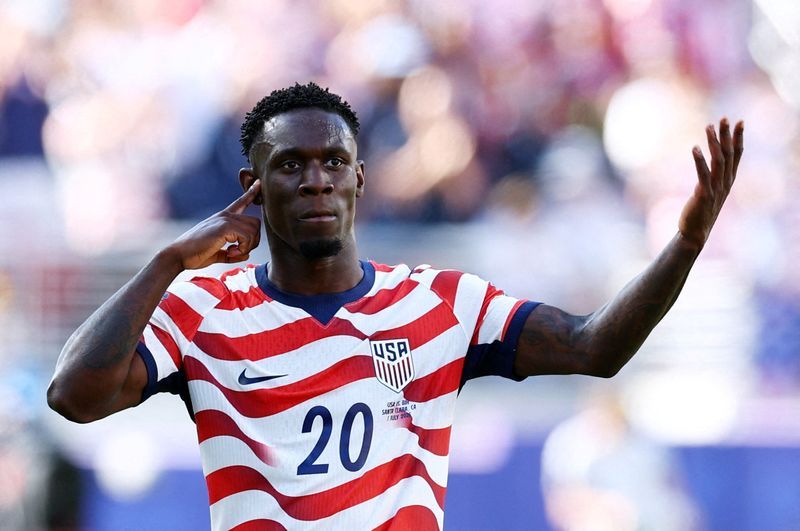
Folarin Balogun stepped onto the field for one of the most politically charged matches in recent World Cup history, caught between competing claims of nationhood, athletic ambition, and the contentious immigration debates roiling American politics. The 25-year-old striker's performance on Monday against Belgium carried implications that stretched far beyond the penalty box, after a dramatic FIFA intervention—reportedly influenced by a presidential phone call from Donald Trump—overturned a red card suspension that should have barred him from play. The timing created a peculiar irony: a politician who has campaigned relentlessly to curtail birthright citizenship found himself intervening to preserve the career of a man whose entire presence on the American team rested upon that very constitutional right.
Balogun's path to wearing the U.S. jersey defies conventional narratives of American soccer. Born in New York only because his Nigerian mother could not safely fly home while heavily pregnant, he left American soil at one month old and was raised entirely in London, developing his craft through Arsenal's storied academy system. England, Nigeria, and the United States all represented plausible destinations for his international career, yet after initially competing for England at youth level, he opted in 2023 to commit to the Stars and Stripes. He later explained that a vacation to Orlando proved decisive, claiming he witnessed the genuine passion of American supporters and felt compelled to represent their nation. This choice transformed him from an incidental American, someone who held citizenship through mere accident of birth, into a deliberate ambassador for the U.S. program.
What should have been a straightforward World Cup narrative became far more complicated when Balogun received a red card on Wednesday following a Video Assistant Referee review. The incident occurred after he planted his boot on Bosnia and Herzegovina defender Tarik Muharemovic's ankle in a challenge that appeared inadvertent, yet warranted dismissal under FIFA's strict protocols. The suspension threatened to exclude him from the crucial round-of-16 encounter with Belgium, robbing the American team of one of their tournament's most dynamic attacking threats. Balogun had emerged as the genuine breakout star of the U.S. campaign, having netted three goals and captured public imagination in ways that even the more established Christian Pulisic had not managed. Where Pulisic represented continuity and established celebrity, Balogun symbolized possibility and fresh energy for a soccer program long struggling for relevance in American sporting consciousness.
The intervention that followed stunned observers. Less than a week after the Supreme Court had dealt Trump a significant defeat by refusing to end birthright citizenship, the president personally contacted FIFA President Gianni Infantino requesting a review of Balogun's case. Though Infantino publicly denied that Trump's intervention influenced the decision, the timing proved impossible to ignore. FIFA announced on Sunday that it would suspend the World Cup ban, clearing Balogun to participate in the Belgium match. The sequence of events transformed a routine disciplinary matter into a flashpoint for America's broader identity and immigration anxieties, inadvertently positioning a soccer player as a symbol in a political struggle over who belongs to the American nation.
For immigration advocates, Balogun's story vindicated one of birthright citizenship's core premises. The Miami Herald published an editorial declaring that Balogun "prove(s) birthright citizenship isn't a loophole—it's America," capturing the sentiment of those who view unconditional birthright as fundamental to American values. Jorge Loweree, the managing director of programs at the American Immigration Council, articulated this perspective with particular clarity, describing Balogun's circumstance as an extraordinary demonstration of how birthright citizenship enables individuals to achieve excellence and contribute meaningfully to the nation. The United States stands among only 33 countries globally, predominantly clustered in the Western Hemisphere, that grant unconditional birthright citizenship—a right affirmed by an 1898 Supreme Court ruling interpreting the Fourteenth Amendment. In this sense, Balogun became not merely an athlete pursuing glory, but a living testament to a constitutional principle currently under significant political challenge.
The cultural significance of Balogun's emergence extends beyond immigration policy to encompass broader questions about American sports identity and representation. For decades, men's soccer in the United States cultivated an image as an overwhelmingly white endeavor, a sport for suburban recreational leagues rather than a pathway for diverse athletic talent. Balogun's breakthrough performance on the World Cup stage, combined with his willingness to embrace explicitly American celebrations—mimicking LeBron James's "Silencer" gesture after scoring—signaled a potential generational shift in how the sport represents itself. Even establishment figures like James recognized his significance, offering public endorsement at a moment when the player's profile was still ascending. This visibility resonated particularly strongly at a historical moment when citizenship, immigration, and American identity occupy central positions in national political discourse.
Public opinion polling suggested that Balogun's narrative aligned with majority American sentiment on birthright citizenship. A Reuters/Ipsos survey conducted earlier in the year found that most Americans opposed efforts to eliminate birthright citizenship entirely, indicating that despite vocal advocacy from Trump and allies, mainstream public opinion has not shifted decisively against the practice. This disconnect between political rhetoric and public preference created space for Balogun's story to resonate across ideological lines, even as opponents of birthright citizenship maintained their opposition on principle. The player's own lack of political awareness or commentary further diffused potential controversy, allowing supporters to project their own values onto his performance rather than engaging with explicitly political messaging.
Balogun himself appeared remarkably unfazed by the sudden elevation of his World Cup performance into a proxy battle over American identity. When a red card initially threatened his participation, teammate Christian Pulisic embraced him in solidarity, and Balogun responded by pledging his full support to teammates rather than indulging in self-pity. His subsequent clearance to play came without inflammatory statements or political posturing, maintaining a professional demeanor that enhanced rather than complicated his symbolic importance. This measured response contrasted sharply with the political machinery mobilizing around his case, suggesting that the most powerful political narratives often emerge not from deliberate messaging but from the intersection of circumstance, timing, and public receptiveness to particular symbolic narratives.
The implications of Balogun's World Cup journey extend beyond immediate tournament results to encompass questions about how nations construct belonging and how political controversies infuse ostensibly neutral sporting contexts with ideological content. Trump's intervention in a FIFA administrative decision, coupled with media coverage that explicitly framed Balogun's story through the citizenship debate, demonstrated how thoroughly politicized even athletic competition has become in contemporary America. For Malaysian and Southeast Asian observers, the episode illuminates the ways that immigration, citizenship, and national identity—longstanding concerns in this region—become contested terrain in which sports, politics, and media converge to produce meaning that transcends the boundaries of any particular sport or competition. Balogun's performance on the field would ultimately determine his legacy, but the forces that mobilized around his suspension and reinstatement had already ensured that his World Cup would be remembered less for its soccer artistry than for its unintended commentary on American political fracture.

