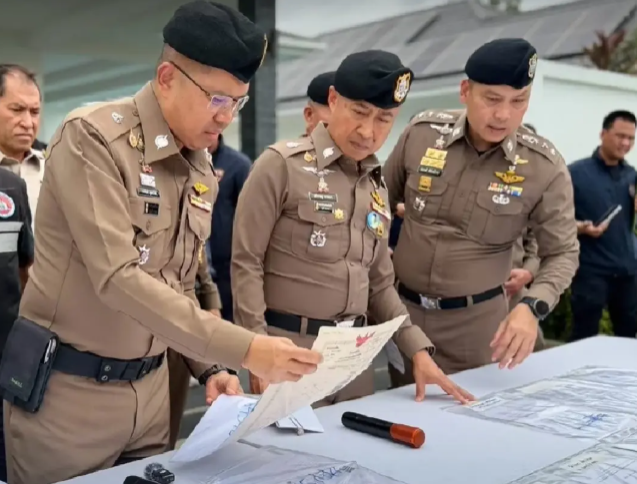
Thai police have intensified their campaign against foreign nationals circumventing property ownership laws, arresting 13 individuals during coordinated raids across Hua Hin in Prachuap Khiri Khan province on Monday. The operation, involving more than 200 police officers and government officials, represents the sixth phase of a nationwide investigation into 33 companies suspected of deploying Thai nominee shareholders to unlawfully hold valuable real estate on behalf of foreign buyers.
The detainees comprised three British nationals, four Chinese, and one each from Italy, France, the Netherlands, Austria, the Philippines, and the United States. Courts had issued arrest warrants for 45 foreigners total, though those arrested have not yet faced formal charges. The operation also resulted in police summoning 39 Thai nationals for questioning as part of the broader inquiry. The scale of the enforcement action underscores Bangkok's determination to address a persistent loophole in Thailand's foreign property restrictions, which prohibit non-citizens from owning land except in exceptional circumstances.
The focus of Monday's enforcement fell on a residential development in Thap Tai subdistrict featuring modern pool villas and detached houses valued individually at between 10 and 20 million baht. Investigators identified six companies operating within this single development allegedly employing Thai nominees as shareholders—four associated with the development's first phase and two from its second phase. The broader investigation now encompasses properties worth approximately 300 million baht spread across the 33 suspect companies identified nationwide, indicating the scale and sophistication of these arrangements.
During questioning, foreign nationals explained they sought professional advice to establish legitimate corporate structures through which to own Thai property. According to police accounts, they consulted law firms and accounting practices that purportedly assured them these arrangements would comply with Thai law. However, investigators discovered the companies involved maintained minimal operational activity and issued no legitimate business operations. The foreign purchasers appear to have believed they were navigating legal channels, though the structures themselves constituted unlawful circumvention of foreign ownership prohibitions.
Thai nationals identified as nominal shareholders presented a consistent narrative during interrogation—they had agreed to hold shares ostensibly on behalf of foreign individuals without ever paying for those shares or exercising any managerial role. These individuals claimed ignorance regarding financial documentation, company accounts, and the nature of their supposed investments. Their testimonies suggest systematic fraud wherein Thai citizens functioned as corporate puppets, lending legitimacy to foreign-controlled entities while maintaining no genuine stake or involvement. Police suspect the layered corporate architecture deliberately obscured ultimate foreign control and beneficial ownership.
The investigation extends implications beyond simple property violations. Authorities have flagged potential corruption involving government officials who may have actively assisted or negligently enabled these schemes. This dimension reflects broader concerns about regulatory capture within Thailand's land and business registration departments. Moreover, police indicated the inquiry would trace financial flows both within Thailand and internationally, potentially uncovering money laundering networks or other financial crimes connected to property acquisition schemes.
This Hua Hin operation concludes a methodical geographic expansion. The campaign commenced on Koh Phangan in Surat Thani, examining nominee companies and professional service networks. Phase 3 extended investigations to Phuket, Phang Nga, and Krabi, where 89 properties valued exceeding 1.05 billion baht came under scrutiny. Chonburi became the focus of Phase 4, followed by Phase 5 in Chiang Mai, which examined 31 companies and 29 land plots worth some 633 million baht. Collectively, the first five phases reviewed 233 land parcels and buildings spanning over 25.6 hectares with a combined estimated value of 2.539 billion baht.
The enforcement results demonstrate escalating legal consequences. Previous phases generated 133 approved arrest warrants, with 20 cases culminating in convictions. This judicial follow-through suggests authorities possess sufficient evidence to pursue prosecutions beyond arrests, though gaps between warrant issuance and final adjudication indicate Thailand's overburdened court system remains a constraint. Despite legal victories, the identification of hundreds of properties nationwide suggests enforcement represents merely the visible portion of a larger underground market.
For Malaysia and Southeast Asian observers, Thailand's nominee crackdown carries instructive implications. Property investment across ASEAN often involves complex cross-border corporate structures and nominee arrangements, particularly in Thailand, Vietnam, and Cambodia. Thailand's aggressive enforcement signals that even popular tourist destinations increasingly scrutinise foreign property transactions. Malaysian investors and expatriates engaged in Thai property markets must now verify their arrangements through reputable legal counsel and ensure genuine business operations underpin corporate holdings. The targeting of professional service providers—law and accounting firms—establishes precedent for holding intermediaries accountable, potentially influencing practices across the region.
Police emphasised the campaign targets illicit nominee schemes specifically rather than legitimate foreign investment complying with Thai law. Registered foreign companies and properly constituted joint ventures with Thai partners remain permissible. However, the distinction between lawful and unlawful structures increasingly depends on demonstration of genuine business operations and Thai nationals exercising authentic shareholding roles. Foreign investors should document legitimate business purposes, maintain transparent financial records, and ensure Thai nominees possess actual decision-making authority.
The Royal Thai Police announced the crackdown would continue nationwide, particularly focusing on tourist destinations where foreign property demand concentrates. Authorities established a dedicated hotline (1599) for public reporting of suspected illegal foreign business activity. This crowd-sourcing mechanism reflects resource constraints but also indicates political commitment to sustained enforcement. The campaign's expansion across six phases over months suggests this represents institutional priority rather than temporary enforcement intensity.
For Southeast Asian policymakers and investors, Thailand's approach raises questions about balancing foreign investment attraction against property nationalism. Strict enforcement of nominee prohibitions protects Thai national interests but may deter legitimate foreign direct investment in property development and tourism. Malaysia, having more permitting avenues for foreign property ownership through designated zones and property types, presents a relatively welcoming contrast. However, Malaysian authorities similarly monitor nominee arrangements and financial crimes, suggesting regional convergence toward tighter foreign property regulation amid concerns about capital flight, money laundering, and speculative investment.
The investigation's ongoing nature means additional arrests and prosecutions will likely emerge as police complete financial analysis and trace international connections. Foreign nationals currently facing investigations should anticipate prolonged legal processes and potential asset freezing. The broader implications extend to Thailand's regional investment reputation, suggesting investors require enhanced due diligence when navigating property acquisitions, particularly through corporate intermediaries or unfamiliar professional advisers.

