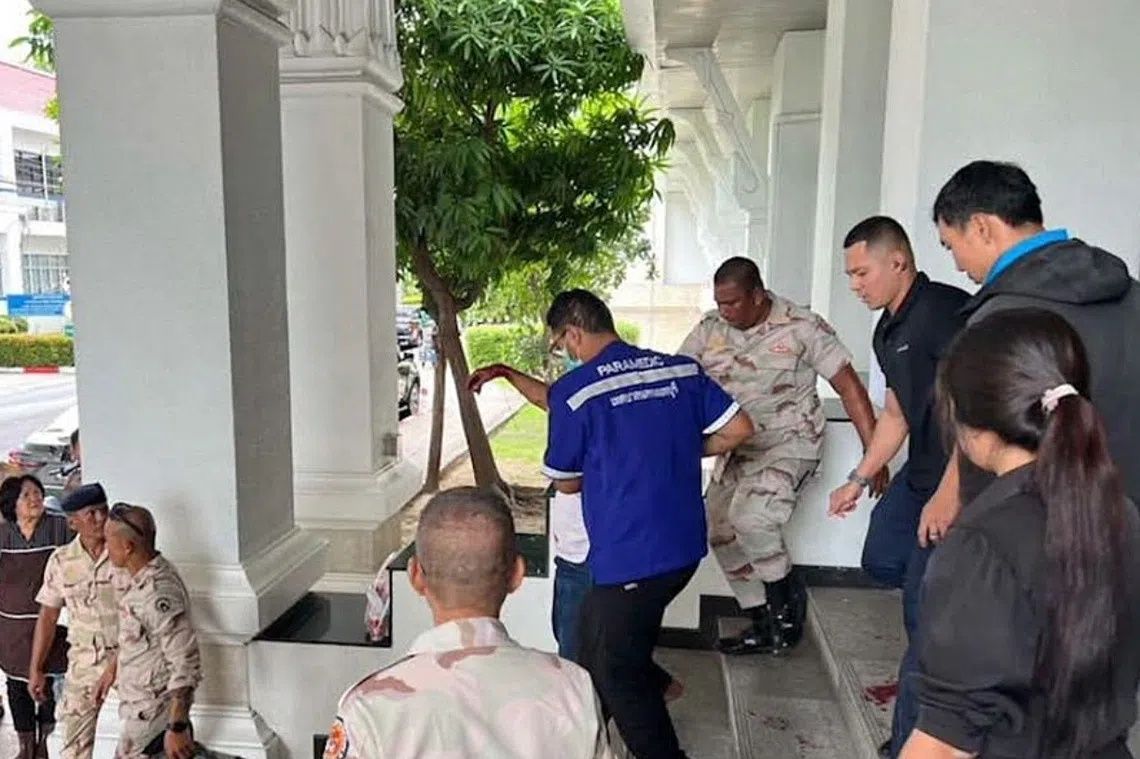
Thailand's fragile recovery from one of its worst mass shootings suffered a fresh blow on Monday when a gunman unleashed gunfire at a local government office on Bangkok's outskirts, wounding two officials and underscoring the country's persistent struggle with firearms violence. The arrest of the suspected shooter—identified as a former lawmaker—came just days after a teenager's rampage at a school in the same province left nine people dead and more than twenty injured, forcing the nation to confront uncomfortable questions about access to weapons and the adequacy of existing safety measures.
Major General Dejrapee Kongdee, the provincial police commander, confirmed that the alleged attacker targeted a senior provincial official and his driver at the government office. Both victims were transported to hospital for medical care, though authorities provided limited details about the severity of their conditions. The timing of the incident—occurring in Nonthaburi Province, where the school shooting took place just seventy-two hours earlier—appeared unlikely to be coincidental, raising concerns about potential copycat incidents or a broader escalation in violent crime.
The shooting at Debsirin Nonthaburi School on Friday represented Thailand's deadliest mass shooting event in nearly four years. A fourteen-year-old boy allegedly murdered his grandparents before arriving at the school and conducting a sustained assault that left nine people dead, with over twenty others sustaining injuries. The teenager then turned the weapon on himself, ending the rampage and sparking immediate national outcry. The incident shattered Thailand's relative calm on the firearms front and dominated media coverage and public discourse in ways that transcended typical crime reporting.
The back-to-back nature of these incidents has created palpable anxiety among Thai society, particularly among parents and educators. Schools in the affected regions have hastily implemented enhanced security protocols, with students passing through metal detectors and undergoing additional screening procedures as they returned to classrooms on Monday. These visible security measures serve as stark reminders of the vulnerability that educational institutions now confront, forcing administrators and families alike to grapple with the uncomfortable reality that traditional school environments no longer feel entirely safe.
Prime Minister Anutin Charnvirakul seized upon the moment to reassert his government's commitment to addressing Thailand's gun problem. He reiterated his administration's intention to implement tighter gun control measures, signalling that the threshold for legislative action had been reached. His statements reflected broader political recognition that the public appetite for meaningful change had reached a critical point, with constituents increasingly demanding government intervention to prevent future tragedies of this magnitude.
The dual shooting incidents have revived debate that periodically surfaces in Thai public discourse regarding civilian firearms access, licensing procedures, and enforcement mechanisms. Gun ownership in Thailand is regulated but not prohibited for civilians, and critics have long contended that the licensing regime contains gaps that enable weapons to fall into dangerous hands. The school shooting and subsequent government office attack provided concrete evidence that regulatory deficiencies exist, even if comprehensive solutions remain elusive.
The fourteen-year-old shooter's access to firearms raises questions about household gun storage, parental supervision, and whether background checks or psychological evaluations caught warning signs before the attack occurred. Thai authorities have conducted preliminary investigations but have released limited information about how the teenager obtained the weapon or whether he displayed behavioral indicators that might have prompted intervention. These investigative gaps matter not merely for post-incident accountability but for understanding whether systemic failures facilitated the tragedy.
For Malaysia and other Southeast Asian nations watching Thailand's experience, the episodes offer instructive cautionary lessons. While Malaysia maintains its own firearms regulations through the Arms Act and related legislation, the Thai precedent demonstrates how quickly situations can escalate even in countries with ostensibly moderate gun ownership rates. Mass shooting incidents remain statistically rare in Southeast Asia compared to some Western countries, but their rarity does not render them impossible or inevitable, particularly as urbanization, social stress, and access to weapons converge in unexpected ways.
The political response in Thailand will likely influence regional conversations about gun policy. If Prime Minister Anutin's government successfully implements meaningful legislative reforms—whether through stricter licensing requirements, enhanced background check procedures, more stringent storage obligations, or other measures—the outcomes will receive attention from policymakers across Southeast Asia. Conversely, if the government's announced intentions falter or produce limited results, that outcome would suggest the formidable political obstacles that gun control reform encounters even after high-casualty events.
As Thai society processes the dual traumas of these shooting incidents, fundamental questions about the relationship between armed civilian populations and public safety remain contested. The teenagers returned to school, the wounded recovered in hospitals, and the political machinery activated familiar processes of investigation and reform rhetoric. Yet whether these mechanisms will produce substantive change that genuinely reduces future violence—or whether Thailand will cycle through this pattern again—remains to be determined by the government's subsequent actions and the sustainability of current public pressure for legislative action.

