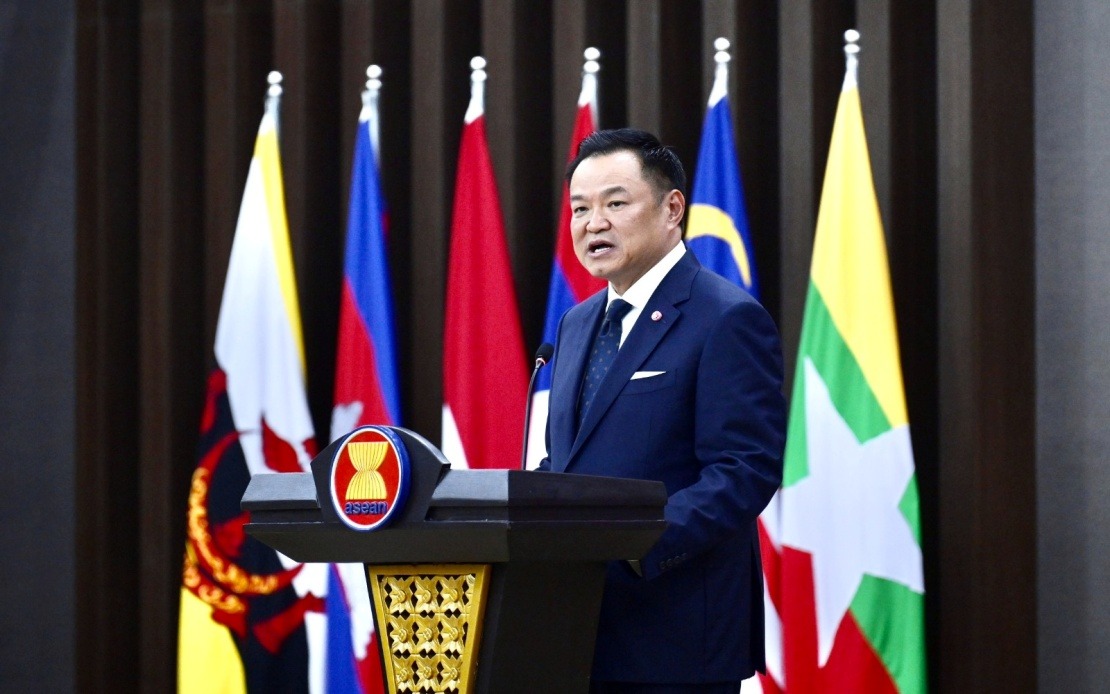
During an address at the ASEAN Secretariat in Jakarta, Thai Prime Minister Anutin Charnvirakul unveiled a comprehensive three-point agenda for reshaping Southeast Asia's regional bloc, urging members to prioritize institutional strength, practical resilience, and genuine improvements in the lives of ordinary citizens. The visit marked Anutin's first official trip to Indonesia since assuming office as Thailand's 32nd prime minister in September 2025, and notably represents the first such high-level bilateral engagement between a Thai premier and Jakarta in fifteen years, signalling renewed emphasis on strengthening Bangkok's relationship with its most populous neighbour.
Anutin's vision rests on the premise that contemporary regional challenges spanning geopolitical competition, economic volatility, technological disruption, and security threats cannot be tackled by individual nations acting in isolation. This framing carries particular weight for Malaysia and other middle-sized Southeast Asian economies caught between great-power competition and economic interdependencies. The Thai leader argued that ASEAN's credibility hinges on developing collective responses that pool resources and expertise across borders, essentially articulating a defence of multilateralism at a time when unilateral approaches gain traction globally.
Central to Anutin's prescription is the question of ASEAN's founding principles, particularly the consensus rule and non-interference doctrine that have defined the bloc's decision-making culture since 1967. Rather than abandoning these principles, the Thai premier proposed applying them with greater flexibility, suggesting that rigid adherence to consensus has sometimes paralysed ASEAN's capacity to respond swiftly to crises. This proposition will resonate with those who have watched ASEAN struggle over Myanmar, where consensus requirements have constrained unified action. The implicit message is that procedural adaptation need not undermine the spirit of ASEAN cooperation but might actually strengthen it by enabling faster, more coordinated responses.
The prime minister outlined concrete priorities that reflect genuine Southeast Asian concerns. Supply chain diversification has become urgent following global disruptions and as major economies move to reduce dependence on China. Food and energy security sits atop many regional agendas, particularly for nations vulnerable to price shocks and import dependencies. Digital connectivity remains uneven across ASEAN despite the region's young, tech-savvy population, while skills gaps threaten to widen as artificial intelligence and automation reshape labour markets. By elevating these issues, Anutin framed ASEAN's future in practical, development-oriented terms rather than zero-sum geopolitical competition.
Anutin's emphasis on measuring ASEAN's success through tangible citizen benefits represents a subtle shift in how Bangkok wants the bloc evaluated. Rather than assessing ASEAN primarily through diplomatic statements and institutional mechanisms, this approach asks whether ordinary people experience improved economic opportunities, greater safety from transnational crime, and more effective governance. Such framing could inspire Malaysian policymakers to demand accountability from regional institutions and might encourage ASEAN to focus on issues like human trafficking, drug smuggling, and cybercrime that directly affect public welfare across borders.
The Thai premier stressed that ASEAN must adopt a proactive rather than reactive posture, preparing for anticipated challenges rather than scrambling to respond after crises erupt. This prescient approach reflects lessons from the pandemic, financial crises, and security emergencies that have repeatedly caught ASEAN relatively unprepared. Advance planning for supply chain disruptions, pandemic preparedness, climate adaptation, and cybersecurity threats would represent a maturation of ASEAN's institutional capacity and a departure from the crisis-driven mode that has often characterized regional responses.
Regarding Myanmar, Anutin reaffirmed Thailand's support for ASEAN's Five-Point Consensus while advocating measured re-engagement rather than isolation. He cited the International Committee of the Red Cross' recent visit to detained former State Counsellor Aung San Suu Kyi as evidence that dialogue-based approaches can yield incremental progress. This calibrated stance reflects Bangkok's geographical proximity to Myanmar and its pragmatic assessment that confrontation yields little leverage, while maintaining contact preserves channels for future influence. For Malaysia and other ASEAN members, this suggests Thailand believes Myanmar's trajectory should not be abandoned but patiently negotiated.
Anutin's remarks on Cambodia underscore Thai commitment to bilateral reconciliation and regional peace frameworks. By pledging to rebuild mutual trust and resolve differences peacefully under international law, the Thai PM signalled that neighbouring disputes, while real, need not permanently damage ASEAN cohesion. This approach models the kind of patient diplomacy that could benefit broader Southeast Asian stability, particularly given maritime boundary questions and historical tensions that periodically surface across the region.
The timing of Anutin's Jakarta visit and his emphasis on ASEAN's upcoming 60th anniversary next year suggests Thailand intends to position itself as a champion of institutional renewal. For Malaysia, which itself holds rotating ASEAN chairmanships and routinely grapples with coordination challenges, Thai leadership on these issues offers both partnership opportunities and implicit pressure to match Bangkok's ambitions for regional transformation. The next fifteen months will test whether ASEAN's member states can operationalize Anutin's vision or whether procedural obstacles and competing national interests will again frustrate collective action.

