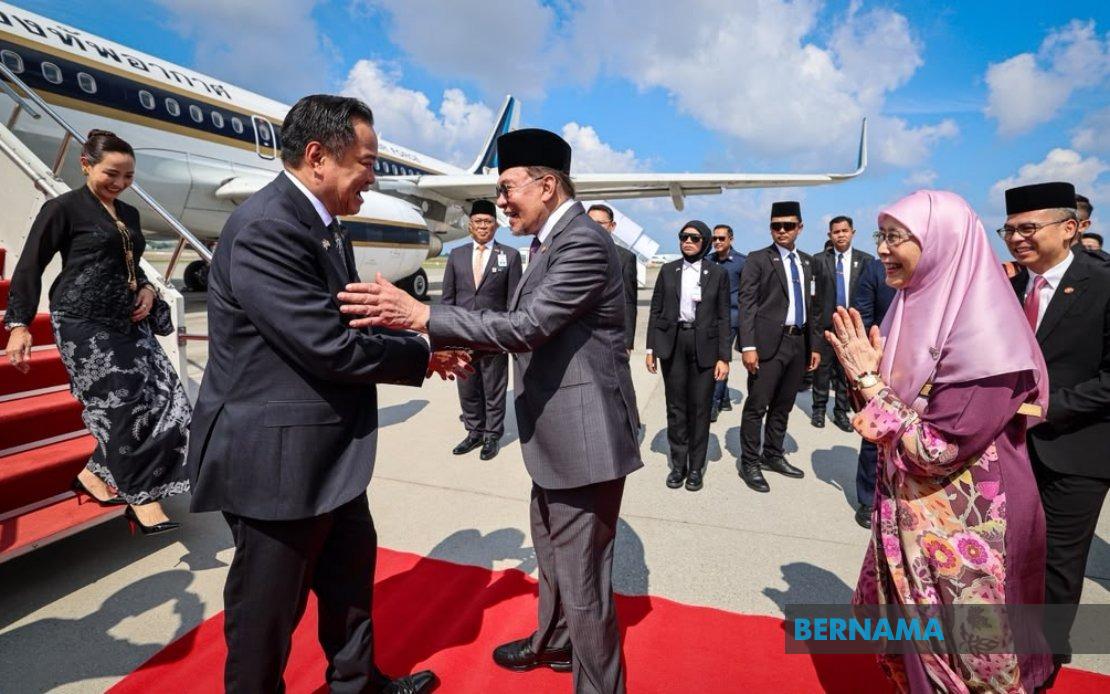
Thailand's Prime Minister Anutin Charnvirakul touched down at Kuala Lumpur International Airport on July 9, beginning a two-day official visit that underscores the deepening diplomatic ties between two of Southeast Asia's most economically significant neighbours. Anutin, accompanied by his spouse Thananon Charnvirakul, landed at the Bunga Raya Complex at 11.11 am, where he received a formal welcome from Malaysian Prime Minister Datuk Seri Anwar Ibrahim. The arrival marked the first visit to Malaysia by the Thai leader since his reappointment to office in March 2026, signalling renewed commitment to strengthening bilateral relationships across multiple sectors.
The ceremonial dimensions of the visit reflected the importance both governments place on their relationship. A full honour guard comprising 34 officers and personnel from the First Battalion of the Royal Ranger Regiment, commanded by Major Muhammad Nur Addeen Mustaza, saluted the Thai delegation. The traditional playing of both nations' national anthems followed, while Anutin was introduced to Malaysia's cabinet ministers and senior government officials. The presence of Prime Minister Anwar's wife, Datuk Seri Dr Wan Azizah Wan Ismail, and Communications Minister Datuk Fahmi Fadzil, who served as the receiving minister, emphasised the high-level nature of the engagement.
During his time in Malaysia, Anutin will participate in substantive bilateral discussions with Anwar at Perdana Putra, the official residence of the Prime Minister. These conversations are expected to review the trajectory of Malaysia-Thailand cooperation and identify avenues for expanded partnership. A particularly significant element involves the witnessing of a memorandum of understanding on agricultural cooperation, a sector where both nations recognise substantial mutual benefit. This agreement reflects each country's agricultural capabilities and the opportunities for knowledge exchange and market integration in food production and trade.
The economic relationship between Malaysia and Thailand has grown markedly in recent years. During 2025, Thailand ranked as Malaysia's sixth-largest trading partner globally and its second-largest partner within ASEAN, with bilateral commerce reaching RM118.57 billion—equivalent to approximately US$27.73 billion. This substantial figure demonstrates the degree to which their economies are intertwined, extending across manufacturing, agriculture, services, and energy sectors. For Malaysian businesses and investors, Thailand represents a crucial market and production hub, while Thai enterprises similarly view Malaysia as an essential gateway to broader Southeast Asian opportunities.
The momentum in trade has accelerated into 2026. Between January and March this year, bilateral commerce totalled RM31.33 billion, or US$7.90 billion, surpassing the comparable quarter in 2025 when trade stood at RM27.35 billion (US$6.15 billion). This year-on-year increase of roughly 14.5 percent signals robust economic activity and growing confidence among businesses in both countries. For Malaysian importers and exporters, this trajectory suggests a strengthening market environment, though it also reflects competitive pressures requiring continuous innovation and efficiency improvements.
On July 10, the two Prime Ministers will travel together to Bukit Kayu Hitam in Kedah, a location of profound symbolic and practical importance. There they will officially open a new road connection linking Malaysia's Immigration, Customs, Quarantine and Security Complex in Bukit Kayu Hitam with Thailand's corresponding Customs, Immigration and Quarantine Complex in Sadao. This infrastructure project represents more than mere physical connectivity; it embodies the commitment both nations have made to facilitate smoother, faster cross-border movement of goods, services, and people. The road opening acknowledges the reality that Malaysia and Thailand share not merely a border but interwoven supply chains and millions of residents whose livelihoods depend on efficient regional trade.
The Bukit Kayu Hitam-Sadao corridor represents one of Southeast Asia's busiest land crossing points. Enhancing the infrastructure here carries implications extending far beyond bilateral trade, affecting the entire ASEAN region's logistics networks. Improved border efficiency reduces transaction costs, shortens transit times, and increases the competitiveness of the region globally. Malaysian exporters shipping goods northward and Thai producers reaching southern markets both benefit from streamlined procedures and reduced bureaucratic delays. For manufacturers operating in border regions, the impact translates directly into improved profit margins and enhanced market access.
Agricultural cooperation, highlighted through the MoU signing, warrants particular attention given the sector's importance to both nations and the region. Thailand ranks among the world's largest producers of rice, cassava, and processed agricultural products, while Malaysia maintains significant output in palm oil, rubber, and seafood. Climate vulnerabilities and the imperative to improve food security across Southeast Asia have elevated agricultural cooperation to strategic importance. Collaboration in farming techniques, pest management, agricultural research, and market development can enhance productivity for both countries while contributing to regional food resilience.
Anwar's hosting of a luncheon at the Seri Perdana Complex for Anutin and his delegation follows diplomatic protocol while providing an informal setting for relationship-building. Such occasions frequently generate the personal rapport between leaders that facilitates smoother handling of bilateral issues and creates frameworks for addressing potential disagreements constructively. Given the complexity of Malaysia-Thailand relations, which encompass not only trade and investment but also security matters, irregular migration, and transnational crime, the investment in personal diplomatic relationships proves invaluable.
The broader context surrounding this visit includes regional dynamics affecting both nations. ASEAN solidarity remains important as the bloc navigates geopolitical pressures from major powers and addresses internal challenges ranging from inequality to climate change. Malaysia and Thailand, as significant ASEAN members with substantial economies and influence, play crucial roles in maintaining bloc cohesion and advancing regional interests. Strengthening their bilateral relationship reinforces ASEAN's collective capacity to address shared challenges and pursue joint opportunities in an increasingly complex international environment.
For Malaysian observers, Anutin's visit represents an opportunity to assess the health of one of the country's most important regional relationships. Trade data shows the partnership remains economically robust, while the ceremonial and substantive elements of the visit demonstrate continued political commitment from both sides. The infrastructure initiatives and agricultural cooperation agreements under discussion promise tangible benefits for businesses and citizens on both sides of the border. However, persistent challenges including irregular migration flows, environmental management in shared river basins, and coordination on regional security matters require ongoing attention and dialogue, precisely the type of engagement this visit facilitates.

