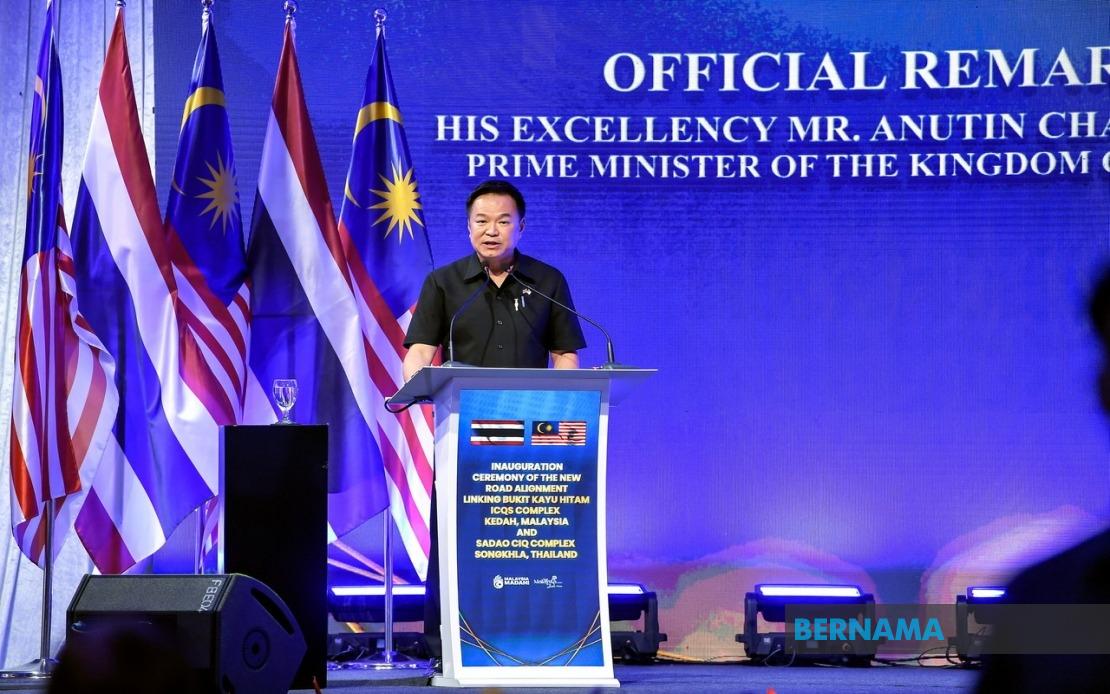
Thai Prime Minister Anutin Charnvirakul has reaffirmed his government's commitment to completing all missing transport links that will facilitate the smooth flow of trade and people between Malaysia and upper Thailand, with the ultimate goal of extending these economic corridors to China and Russia. Speaking at the inauguration of a new road alignment at the Malaysia-Thailand border in Bukit Kayu Hitam on July 10, Anutin emphasised that closing these infrastructure gaps represents a cornerstone of bilateral economic strategy and regional integration efforts.
The new road connection linking the Sadao Customs, Immigration and Quarantine (CIQ) Complex in Thailand to the Bukit Kayu Hitam Immigration, Customs, Quarantine and Security (ICQS) Complex in Kedah exemplifies the tangible results of coordinated government action between Bangkok and Kuala Lumpur. This project emerged from sustained dialogue and demonstrates both nations' resolve to transform border crossing procedures from bottlenecks into efficient commercial gateways. The ceremonial opening, jointly officiated by Anutin and Malaysian Prime Minister Datuk Seri Anwar Ibrahim, underscored the political significance attached to deepening bilateral transport infrastructure.
For Malaysian stakeholders, the implications are substantial. The Bukit Kayu Hitam crossing currently handles the heaviest traffic volume along the entire Malaysia-Thailand border, meaning that congestion relief here could yield immediate benefits for logistics operators, manufacturers dependent on cross-border supply chains, and commuters. By reducing transit delays and administrative friction at this critical chokepoint, the new alignment promises faster delivery times and lower operational costs for businesses spanning both nations. The efficiency gains extend beyond bilateral trade to encompass the broader regional network, where Malaysia functions as a crucial transit hub linking Southeast Asian production centres to Singapore and Indonesia.
Thailand's broader vision encompasses bidirectional trade flows. Anutin articulated a commitment to facilitating not only Malaysian and Chinese goods moving northward through Thai territory, but also enabling Thai and Chinese products to traverse Malaysia toward Singapore and Indonesian markets. This reciprocal approach reflects recognition that infrastructure investment generates mutual economic returns rather than favouring one party. The interconnected nature of Southeast Asian supply chains means that transportation improvements benefiting northbound traffic simultaneously enhance southbound logistics, multiplying the value creation for all participants.
Beyond the immediate Bukit Kayu Hitam project, Thai officials have signalled their intention to pursue additional connectivity initiatives. Proposed improvements spanning the Songkhla-Kedah, Satun-Perlis, and Narathiwat-Kelantan border regions would create multiple redundant pathways for trade and travel, reducing congestion risks and offering businesses alternative routes. These initiatives hold particular significance for Malaysia's northern states and Thailand's southern provinces, regions that historically lag their respective nations' more developed central areas. Enhanced connectivity promises to redistribute economic opportunities, potentially catalysing manufacturing clusters, agricultural processing hubs, and tourism development in peripheral border communities.
The economic rationale underlying this infrastructure push centres on unlocking dormant potential within southern Thailand and northern Malaysia. Both regions possess manufacturing capabilities, agricultural resources, and tourism assets that remain underutilised due to connectivity constraints. When transport barriers diminish, regional supply chains consolidate, investment flows accelerate, and employment opportunities multiply. The creation of formal cross-border economic zones has proven effective in similar contexts across Southeast Asia, suggesting that Thailand and Malaysia may move toward establishing such mechanisms to complement their improved physical infrastructure.
From Malaysia's perspective, accepting Thai infrastructure improvements also addresses internal policy objectives. The country has consistently advocated for enhanced Regional Comprehensive Economic Partnership (RCEP) implementation and deepened ASEAN connectivity initiatives. By supporting Thailand's transport expansion plans, Malaysia reinforces its positioning as a regional integration champion whilst simultaneously benefiting from reduced trade friction. For Malaysian manufacturers seeking to access Thai and Chinese markets, improved border infrastructure directly translates into competitive advantages through lower logistics costs and faster time-to-market.
Anutin's emphasis on simplified border procedures and facilitated people movement carries political weight extending beyond commerce. Enhanced cross-border mobility strengthens people-to-people connections between Malaysian and Thai communities, fostering cultural understanding and reducing friction points that occasionally emerge along the border. Tourism flows, educational exchanges, and family visits all benefit from smoother passage procedures. The reduction of bureaucratic complexity at border checkpoints improves traveller experience whilst legitimising government efficiency narratives in both capitals.
However, successful implementation faces several challenges. Transport infrastructure projects often encounter delays due to environmental assessments, community consultations, and budgetary constraints. Thailand's political environment, marked by periodic institutional instability, occasionally disrupts long-term policy continuity. Additionally, while both governments have articulated commitments, translating these into coordinated action across multiple border points requires sustained bureaucratic coordination and political attention. Malaysian and Thai officials must maintain momentum despite competing domestic priorities and potential shifts in political leadership.
The broader geopolitical context also shapes these initiatives. China's Belt and Road Initiative has positioned connectivity as a strategic priority across Southeast Asia, and both Thailand and Malaysia recognise the importance of positioning their territories as attractive transit corridors. By improving bilateral transport links, Thailand and Malaysia enhance their appeal to Chinese investors and traders seeking efficient conduits through Southeast Asia. Simultaneously, these projects strengthen ASEAN unity by demonstrating member states' commitment to regional integration architecture.
Looking forward, the success of current initiatives will determine whether Malaysia and Thailand can expedite work on remaining missing links. The political goodwill evident in Anwar and Anutin's public statements requires translation into budget allocations, project timelines, and sustained governmental attention. For Malaysian businesses, government support for cross-border infrastructure represents an opportunity to diversify supply chains, access new markets, and reduce operational expenses. The challenge lies in ensuring that efficiency gains from improved infrastructure translate into tangible economic benefits for businesses and communities in both nations, rather than merely facilitating commerce without generating local prosperity.
The inauguration of the Bukit Kayu Hitam-Sadao road alignment signals renewed momentum toward comprehensive Malaysia-Thailand connectivity. Whether this momentum proves sustainable will substantially influence regional trade dynamics, investment patterns, and the practical functionality of Southeast Asian economic integration aspirations that remain incomplete despite years of regional cooperation frameworks.

