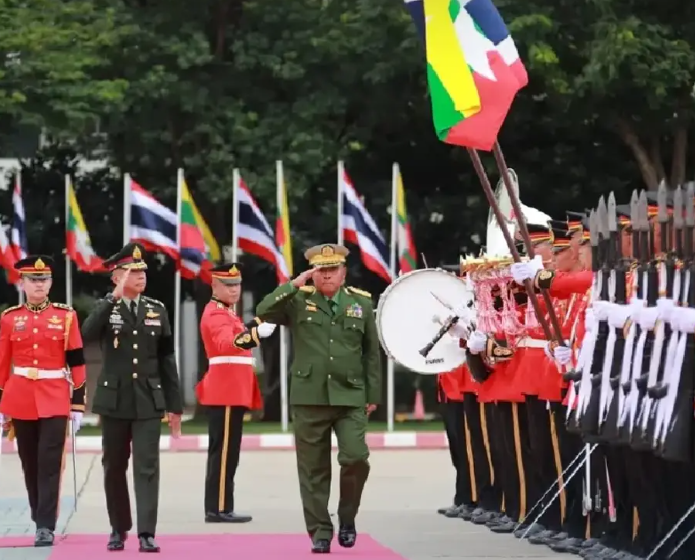
Thailand rolled out a diplomatic welcome for Myanmar's military chief Ye Win Oo on Thursday, hosting what amounts to a symbolic reset between two neighbouring armed forces as Myanmar's post-coup leadership attempts to normalise its standing in the region. The visit to Bangkok represents Ye Win Oo's first official foreign trip since taking over as military leader, underscoring Myanmar's intensifying effort to climb out of international isolation that has lasted since the 2021 military coup that upended civilian rule and precipitated a prolonged civil conflict.
The trajectory of Myanmar's military hierarchy has shuffled considerably in recent months following the deeply contentious elections held around the start of 2026. Min Aung Hlaing, the General who orchestrated the coup and held the top military position for years, transitioned to the civilian presidency after the voting concluded, while Ye Win Oo, regarded as a dependable ally of the ruling junta, assumed the position of military chief. This manoeuvre, while technically repositioning the coup architect into a civilian role, has been widely dismissed by international observers as window-dressing that perpetuates military dominance through alternative channels rather than genuinely restoring democratic governance.
Thursday's engagement between Thai military chief Ukris Boontanondha and his Myanmar counterpart took place in a Bangkok hotel and represents the kind of pragmatic bilateral engagement that regional neighbours have begun to adopt toward Myanmar's junta. The two nations share an extensive 2,400-kilometre border that has become increasingly destabilised by Myanmar's ongoing internal conflict, which has fractured into a full-scale civil war since the 2021 coup. Border security, refugee flows, and cross-boundary militant activity are expected to dominate the discussions, reflecting the concrete regional challenges that supersede broader questions about democratic legitimacy in Thai-Myanmar relations.
Ye Win Oo brings significant baggage to his military leadership role. Before ascending to the top military position, he served as a spymaster within Myanmar's authoritarian apparatus and has been targeted with sanctions by the United States and other Western nations specifically because of his instrumental role in engineering and supporting the 2021 coup. His appointment to lead Myanmar's armed forces is viewed by democracy advocates as further evidence that the junta has merely reshuffled personnel while maintaining complete control over state apparatus and decision-making structures.
The diplomatic opening from Thailand arrives amid deepening international division over how to respond to Myanmar's military establishment. While Western governments and human rights organisations have taken a hardline stance, characterising the 2026 elections as a fraudulent exercise designed to legitimise military autocracy while sidelining popular figures like ousted leader Aung San Suu Kyi, Southeast Asian neighbours sharing borders with Myanmar have adopted a more transactional approach. Thailand's position exemplifies this regional calculus—Thai Foreign Minister Sihasak Phuangketkeow justified hosting Myanmar's military leaders by stating the decision hinged on "reality" rather than "legitimacy," suggesting that practical considerations regarding border management and regional stability take precedence over democratic principles.
This month alone, Thailand extended a high-profile reception to Min Aung Hlaing, the civilian president and original coup architect, followed now by the hosting of Ye Win Oo. These consecutive diplomatic gestures signal a deliberate Thai strategy to re-engage Myanmar's military leadership as a stabilising counterbalance to the civil war unfolding within Myanmar's borders. For Thailand, which confronts the humanitarian and security consequences of Myanmar's conflict firsthand through refugee populations and cross-border instability, maintaining functional relationships with whoever controls Myanmar's military apparatus appears to trump ideological objections to authoritarian governance.
The human toll of Myanmar's post-coup turmoil remains staggering. The ongoing civil war has claimed an estimated 100,000 lives, displacing hundreds of thousands more and creating a humanitarian catastrophe across multiple regions of Myanmar. The conflict has pitted the military against various armed resistance movements that emerged following the coup, creating a fragmented security landscape where civilian populations bear disproportionate harm. This backdrop of sustained violence and displacement forms the essential context for understanding why neighbouring nations like Thailand view direct engagement with Myanmar's military as strategically necessary rather than merely optional.
However, the timing of these diplomatic overtures carries troubling implications when examined against recent documentation of military abuses. UN investigators released findings just last week detailing an escalating pattern of aerial bombardments targeting civilian infrastructure and populations, alongside systematic arbitrary detention, torture, and sexual violence perpetrated by Myanmar's military forces. These allegations contradict Myanmar's government characterisation of UN findings as "one-sided" and based on "unverifiable and inaccurate information," yet they provide a sober accounting of the military apparatus that Thailand and other regional neighbours are now embracing.
Civil society organisations have responded with sharp criticism of this diplomatic realignment. The Special Advisory Council for Myanmar condemned Thailand's approach as effectively legitimising military rule, stating this week that by receiving Myanmar's military leaders, Thailand has "torched its credibility" in the eyes of democracy advocates and that allowing Ye Win Oo's visit compounds this damage by "adding to its ignominy." This assessment reflects a fundamental tension between regional pragmatism and democratic solidarity—neighbouring countries acknowledge they must manage relations with Myanmar's military reality, yet this necessity comes at a considerable cost to regional leadership credibility on human rights and democratic governance.
The broader implications of Myanmar's post-coup diplomatic rehabilitation extend throughout Southeast Asia and signal how regional strategic interests can override international human rights norms. If Myanmar's military successfully leverages the 2026 elections as a platform to normalise international relations and gradually restore trade, investment, and diplomatic standing despite widespread fraud allegations and ongoing atrocities, it establishes a concerning precedent for how military-led governments can rehabilitate their image through election cosmetics and border pragmatism. For Malaysian observers, this development underscores the complex balancing act required when neighbouring nations undergo authoritarian transitions—maintaining necessary bilateral relationships while declining to endorse the legitimacy of fundamentally flawed governance structures presents an ongoing diplomatic challenge for the region.

