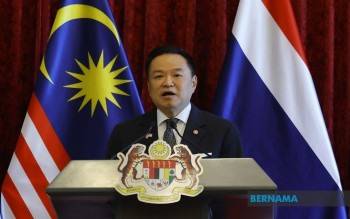
Thailand's Prime Minister Anutin Charnvirakul has expressed strong confidence that the kingdom will reach its ambitious US$30 billion bilateral trade target with Malaysia by 2027, signalling the accelerating economic momentum between two of Southeast Asia's most significant trading economies. Speaking at a joint press conference with Prime Minister Datuk Seri Anwar Ibrahim following an MoU exchange ceremony at Perdana Putra Complex in Putrajaya on July 9, Anutin underscored the robust health of current bilateral commercial ties and indicated that the milestone is well within reach given the active cooperation both nations are pursuing.
With bilateral trade between the two countries currently hovering near approximately US$28 billion, the additional US$2 billion increase represents a modest but meaningful target that reflects Malaysia's established position as Thailand's largest trading partner within the ASEAN bloc. The proximity of current figures to the ultimate goal demonstrates that the target is neither unrealistic nor overly ambitious, but rather represents a natural progression of existing commercial relationships and expanding market opportunities. This trajectory suggests that both governments view the trade expansion not as a dramatic overhaul but as a consolidation of existing strengths and a methodical deepening of sectoral cooperation.
The Thai premier's optimism appears grounded in concrete plans to further institutionalise trade cooperation between the nations. Anutin indicated that officials from both countries will convene through the joint trade committee mechanism to establish fresh, more comprehensive trade targets that will supersede the current US$30 billion objective. This forward-looking approach suggests that policymakers anticipate sustained economic growth and deeper integration across multiple industries, requiring periodic recalibration of bilateral goals to reflect evolving capabilities and market dynamics.
Thailand has signalled particular emphasis on leveraging the complementary economic strengths of both nations to enhance regional value chains and supply chain networks. This strategic positioning reflects a broader Southeast Asian trend towards deepening intra-regional economic interdependence and reducing reliance on distant markets. By building on areas where each nation possesses distinctive competitive advantages, the two countries aim to create integrated production networks that benefit businesses and consumers throughout the region whilst simultaneously strengthening their respective positions in global commerce.
Among the priority sectors identified for intensified cooperation, food security emerges as a critical focus area—a dimension that carries particular resonance for Malaysia, a significant food importer that depends heavily on regional suppliers. Energy security represents another cornerstone of the bilateral agenda, reflecting both nations' geographic and economic vulnerabilities in an era of volatile global energy markets and the region's transition towards more sustainable power generation. The emphasis on digital economy development and high-technology industries signals recognition that manufacturing-led growth strategies must evolve towards higher-value services and innovation-driven sectors to maintain competitiveness in an increasingly knowledge-intensive global economy.
Prime Minister Anwar Ibrahim committed Malaysia's full institutional weight towards achieving the bilateral trade target, with both the Ministry of Foreign Affairs and the Ministry of Investment, Trade and Industry designated as lead agencies. This ministerial-level coordination underscores the significance that Kuala Lumpur attaches to deepening economic relations with Bangkok and suggests that trade expansion will not be left to market forces alone but will be actively nurtured through government facilitation and strategic policy alignment. The involvement of MITI particularly signals that Malaysia views the relationship as integral to its broader economic transformation agenda.
Anwar articulated a philosophy that elevates trade and economic cooperation as foundational elements for strengthening bilateral friendship and expanding collaboration across multiple domains beyond commerce. His reference to tourism alongside trade and investment indicates recognition that modern economic partnerships extend beyond traditional merchandise exchange to encompass services, cultural exchange, and people-to-people connectivity. This holistic approach reflects evolving understanding that sustainable regional relationships require multifaceted engagement across economic, social, and cultural dimensions.
Anutin's two-day official visit to Malaysia, which commenced on July 9 at Kuala Lumpur International Airport at 11.11 am, represents his first trip to Malaysia since his reappointment as Thailand's prime minister in March 2026. The significance of this inaugural visit since his return to office underscores the importance both governments attach to the bilateral relationship and suggests that renewal of high-level engagement is integral to the broader strategic agenda of both administrations. The bilateral meeting at Perdana Putra provided opportunity for comprehensive review of relationship progress and identification of new cooperation avenues.
The timing and substance of this high-level engagement carries implications extending beyond bilateral Malaysia-Thailand dynamics, as it reflects the broader trajectory of ASEAN cohesion and intra-regional economic integration. By positioning trade and investment as primary pillars of bilateral cooperation, both nations model a pragmatic approach to regional relations that prioritizes shared economic interests as drivers of stability and prosperity. This framework potentially creates positive spillover effects, encouraging other ASEAN member states to similarly deepen economic interdependence as a mechanism for conflict avoidance and mutual prosperity.
The US$30 billion target should be understood within the context of evolving global economic patterns and shifting supply chain architectures in the post-pandemic era. As multinational enterprises reassess geographic distribution of production networks and seek to diversify away from single-nation dependencies, ASEAN nations including Malaysia and Thailand are positioned as attractive alternatives to more distant manufacturing hubs. Bilateral trade expansion between these two economies may thus reflect broader repositioning of global supply chains rather than merely bilateral demand growth, with important implications for how both governments prioritise sectoral development and infrastructure investment.
Further deepening of Malaysia-Thailand economic ties also carries implications for the broader ASEAN economic integration project, as progress between these two significant economies can serve as catalyst or model for other bilateral relationships within the bloc. Success in achieving ambitious trade targets whilst simultaneously strengthening supply chain resilience and expanding cooperation in emerging sectors such as digital economy may demonstrate feasibility of deeper integration that balances competitive interests with mutual benefit—a challenge that has historically complicated ASEAN cooperation efforts.
The bilateral engagement initiated by Anutin's visit sets trajectory for the coming years, with the joint trade committee serving as institutional mechanism for translating ambitions into concrete policy measures and commercial opportunities. Whether the US$30 billion target represents a transitional goal towards even more expansive trade relationships or represents a stabilisation point around which Malaysia and Thailand consolidate their economic partnership will become clearer as implementation progresses and new targets are negotiated through established institutional channels.

