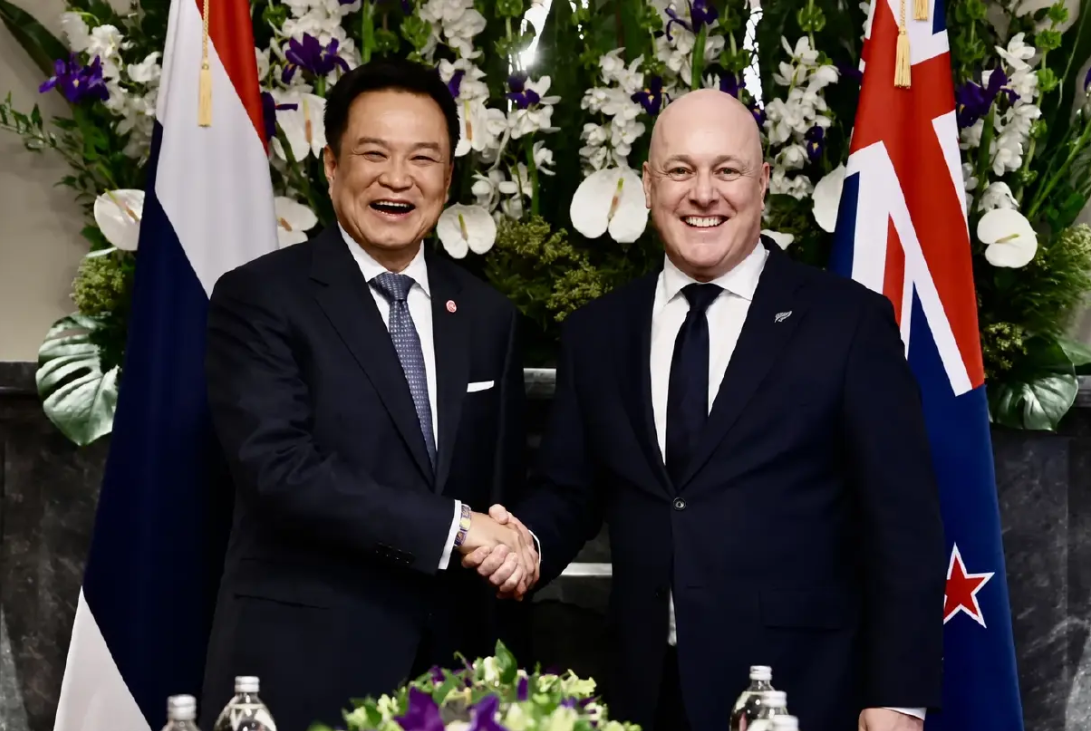
Thailand and New Zealand have formally upgraded their diplomatic relationship to a strategic partnership, marking a significant deepening of ties between the two nations as they commemorate seven decades of relations. The milestone was sealed when Thai Prime Minister Anutin Charnvirakul and New Zealand Prime Minister Christopher Luxon signed the Joint Declaration on Strategic Partnership at Government House in Wellington on August 21, during Anutin's official visit to the country. The elevation reflects growing recognition of shared interests and mutual benefits in an era of regional economic realignment and geopolitical shifts affecting Southeast Asia and the Pacific.
Central to the upgraded relationship is an ambitious trade target that would see bilateral commerce nearly triple to US$7.5 billion, equivalent to approximately 246 billion baht, by 2045. This goal underscores both nations' commitment to deepening economic integration over the coming two decades. Currently, bilateral trade between Thailand and New Zealand remains relatively modest compared to the potential, suggesting considerable room for expansion as businesses in both countries seek new markets and partnership opportunities. The aspiration reflects confidence in the complementary nature of their economies, with New Zealand's advanced agricultural exports and technology sector potentially finding ready markets in Thailand, while Thai manufacturers and services could access Oceanic markets.
The partnership framework rests on four interconnected pillars designed to translate diplomatic goodwill into tangible benefits for ordinary citizens and businesses. The first pillar focuses on political and security cooperation, with particular emphasis on combating transnational crime, online scams and human trafficking—issues that have become increasingly urgent across Southeast Asia and the Pacific region. Thailand and New Zealand have committed to strengthening law enforcement coordination and information-sharing mechanisms, recognizing that modern security challenges transcend borders and require sophisticated, multilateral responses. This cooperation gains added relevance given the rise of cybercrime and digital fraud affecting both developed and developing nations.
Economic and innovation cooperation forms the second pillar, with both countries pledging to expand trade and investment while prioritizing emerging areas including food security, renewable energy, green economy initiatives and sustainable agriculture. The Thailand–New Zealand Closer Economic Partnership (TNZCEP) will be further developed to unlock additional commercial opportunities. For Malaysian observers, this partnership architecture offers instructive lessons about how regional players can position themselves within broader economic networks, particularly as global supply chains undergo restructuring in response to geopolitical tensions and climate pressures. The focus on green economy and sustainable agriculture reflects international trends that are reshaping investment patterns and consumer preferences across Asia-Pacific.
The third pillar encompasses education, culture and people-to-people connections, recognizing that lasting partnerships require more than formal government agreements. Both nations plan to expand educational exchanges, skills development programs and capacity-building initiatives while promoting cultural understanding. This dimension carries particular significance for Southeast Asia, where educational partnerships with developed nations can enhance human capital and facilitate knowledge transfer. Thai students studying in New Zealand and vice versa create networks that often yield long-term diplomatic and commercial dividends. The emphasis on cultural connectivity also addresses the reality that regional stability increasingly depends on mutual understanding and soft power rather than military posturing alone.
Regional and multilateral cooperation comprises the fourth pillar, with Thailand and New Zealand committing to closer collaboration through Mekong frameworks, Asean-led mechanisms, APEC and other international forums. This aspect carries strategic significance for Southeast Asia, as it reflects how middle powers like Thailand are leveraging partnerships with developed nations to amplify their voice in multilateral institutions. Both countries reaffirmed their commitment to a rules-based international order and the multilateral system as foundations for peace, stability and sustainable development—a position that gains importance amid rising tensions between major powers and questions about the future of international institutions.
Concrete cooperation agreements accompany the strategic partnership declaration, including arrangements on cultural cooperation, civil service education exchange, police partnership and information-sharing, and a private sector accord between Thai and New Zealand companies. These instruments translate rhetorical commitments into operational frameworks with clear responsibilities and mechanisms for monitoring progress. The police partnership particularly reflects contemporary security priorities, as law enforcement agencies worldwide grapple with sophisticated criminal networks and cyber threats that demand international cooperation and intelligence-sharing.
Airline connectivity emerges as a tangible symbol of partnership deepening, with Thai Airways planning to resume direct Bangkok–Auckland services by March 2027. Direct flights typically catalyze tourism, investment and people-to-people contact by reducing travel time and costs. For Thailand's tourism sector, which remains crucial to the national economy, restoring this route represents an opportunity to tap New Zealand's affluent market. Anutin's indication that earlier resumption is possible suggests enthusiasm for accelerating the timeline, reflecting the economic and diplomatic significance attached to this connection. The restoration would also benefit Thai diaspora communities in New Zealand and New Zealand citizens with ties to Thailand seeking to maintain personal and business relationships.
The partnership timing coincides with Anutin's pursuit of Thailand's membership in the Organisation for Economic Co-operation and Development (OECD), an objective he raised during discussions with Luxon. New Zealand's expressed backing for Thailand's OECD bid carries meaningful weight, as member countries collectively evaluate applicants and consensus matters significantly. OECD membership would position Thailand as a developed or upper-middle-income economy in international forums, potentially affecting access to certain markets and investment flows while imposing stricter regulatory and transparency requirements. This dimension reveals how strategic partnerships increasingly serve instrumental purposes beyond diplomatic symbolism, becoming vehicles for advancing specific policy objectives within international architecture.
The strategic partnership represents a calculated expansion of New Zealand's Indo-Pacific engagement amid broader shifts in international alignments. For Thailand and the broader Southeast Asian region, such partnerships with developed democracies like New Zealand provide counterbalance to other great power influences while offering access to advanced technology, capital and markets. The framework's emphasis on sustainable development, environmental conservation and green economy positioning reflects contemporary priorities that increasingly drive foreign policy and international cooperation decisions across the region.
Looking forward, the success of this partnership will depend on implementation capacity and genuine commitment from both public and private sectors to pursue the identified opportunities. The 2045 trade target, while ambitious, requires consistent policy support, investment in logistics and infrastructure, and active business engagement. The four-pillar framework provides structure, but realizing benefits demands ongoing diplomatic attention and resources. For Malaysia and other ASEAN members, Thailand's experience with this partnership offers lessons about leveraging strategic relationships to advance national development objectives while contributing to regional prosperity and stability.

