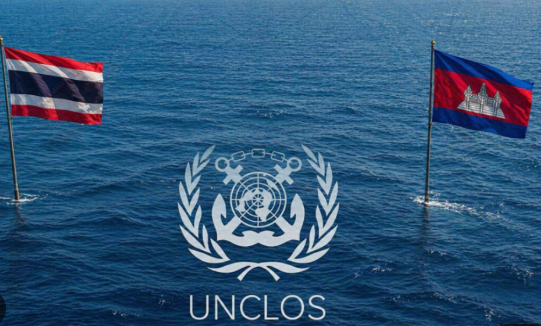
Thailand has formally accepted Cambodia's request to enter compulsory conciliation proceedings under the 1982 United Nations Convention on the Law of the Sea, or Unclos, to address their long-standing dispute over maritime boundaries in the Gulf of Thailand. However, Bangkok has made a point of clarifying that the process will not function as a court case, and that any recommendations emerging from the conciliation will carry no legal force. This measured acceptance reflects Thailand's desire to manage the dispute while maintaining flexibility in future negotiations.
The Thai Ministry of Foreign Affairs submitted its formal response to Cambodia on June 19, several weeks after Cambodia had lodged its notification on June 2. In accepting the conciliation request, Thailand has sought to frame the entire process carefully, insisting that proceedings remain confined to the technical question of maritime delimitation under Unclos, rather than extending to broader matters such as provisional arrangements or resource-sharing frameworks that Cambodia may have intended to include.
For the conciliation proceedings, Thailand has designated Deputy Prime Minister and Foreign Minister Sihasak Phuangketkeow as its Agent, with Songchai Chaipatiyut, Thailand's ambassador to Kuwait and a former Treaties and Legal Affairs official, serving as Deputy Agent. The country has also nominated two international legal experts to serve as conciliators: Judge Albert J Hoffmann of South Africa and Judge Rudiger Wolfrum of Germany, both recognised as leading authorities in maritime law. The appointment of respected international figures signals Thailand's commitment to a credible process, even as it hedges against binding outcomes.
The conciliation mechanism itself follows established Unclos procedures. The four conciliators appointed by both countries—two from each nation—will have thirty days from Thailand's formal response to select a fifth neutral conciliator who will chair the entire commission. Once constituted, the five-member commission is expected to conduct hearings, review documentation, and prepare a report containing recommendations within approximately twelve months, though both parties retain the option to extend this timeline if circumstances warrant.
Thai officials have emphasised a crucial distinction: conciliation under Unclos differs fundamentally from international litigation or arbitration. The conciliators are characterised not as advocates for either side but as impartial specialists tasked with absorbing the positions of both countries, contextualising the underlying disagreement, and proposing pathways toward mutual accommodation. This framing acknowledges the process's legitimacy while tempering expectations about its authority to impose solutions.
According to the Foreign Ministry, the conciliation commission will ultimately produce a report containing recommendations that can serve as a foundation for resumed bilateral negotiations. Crucially, Thailand has stressed that this report will not be binding on either party under international law. This position aligns with Unclos Annex V, which explicitly stipulates that conciliation commission reports and recommendations create no legal obligations. Both countries would still need to engage in direct discussions to resolve any outstanding disagreements following the conciliation phase.
Thailand's insistence on returning to bilateral channels reflects its broader negotiating posture. Thai officials have repeatedly stated that the maritime dispute must ultimately be resolved through direct talks between the two governments, with conciliation serving primarily as a structured forum to improve understanding and identify common ground rather than as a substitute for diplomatic engagement. This stance suggests Thailand views the process as a diplomatic tool rather than a mechanism for settling the matter definitively.
A significant source of tension involves the scope of conciliation itself. Thailand has sought to limit discussions strictly to maritime boundary delimitation, the technical process of drawing a line separating the territorial waters and continental shelves of the two nations. Cambodia's notification, however, appeared to encompass not merely delimitation but also provisional arrangements for joint development and equitable sharing of offshore resources. This scope disagreement reflects deeper complexities: the disputed area in the Gulf of Thailand contains substantial natural gas reserves and other hydrocarbon resources, making the boundary question inseparable from economic development interests.
Thailand's position has hardened somewhat recently. In May, the Thai Cabinet voted to terminate the 2001 Memorandum of Understanding with Cambodia—internally designated as MoU 44—which had established the framework for managing overlapping maritime claims on the continental shelf. Prime Minister Anutin Charnvirakul attributed the termination to stalled progress over twenty-five years rather than to escalating tensions with Cambodia, framing it as a necessary adjustment to the cooperation framework. Despite this move, Thailand stated it would continue maritime boundary discussions with Cambodia, now anchored explicitly to Unclos rather than the superseded bilateral agreement.
The underlying resources at stake lend urgency to the dispute. The Gulf of Thailand has historically been a productive region for natural gas extraction, and both nations have interests in developing these reserves. The overlap in maritime claims means that resources in the disputed area could theoretically be exploited by either country, creating incentives for boundary clarity. Joint development arrangements, which Cambodia appears to prefer, would allow both countries to benefit from extraction even without resolving the boundary question definitively—an approach that appeals to some Thai policymakers but remains contentious.
Cambodia initiated the compulsory conciliation mechanism after the bilateral MoU was cancelled, presenting the move as a commitment to peaceful resolution through established international law. By invoking Unclos procedures, Cambodia signalled that it sought to internationalise the dispute and shift it from purely bilateral channels to a process involving international legal frameworks and neutral parties. This strategic choice reflects Cambodia's assessment that bilateral negotiations had yielded insufficient progress and that external procedural structures might generate momentum.
Thailand's acceptance of conciliation, despite its reservations, demonstrates a recognition that outright rejection would damage its international standing and relationships within Southeast Asia. Conciliation offers a middle path: Thailand participates in a legitimate international process while maintaining its position that the outcome will not be binding and that bilateral negotiation remains paramount. This approach allows Bangkok to appear cooperative and committed to peaceful resolution while preserving its negotiating flexibility.
The coming months will test whether conciliation can bridge the conceptual gap between the two countries' visions of the dispute and its resolution. For Malaysia and other Southeast Asian nations watching closely, the Thailand-Cambodia process offers lessons in managing maritime disagreements in a region where overlapping claims remain common. The outcome of the conciliation—whether it generates useful recommendations that accelerate bilateral settlement or becomes another stage in a prolonged impasse—will shape how regional powers approach similar disputes in the future.