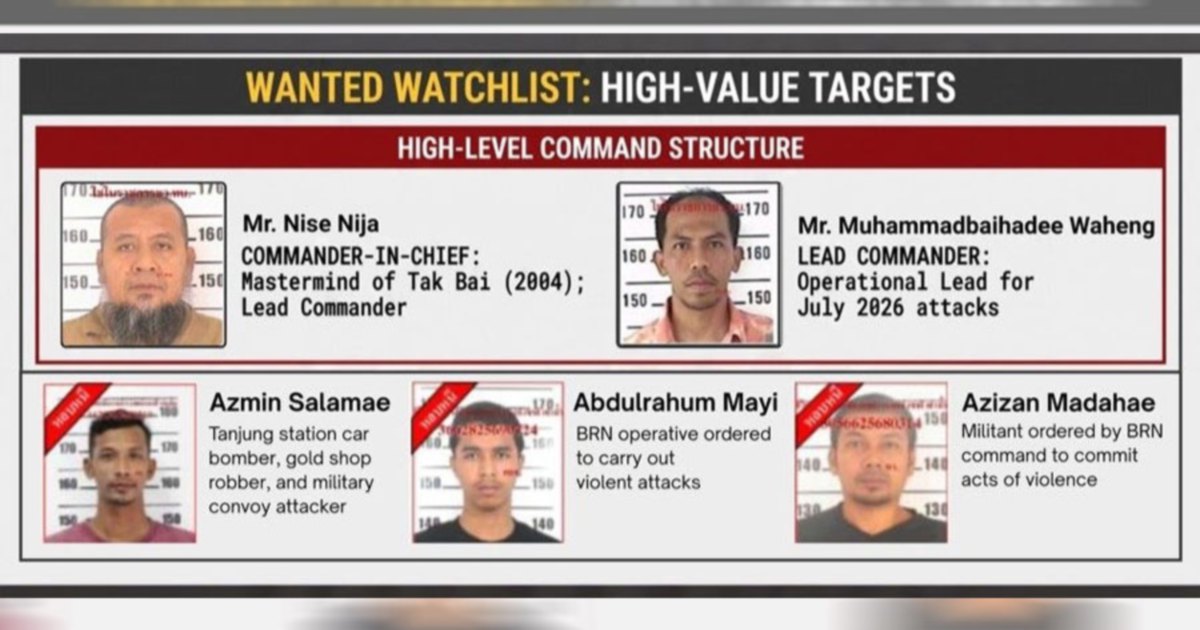
Thai law enforcement has intensified its manhunt for five individuals suspected of orchestrating and executing a violent assault on a security checkpoint in Thailand's volatile southern border region. The attack, which occurred on July 22 along Bukit Sami Municipal Road in the Tanjong Mas subdistrict of Ra-ngae, Narathiwat, claimed multiple lives and has prompted authorities to cast a wide net for those responsible.
Narathiwat province, which sits directly across the border from Malaysia's northern states of Perlis and Kedah, has long been a flashpoint for militant activity and communal violence. The checkpoint targeted in the July incident serves as part of Thailand's security infrastructure designed to monitor and control movement in this strategically sensitive zone. The brazen nature of the attack—occurring at what is ostensibly a secure government facility—suggests a degree of coordination and tactical sophistication that has alarmed security officials on both sides of the frontier.
The issuance of arrest warrants for the five suspects marks an important development in the investigation, indicating that Thai police have gathered sufficient evidence to identify and formally charge the individuals. The warrants represent a formal escalation of the manhunt and provide legal authority for apprehension across provincial and national boundaries. For Malaysian security forces, such developments are significant given the cross-border implications of militant networks and criminal syndicates that often exploit the porous frontier between the two nations.
Thailand's southern provinces have struggled with persistent insurgency and organised crime for decades. The deeper drivers—involving ethnic Malay-Muslim grievances, separatist movements, and criminal opportunism—create a complex security environment where distinguishing between politically motivated violence and common criminality is often difficult. This July 22 ambush sits within that murky context, though its targeting of security personnel suggests either militant political motivations or calculated criminal intent to acquire government resources or intelligence.
For Malaysia, incidents in Narathiwat carry particular relevance. The border communities in Perlis and Kedah maintain social and economic ties with their Thai counterparts, and any escalation in violence risks destabilising cross-border commerce and civilian movement. Malaysian authorities maintain close intelligence-sharing arrangements with Thai counterparts, and the identification of these five suspects will likely be of interest to Malaysian security agencies operating in the northern frontier zone.
The investigation's trajectory will depend on whether Thai police can locate and apprehend the suspects. The southern Thai provinces present significant geographical and logistical challenges for law enforcement—dense jungle terrain, sympathetic populations in certain areas, and porous borders facilitate suspect movement and concealment. Some individuals may have already crossed into Malaysia or other neighbouring territories, complicating the apprehension process and requiring regional police cooperation.
From a broader security perspective, the July 22 incident reflects the ongoing challenge that Thailand faces in stabilising its southernmost provinces. Counterinsurgency operations, border security enhancement, and community engagement have yielded mixed results over the years. The continued emergence of coordinated attacks on government facilities suggests that militant or criminal networks retain operational capacity and local support infrastructure, despite significant security expenditure and military involvement in the region.
The five-suspect warrant issuance also raises questions about the intelligence picture available to Thai authorities. Identifying suspects relatively quickly points either to strong leads from eyewitness testimony, forensic evidence, or intelligence from informants and surveillance networks. Conversely, the fact that warrants have been issued but suspects remain at large suggests either genuine concealment or reluctance to move against individuals within networks that possess operational capability and potentially local sympathies.
For Malaysian readers with commercial or family interests in Narathiwat and surrounding provinces, this development underscores the importance of situational awareness and security consciousness when crossing the border. Malaysian Foreign Ministry advisories have periodically cautioned against travel to volatile areas of Thailand's southern provinces, and incidents like this reinforce such guidance.
The longer-term implications remain uncertain. If Thai authorities successfully apprehend and prosecute these five individuals, it may yield intelligence about broader networks and operational structures. Conversely, if the suspects evade capture, it may embolden similar attacks and suggest that security defences remain vulnerable. Regional security observers will be watching closely to see how the investigation develops and whether cross-border cooperation mechanisms prove effective in bringing the suspects to justice.
Thailand's Interior Ministry and security apparatus face mounting pressure to restore public confidence in government capacity to protect civilians and security personnel in the troubled region. The formal warrant issuance represents a necessary procedural step, but the true measure of success will be the apprehension, interrogation, and prosecution of those responsible. Until the five suspects are in custody, the southern provinces will remain a zone of active security concern for both Thailand and its Malaysian neighbours.

