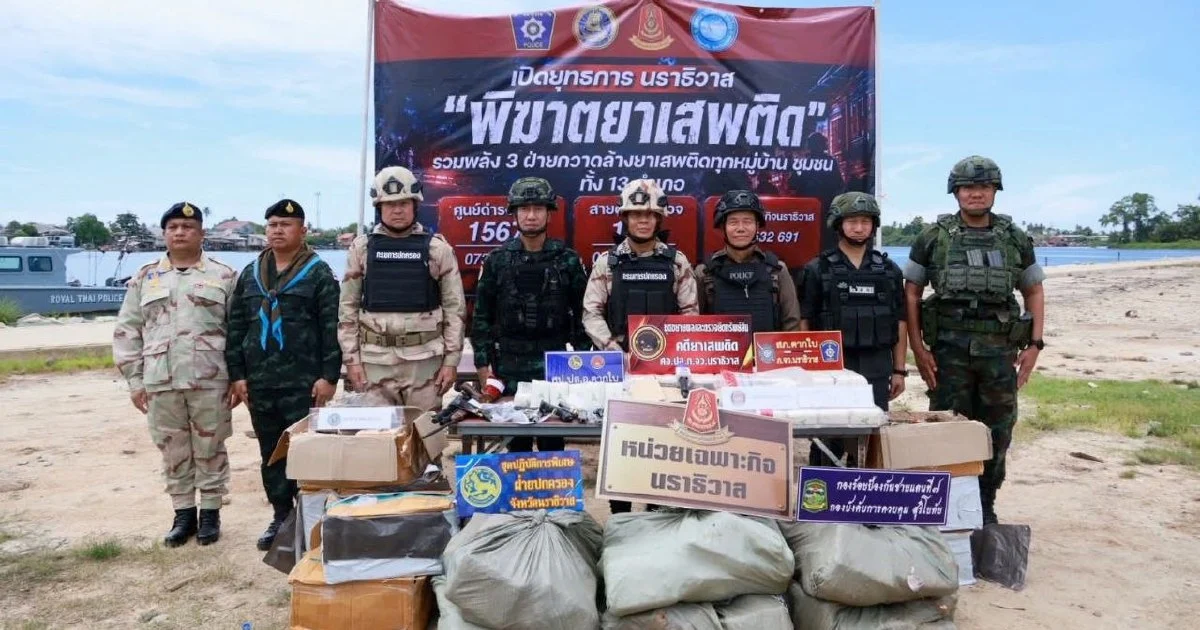
Thai law enforcement agencies have delivered a significant blow to transnational drug trafficking operations in the region, announcing the arrest of 233 suspected members of organized narcotics syndicates during an intensive crackdown centred on Narathiwat province near the Malaysian border. The operation, which unfolded over a month-long period, represents one of the largest coordinated enforcement efforts against drug trafficking in Thailand's southern border region, an area long plagued by cross-border smuggling activities involving networks that extend into Malaysia and beyond.
Among those detained are individuals believed to maintain direct operational links with Malaysian-based drug trafficking networks, suggesting that the illicit trade continues to thrive along the porous frontier separating the two nations. The seizure of contraband valued at RM1.2 million underscores the scale of narcotics movement through this critical corridor, where geographical proximity and established trafficking routes have historically made the region a favoured transit zone for illegal drugs destined for markets throughout Southeast Asia and beyond.
The Narathiwat province, situated at Thailand's southernmost point adjacent to Kelantan and Terengganu states in Malaysia, has long represented a critical chokepoint for international drug enforcement authorities. Its strategic position, combined with challenging terrain and numerous unmapped border crossing points, has made it an attractive operational base for trafficking syndicates seeking to circumvent detection. The month-long enforcement initiative appears designed to disrupt established smuggling networks operating from this location, though the identification of Malaysian-connected suspects indicates that disruption of the supply chain requires coordinated regional response.
The broader implications of this operation extend beyond Thailand's borders and directly affect Malaysian law enforcement priorities. Drug trafficking syndicates operating across the Thailand-Malaysia frontier typically employ compartmentalized organizational structures where separate teams handle procurement, transportation, concealment, and distribution functions. By targeting one jurisdiction's operations, Thai authorities potentially disrupt supply chains that feed addiction and criminal activity throughout Malaysia's northern states. The involvement of Malaysian-linked traffickers suggests that domestic consumption markets in Malaysia, combined with opportunities for onward trafficking to Singapore and other regional destinations, remain significant drivers of transnational smuggling activity.
The scale of this operation—involving the arrest of over two hundred suspects—demonstrates the resource commitment required to meaningfully impact trafficking syndicates in border regions. Such crackdowns typically involve coordination between multiple Thai agencies, including the Royal Thai Police narcotics division, provincial law enforcement, and potentially military-affiliated forces given Thailand's complex security environment. The concentration of enforcement activity in a single province during a defined period reflects tactical decisions to maximize disruption while maintaining operational security, preventing suspects from dispersing before apprehension.
Thailand's southern provinces have witnessed significant shifts in drug trafficking patterns over recent years, with synthetic drugs increasingly dominating the market alongside traditional heroin production originating from the broader Golden Triangle region. The seizure of RM1.2 million in contraband suggests that this particular operation intercepted high-value shipments, possibly methamphetamine tablets or precursor chemicals, commodities that command premium prices in Malaysian street markets. Understanding the specific composition of confiscated drugs provides critical intelligence regarding trafficking priorities and the chemical supply chains sustaining regional production networks.
For Malaysian authorities, these arrests carry implications for domestic counter-narcotics strategy. Information gleaned from Thai detention operations can illuminate trafficking routes, organizational structures, and financial mechanisms that Malaysian law enforcement might not otherwise observe. Regional intelligence sharing agreements, while imperfect, occasionally facilitate the exchange of such information, enabling each jurisdiction to map transnational syndicate operations and identify critical intervention points. However, cooperation remains inconsistent, with resource constraints and bureaucratic friction sometimes limiting the flow of actionable intelligence between neighbouring countries.
The identification of Malaysian-linked suspects raises questions about the depth of local participation in these networks. Some Malaysian traffickers may operate as independent entrepreneurs leveraging their geographical proximity to source areas, while others function as agents of larger syndicates headquartered in Thailand or elsewhere. Understanding these relationships helps explain why supply-side enforcement in Thailand, while symbolically important, often produces only temporary disruptions to trafficking activity. Alternative supply routes typically exist, and organizations restructure rapidly following major arrests of personnel.
The sustainability of enforcement results remains uncertain given the economic incentives driving participation in drug trafficking. Border communities often experience limited legitimate economic opportunities, and involvement in illicit trade offers immediate financial rewards that substantially exceed lawful employment. Without addressing underlying economic vulnerabilities that make trafficking participation attractive, crackdowns achieve transient disruption at best. The arrest of 233 individuals removes some criminal capacity from regional networks, but recruitment appears perpetual in regions where economic desperation prevails.
These developments underscore the complexity of managing transnational criminal activity in Southeast Asia, where shared borders, cultural connections, and economic disparities create structural conditions favouring smuggling networks. Malaysian and Thai law enforcement agencies necessarily maintain parallel efforts against common adversaries, yet coordination remains limited by resource constraints, linguistic barriers, and occasional jurisdictional tensions. The RM1.2 million seizure represents a success within the immediate operation, but the continued viability of cross-border trafficking networks suggests that larger structural adaptations in regional security cooperation and economic development would be required to meaningfully suppress these activities.

