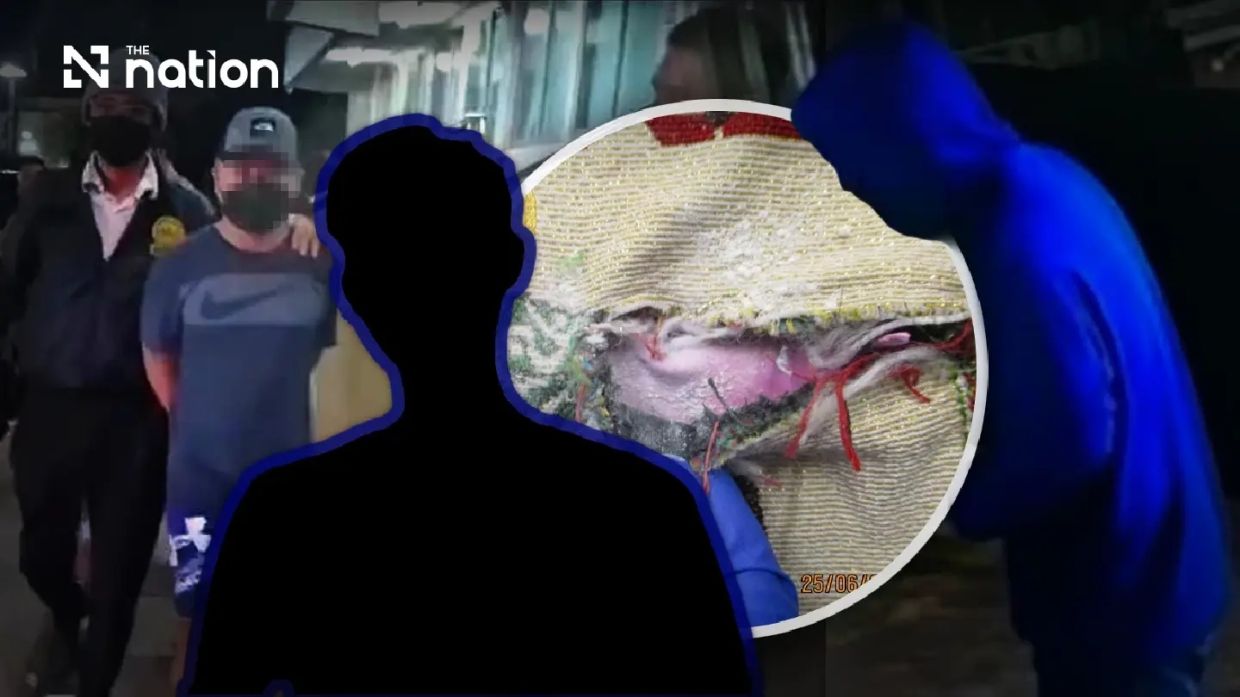
Bangkok authorities have widened their investigation into a significant drug trafficking case after detaining a man suspected of serving as a crucial intermediary between suppliers and couriers. The arrest of the suspect, identified as Ekkawit, represents a significant development in a smuggling operation that attempted to move heroin through Thailand to Australia using commercial flight attendants as unwitting or willing couriers.
Pol Maj Gen Theeradej Thamsuthee, the Metropolitan Police Bureau's deputy commissioner, announced that officers apprehended Ekkawit overnight in Phayao province. According to police investigations, Ekkawit occupied a middle position within the trafficking network, tasked with physically delivering narcotics to a handler named Uthai, who had already been arrested. This handler subsequently transferred the contraband to a female flight attendant who was expected to smuggle it aboard a commercial flight heading to Australia.
The police narrative portrays Ekkawit as operating under the online alias "Rin Rin", which he used to contact Uthai and orchestrate the pickup of an elephant-print fabric bag concealing heroin. The bag had been left at a predetermined location in Chiang Kham district. According to investigators, Ekkawit personally delivered this bag to Uthai, initiating a chain that would eventually place the contraband in the hands of someone travelling internationally. The case demonstrates how trafficking networks exploit legitimate airline personnel and the movement of commercial goods to circumvent border controls.
During interrogation, Ekkawit acknowledged his involvement and disclosed that he received THB100,000 for performing the delivery task. More significantly, he admitted to having executed similar assignments on two or three previous occasions, suggesting the arrangement was part of an established operational pattern rather than an isolated incident. This admission points to a systematic smuggling enterprise with repeated runs, likely generating substantial proceeds for the masterminds directing operations.
The investigation has also identified another crucial figure operating under the name "Rose Rose", whom police believe contacted and instructed the flight attendant, identified as Mina, to carry the bag to Australia. Ekkawit's interrogation revealed that he maintained a direct relationship with the person behind the Rose Rose profile, providing investigators with potential pathways to dismantle higher levels of the network. Law enforcement has determined that Rose Rose directed not only Ekkawit but multiple associates through encrypted chat communications, demonstrating sophisticated coordination tactics typical of transnational drug organisations.
The operational mechanics of this smuggling cycle reveal layers of compartmentalisation designed to obscure accountability. Ekkawit's account indicates that Rose Rose instructed him to purchase an elephant-print bag in Chiang Mai. Once obtained, he notified his superior, who then arranged for associates to collect the bag and conceal heroin inside—allegedly occurring in Laos, though police remain sceptical of this claim. After a one or two-day interval allowing for the drug insertion, Rose Rose would orchestrate Ekkawit's retrieval of the loaded bag along with cash compensation left at a predetermined kilometre marker.
The payment structure reveals another layer of the network's architecture. Ekkawit coordinated Uthai's participation through electronic fund transfers, depositing THB60,000 via cash machines rather than direct contact. This electronic distancing served to reduce direct association between participants while maintaining the cash-based nature of drug trafficking that enables rapid movement of proceeds and complicates financial investigation. The use of multiple intermediaries and communication channels suggests a network attempting to insulate higher-level organisers from direct contact with street-level operatives.
Police investigations suggest that the person using the Rose Rose identity operates as a coordinator but not as the network's ultimate authority. Senior detectives believe a more established organiser remains above this coordinator, potentially orchestrating multiple trafficking routes and maintaining insulation from operational details. This hierarchical structure reflects the typical architecture of international narcotics syndicates, where command authority remains distant from the couriers and handlers who face greatest arrest risk. Pol Gen Samran Nuanma, the deputy national police chief, was scheduled to conduct further interrogation of Ekkawit on Friday, July 10, 2026, suggesting high-level interest in the case.
Ekkawit's connection to Rose Rose extends beyond operational coordination. Investigators discovered that the two individuals are close relatives both originating from Phayao province, with photographs documenting their travelling together. This familial bond potentially facilitated recruitment into the network and provided an existing trust relationship. The use of family connections in trafficking organisations is common across Southeast Asia, as such ties provide both motivation for protection and assumed reliability.
The case against previously arrested handler Uthai presents additional complications for investigators. Uthai claims to have executed the courier role five or six times, but police remained unconvinced, believing his initial statements were rehearsed prior to detention. Evidence indicating that Uthai had rented accommodation in Phra Nakhon Si Ayutthaya province for five to six months suggests substantially greater involvement than he initially acknowledged. This pattern of understatement during interrogation remains typical in serious drug cases, as suspects attempt to minimise their culpability.
Authorities emphasise they are pursuing comprehensive dismantling of the entire network rather than merely addressing immediate participants. The involvement of international commercial carriers and Australia as a destination indicates this smuggling operation forms part of broader Southeast Asian-to-Pacific narcotics flows. The use of flight attendants as couriers particularly concerns regional aviation authorities, as it suggests recruitment of legitimate airline personnel vulnerable to coercion or financial incentive. Investigators have obtained substantial information about the Rose Rose profile despite its anonymous account structure, demonstrating capabilities in tracking encrypted communications.
The case carries significant implications for Southeast Asian law enforcement cooperation regarding transnational drug trafficking. Thailand's position as a production and transit point for narcotics moving to developed markets makes such investigations critical for regional security. The network's apparent sophistication—using multiple intermediaries, encrypted communications, electronic payments, and exploitation of legitimate transport systems—reflects evolution in trafficking methods requiring equally sophisticated countermeasures from authorities across the region.

