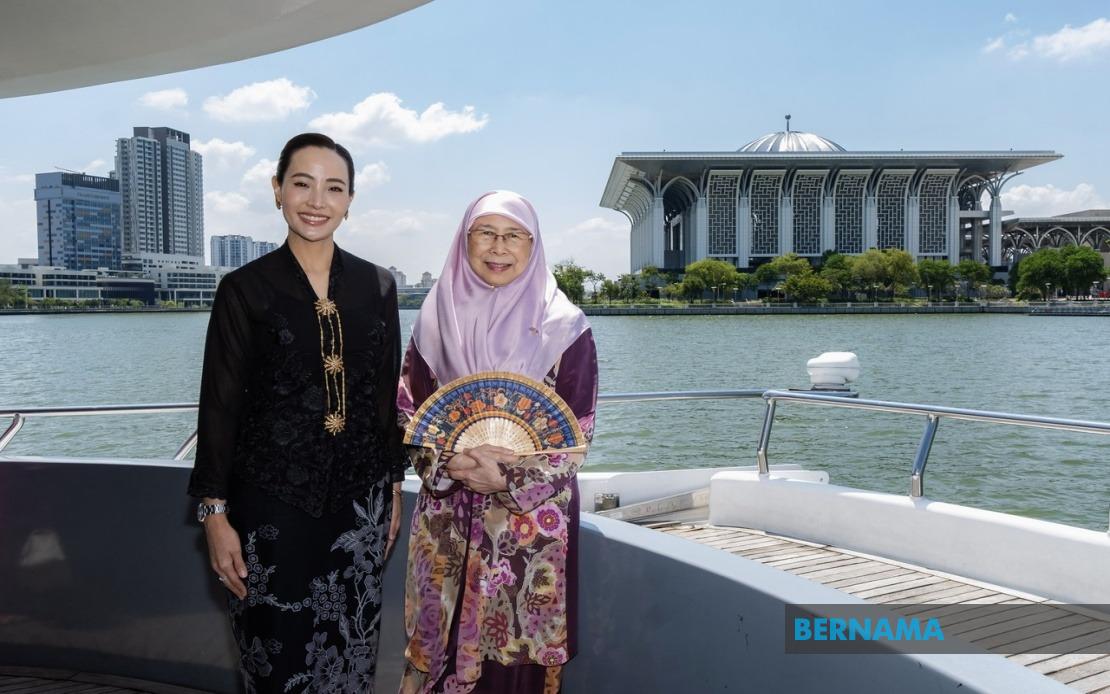
Thailand's Prime Minister's wife Thananon Charnvirakul spent Thursday afternoon experiencing one of Putrajaya's most cherished attractions, gliding across Tasik Putrajaya to admire the federal territory's distinctive architectural ensemble and verdant surroundings. The leisure cruise, lasting approximately 45 minutes, provided the visiting dignitary with an intimate perspective of Malaysia's meticulously planned capital city and its landmark structures—a carefully curated introduction to the administrative heart of Southeast Asia's fifth-largest economy.
Thananon arrived at the waterfront at approximately 12.10 pm and was formally greeted by Datuk Seri Dr Wan Azizah Wan Ismail, wife of Prime Minister Datuk Seri Anwar Ibrahim. The reception reflected the protocols typically extended to spouses of high-ranking foreign officials, underscoring the diplomatic significance Malaysia attaches to Thailand as a crucial neighbouring ally. Minister Hannah Yeoh, who holds the portfolio for the Prime Minister's Department covering Federal Territories, also participated in the welcome, emphasising governmental coordination at both federal and ministerial levels.
During their time on the water, Thananon and Dr Wan Azizah engaged in conversation whilst observing Putrajaya's carefully landscaped vistas. The setting provided an informal yet dignified environment for bilateral exchange, typical of how nations use cultural and recreational experiences to nurture interpersonal connections between leaders and their families. Such moments, often overshadowed by formal state dinners and official ceremonies, frequently prove instrumental in establishing the personal rapport upon which sustained diplomatic relationships rest.
Thananon's presence in Malaysia forms part of a broader two-day official visit by her husband, Thai Prime Minister Anutin Charnvirakul, who arrived in the country the same day. The couple received a full ceremonial welcome at the Bunga Raya Complex within Kuala Lumpur International Airport, complete with official protocols befitting a head of government's visit to a fellow ASEAN member state. This formal reception signalled Malaysia's commitment to according Thailand's leadership the respect and prominence commensurate with the importance both nations attach to their bilateral partnership.
Anutin's current visit marks his first journey to Malaysia since resuming the office of Prime Minister in March 2026, a timeline of particular significance given the fluid nature of Thai politics and the restoration of his leadership mandate. His return to Malaysia at this juncture represents a deliberate choice to reaffirm Thailand's engagement with its Malaysian counterpart and to reset diplomatic momentum following his return to power. The visit has been extended at the formal invitation of Prime Minister Anwar, reflecting the latter's commitment to deepening Malaysia-Thailand relations and signal that the Malaysian government views Anutin's reappointment favourably.
The official narrative surrounding this visit emphasises the commitment both nations share toward reinforcing their historically robust bilateral relationship. Malaysia and Thailand have long maintained cordial diplomatic and economic ties spanning multiple decades, though both countries have experienced periods of domestic political turbulence. The emphasis on shared interests and mutual cooperation in the formal language of both governments suggests contemporary discussions likely encompass trade, cross-border security, infrastructure development, and regional geopolitical positioning within the wider ASEAN framework.
From a Malaysian perspective, Anutin's visit carries particular weight given Thailand's strategic location along Malaysia's northern border and the complex web of bilateral agreements governing everything from border management to coordinated regional security efforts. Thailand remains instrumental to Malaysian interests in maintaining stability within the Greater Mekong Subregion and in bolstering ASEAN's collective approach to issues ranging from climate change to maritime security. Conversely, Thailand views Malaysia as a crucial partner in navigating regional economic corridors and in addressing shared challenges including human trafficking and transnational organised crime.
The timing of this official visit, occurring during a period when both nations grapple with evolving domestic political landscapes and economic adjustments, underscores a mutual determination to maintain institutional continuity and bilateral goodwill regardless of leadership transitions or internal political shifts. Such visits serve as anchors for national relationships, preventing momentary domestic distractions from derailing decades-long partnerships. For Malaysian stakeholders, Anutin's return and the formality of this visit provide reassurance that Thailand remains committed to the bilateral relationship despite any internal political considerations.
The decision to include a recreational component such as the Tasik Putrajaya cruise demonstrates how modern diplomacy balances ceremonial formality with accessible, humanising experiences. Putrajaya itself, as Malaysia's administrative capital built on the vision of previous leadership, serves as a physical manifestation of national aspirations and planning capacity. Showcasing the city to visiting dignitary spouses communicates national pride and accomplishment while creating memorable impressions that often translate into positive diplomatic sentiment. For the Thai delegation, observing Putrajaya's integration of modern infrastructure with environmental stewardship offers insights into Malaysian governance philosophy and urban development priorities.
The broader implications of Anutin's visit extend beyond ceremonial exchanges. The two-day engagement provides substantive opportunity for senior officials from both nations to address agenda items requiring high-level political attention and decision-making. Such visits typically encompass working sessions between relevant ministers, discussions on bilateral agreements requiring renewal or amendment, and strategic conversations regarding regional developments demanding coordinated responses. The family component, whilst appearing peripheral to formal diplomacy, often facilitates informal discussions between spouses and entourages, generating candid exchange that occasionally proves invaluable in resolving diplomatic impasses.
Looking forward, Malaysia's reception of Thai leadership during this visit signals to the broader regional community and international observers Malaysia's commitment to maintaining robust ASEAN partnerships. In an era of great power competition and regional strategic realignment, bilateral ASEAN relationships assume heightened significance. Malaysia's deliberate approach to hosting Thai leadership, evident in the ceremonial protocols and curated experiences like the Putrajaya cruise, demonstrates national commitment to preserving institutional partnership even as global circumstances shift around established relationships.

