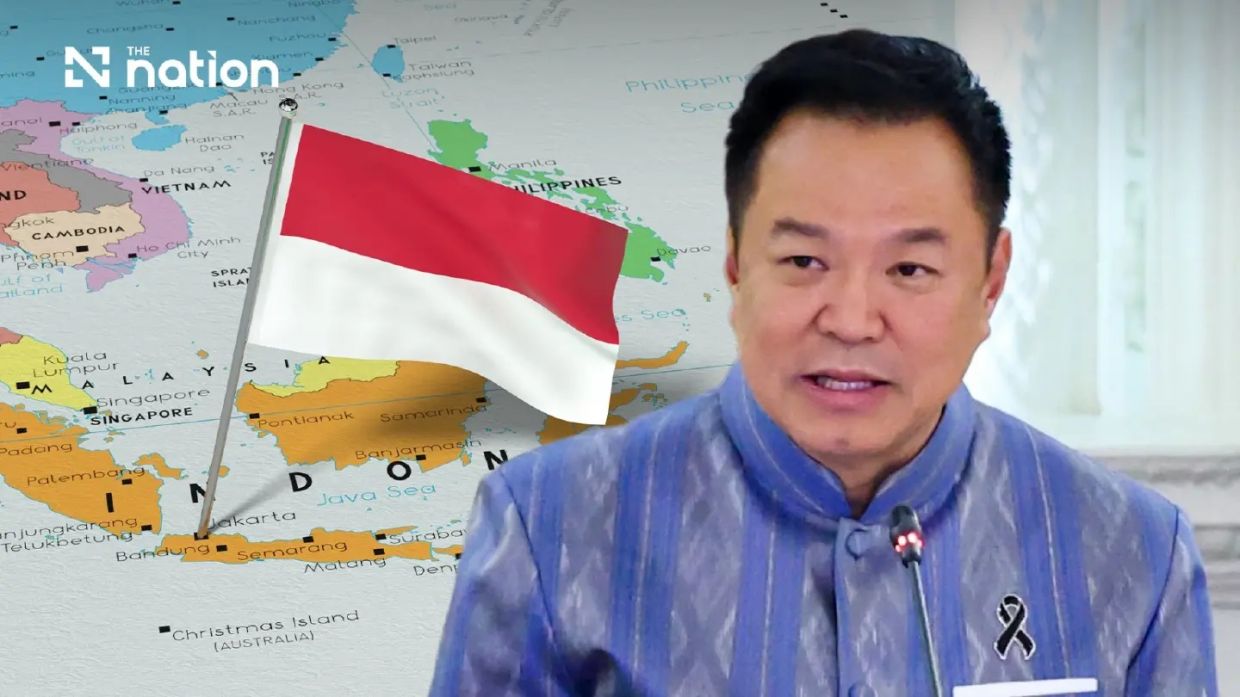
Prime Minister Anutin Charnvirakul will embark on a significant diplomatic mission to Indonesia on Monday and Tuesday (August 3–4), marking the first official visit by a Thai prime minister to the country in 15 years. The high-level engagement reflects Bangkok's determination to reinvigorate one of Southeast Asia's most consequential bilateral relationships and position Thailand as a key regional player during a period of mounting geopolitical uncertainty and economic competition.
During his two-day visit to Jakarta, Anutin will engage directly with Indonesian President Prabowo Subianto to chart a course for expanded cooperation across multiple domains. The bilateral agenda encompasses trade and investment frameworks, tourism development, security arrangements, food security initiatives, energy partnerships, educational exchanges and broader business collaboration. This expansive scope underscores how Thailand and Indonesia, as two of Asean's founding pillars, recognise the need for comprehensive engagement that extends beyond traditional diplomatic courtesies to address practical economic imperatives.
Beyond the presidential talks, Anutin's itinerary includes a strategic address at the Asean Secretariat headquarters where he will articulate Thailand's regional priorities and lay out preliminary positions as the kingdom prepares to assume the prestigious Asean chairmanship in 2028. This platform will allow Bangkok to signal its vision for the 10-member bloc's future direction and demonstrate proactive leadership on critical transnational issues that affect all Southeast Asian nations.
Government Spokesperson Rachada Dhnadirek characterised Indonesia's significance in sweeping economic terms, noting the country's population of approximately 280 million inhabitants and status as Asean's largest economy. For Thai policymakers, Indonesia represents an enormous untapped market with substantial absorption capacity for Thai goods and services. Beyond immediate commercial gains, closer economic integration with Indonesia could provide Thai enterprises—from multinational corporations to small and medium-sized businesses—with crucial access to supply chains, investment opportunities and growth corridors that have remained underutilised during the 15-year hiatus in top-level bilateral engagement.
The visit's underlying rationale reflects a deliberate recalibration of Thailand's foreign policy toward economic maximisation and tangible welfare improvements for Thai citizens. Rather than viewing international relations as an abstract exercise in diplomatic protocol, the government explicitly frames bilateral engagement as instrumental to widening market access for Thai agricultural exports, attracting inbound investment, generating employment opportunities and facilitating workforce development initiatives. Rachada emphasised that knowledge and technology exchanges in sectors where the two nations possess complementary strengths will feature prominently, suggesting collaboration in areas ranging from advanced agriculture to digital infrastructure.
Indonesia's sheer economic weight makes it indispensable to Thailand's regional ambitions. With nearly 280 million inhabitants and the bloc's most developed industrial base, Indonesia presents both a consumer market of unprecedented scale and a potential production hub for companies seeking to diversify away from existing concentration in Thailand. For Malaysian and Singaporean investors observing these developments, the Thailand-Indonesia rapprochement signals a reshaping of Southeast Asian supply chains and market dynamics that will influence regional competitiveness across multiple sectors.
The bilateral talks will necessarily address Asean's institutional challenges and collective capacity to navigate turbulent global conditions. Both nations share interests in preserving regional peace, managing transnational security threats, and maintaining Southeast Asia's relevance amid great-power competition between the United States and China. The discussions will likely touch on Asean's ability to respond cohesively to shifting economic patterns, cross-border criminal networks and geopolitical developments that test the bloc's unity and effectiveness. Thailand's pending chairmanship in 2028 adds urgency to these conversations, as Bangkok will inherit responsibility for steering consensus among members with divergent strategic preferences.
The economic dimensions of the visit extend beyond bilateral trade mechanics. Anutin's attendance at a business forum organised jointly by the Indonesian Chamber of Commerce and Industry (KADIN) and the Thai Chamber of Commerce in Indonesia will serve as a practical matchmaking mechanism, directly connecting executives and entrepreneurs from both countries to identify concrete investment and trade opportunities. This component acknowledges that government-level declarations mean little without corresponding private-sector participation and enthusiasm. By facilitating business-to-business connections, Thailand aims to generate self-sustaining economic momentum that transcends the diplomatic calendar.
Thailand's articulated vision for Asean centres on constructing a united regional bloc that achieves economic resilience while remaining people-focused, pursuing balanced and sustainable growth trajectories. This formulation reflects Bangkok's attempt to position itself as a moderate voice advocating for inclusive development that does not sacrifice environmental stewardship or social cohesion for rapid GDP expansion. As Thailand prepares to chair Asean in 2028, outlining such aspirations to both Indonesia and the broader regional community establishes interpretive frameworks that will guide Bangkok's agenda-setting authority during its tenure.
Rachada characterised the visit as embodying a comprehensive foreign-policy approach centred on constructing strategic partnerships, maintaining equilibrium in Thailand's international relationships and fortifying the kingdom's negotiating leverage in economic matters. The emphasis on balance suggests Bangkok's desire to avoid excessive alignment with any single great power while maximising bilateral benefits with major regional economies. In an era of heightened global uncertainty, where supply chains face disruption and investment flows remain volatile, this strategy of deepening ties with immediate neighbours serves Thailand's long-term national interests.
The visit's logistical details reflect its importance to Bangkok's diplomatic establishment. Anutin's departure from Military Air Terminal 2 at Wing 6 toward Halim Perdanakusuma Airport in Jakarta on August 3 initiates a full schedule comprising an official welcoming ceremony, restricted bilateral talks, full delegation-level meetings and joint press commentary at the Indonesian Presidential Palace. The August 4 programme encompasses the KADIN business forum, consultations with Asean's secretary-general on regional cooperation advancement and Anutin's keynote address before meetings with Indonesian private-sector representatives. This densely packed agenda demonstrates both countries' commitment to maximising the visit's substantive output.
The 15-year interval since the last official Thai prime ministerial visit to Indonesia had allowed bilateral ties to atrophy at leadership levels, despite continued lower-level engagement and economic interchange. This visit represents recognition that high-level political momentum matters for sustained economic cooperation and that personal relationships between leaders facilitate smoother negotiations on contentious issues. For Southeast Asian observers, the reactivation of Thailand-Indonesia bilateral engagement carries implications for the region's institutional coherence, investment patterns, and capacity to address transnational challenges requiring coordinated responses from major economies.

