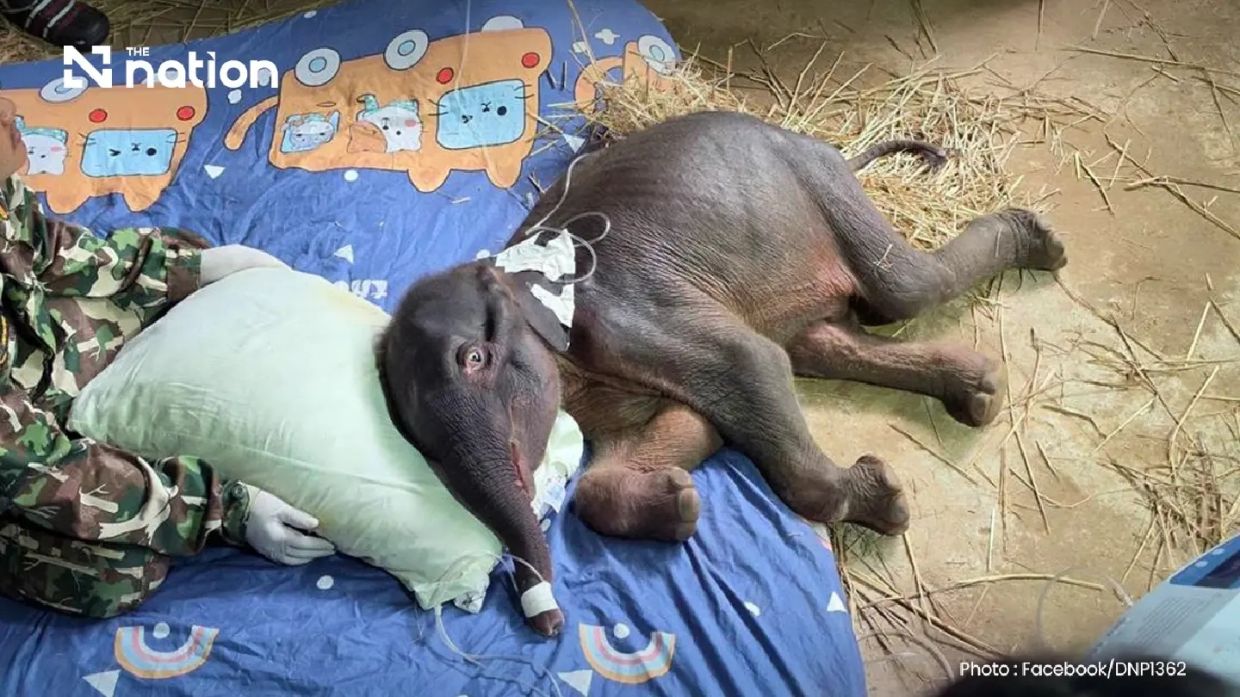
The Department of National Parks, Wildlife and Plant Conservation announced the death of Jiew Sai Yok early Tuesday morning, August 4, after the orphaned elephant calf succumbed to what veterinarians believe was acute kidney failure. The animal, which had been separated from its wild herd and placed under intensive care at Sai Yok National Park in Kanchanaburi province, passed away at approximately 2am following round-the-clock medical treatment. The loss underscores the precarious situation facing young elephants when separated from their mothers, a growing concern across Southeast Asia as habitat loss and human-wildlife conflict increase pressure on wild populations.
Jiew Sai Yok's journey began on July 30 when local villagers discovered the distressed calf near the Huai Mae Nam Noi riverbank in a remote area that proved difficult to access even by boat. The young animal appeared abandoned and showed clear signs of prolonged separation from its mother, displaying weakness and general distress. Rescuers and villagers initially remained overnight at the location, hoping the elephant herd would return to retrieve the calf. Throughout that first night, the animal repeatedly called out for its mother, yet no response came from any nearby adults, suggesting the herd had either moved on or been unable to locate the stranded juvenile.
When veterinarians arrived on July 31 to conduct a preliminary assessment, the scope of the calf's medical challenges became apparent. The journey to the site required up to two hours by boat, and heavy rainfall had swollen waterways, complicating access further. Medical staff found the young elephant suffering from severe dehydration, with numerous sores and abrasions covering its body. Most concerning were canker-like wounds inside the mouth, including one lesion approximately the size of a 10-baht coin, alongside blisters with necrotic tissue on its trunk. The calf exhibited signs of conjunctivitis from insect infection around its eyes and was producing dark yellow-red urine indicative of either infection or severe dehydration. Its digestive system was also compromised, with diarrhoea and a characteristically sour-smelling stool suggesting intestinal distress.
Based on these findings, officials transferred the calf to the national park headquarters, where veterinary teams established a comprehensive 24-hour monitoring and treatment protocol. The animal required continuous intravenous fluid administration to combat its dehydration, alongside supplemental oxygen support to aid its respiratory function. Despite its weakened state, Jiew Sai Yok demonstrated considerable will to survive, consuming milk in quantities of 350 to 500 millilitres every two to three hours. Caregivers noted that although the calf occasionally rallied enough to attempt standing, its underlying condition continued to deteriorate, evidenced by persistent diarrhoea and the continued dark colouration of its urine.
The calf's condition remained fragile throughout the treatment period, reflecting the complex medical challenges posed by prolonged separation and malnutrition. Veterinarians suspect that in addition to acute kidney failure revealed through blood tests, the elephant may have harboured congenital abnormalities in its internal organs that contributed to its decline. Such congenital issues can remain undetected until an animal experiences the stress and physiological demands of life outside the womb, making them particularly difficult to manage in rescue scenarios. The combination of environmental trauma, severe dehydration, and potential developmental complications created a medical situation that proved beyond the capability of even intensive veterinary intervention.
At 2am on August 4, after remaining responsive and seemingly stable enough to continue feeding throughout the night, Jiew Sai Yok fell asleep and did not wake. The veterinary team immediately initiated full resuscitation procedures in an attempt to reverse what they recognised as cardiac failure, yet their efforts proved unsuccessful. The death marked the end of a seven-day rescue effort involving dozens of officials, veterinarians, and village community members who had worked collaboratively to save the animal's life. Park officials noted that the calf had fought courageously throughout its ordeal, remaining engaged with its caretakers and attempting to consume nourishment right until the moment of its death.
To determine definitively whether acute kidney failure or another underlying condition caused the calf's death, veterinary officials have scheduled a necropsy and collected tissue samples for comprehensive laboratory analysis. This procedure is essential not only for understanding what happened to Jiew Sai Yok but also for informing future rescue protocols when separated elephant calves are discovered. Data gathered from such cases helps wildlife professionals better anticipate medical complications and adjust treatment approaches to improve survival rates in subsequent rescues.
The incident reflects broader challenges facing elephant conservation in Thailand and across Southeast Asia. As human settlements expand into forest regions and agricultural zones encroach on traditional migration corridors, young elephants are increasingly at risk of separation from their herds. In many cases, separated calves cannot survive independently; they require maternal milk, protection from predators, and transmission of cultural knowledge about water sources and safe migration routes that only established herd members can provide. Orphaned calves that cannot be reunited with wild populations sometimes enter human care facilities, yet the transition from wild to captive conditions carries its own health risks.
The Department of National Parks extended formal recognition to all veterinarians and rescue personnel involved in Jiew Sai Yok's care, acknowledging that their work, though ultimately unsuccessful, represented the most compassionate response possible to a crisis situation. The animal received medical attention that few wild elephants separated from their herds would ever access, a testament to Thailand's commitment to wildlife welfare. Nevertheless, the outcome underscores the limitations of rescue and rehabilitation when dealing with very young animals with complex medical needs and the critical importance of preventing separations in the first place through habitat protection and human-wildlife coexistence strategies.

