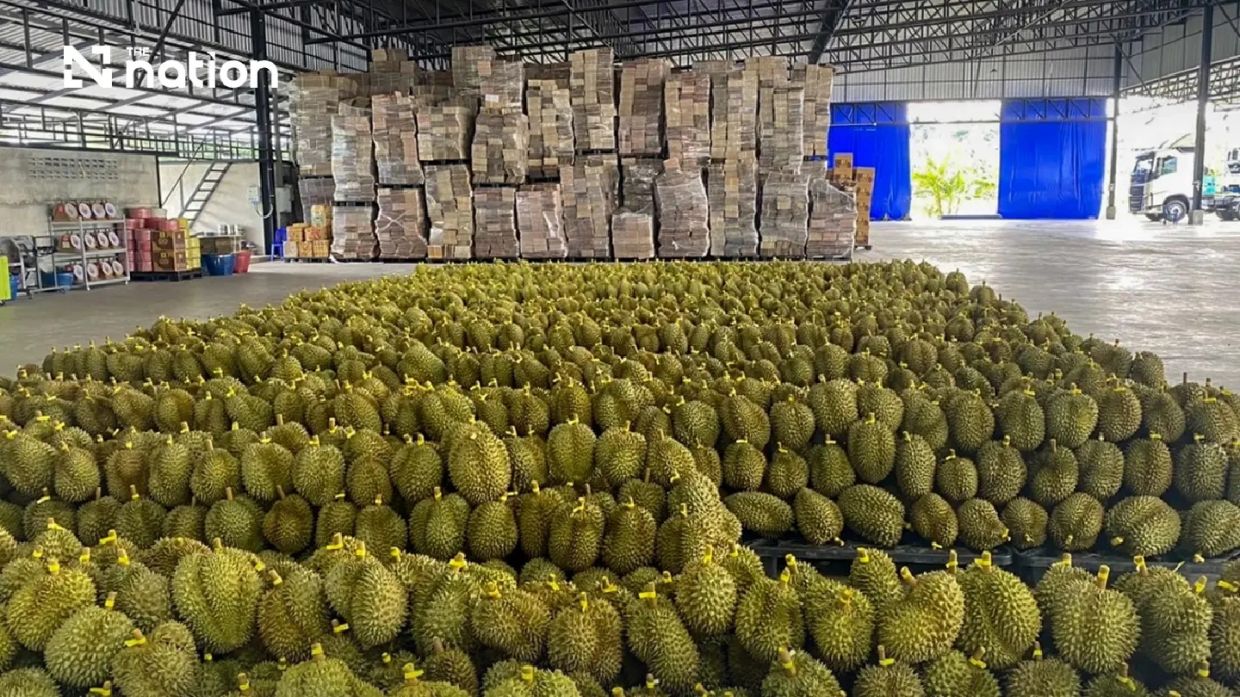
Thailand's fresh durian trade with China has reached a historic turning point, with export values exceeding THB100 billion during the first six months of 2026. The achievement represents not merely a statistical victory but signals a fundamental recalibration of how Southeast Asia's leading fruit exporter approaches quality assurance and market access. Through June 30, 2026, Thailand had shipped 53,665 containers of fresh durian to China, comprising 872,237.24 tonnes valued at THB100.07992 billion—a watershed moment in the kingdom's agricultural export narrative.
The breakthrough reflects a deliberate strategic pivot by Thailand's agricultural establishment, moving away from reactive problem-solving towards comprehensive, systematic quality governance across the entire value chain. Minister of Agriculture and Cooperatives Suriya Jungrungreangkit has championed this transformation during his initial months in office, implementing an overhaul that streamlines inspection procedures while simultaneously strengthening oversight mechanisms. This paradox—reducing bureaucratic touchpoints whilst elevating standards—has proven instrumental in accelerating shipments and bolstering buyer confidence across the strait.
Central to this success are the reinforced "Four Nos" protocols, which explicitly prohibit immature fruit, insect infestations, origin fraud, and contamination by Basic Yellow 2 (BY2), a synthetic dye that had previously triggered alarm among Chinese regulators. These measures directly address persistent sanitary and phytosanitary challenges that previously undermined Thailand's market position. Beyond these foundational safeguards, the government has implemented a four-layer PLUS screening system targeting plant pests, integrated risk management protocols grounded in scientific assessment, and comprehensive traceability mechanisms linking production sites through packaging facilities to the final electronic phytosanitary certificate issued at export. This granular architecture transforms durian exports from a loose collection of individual transactions into a coordinated, verifiable supply network.
The technological dimension of this upgrade deserves particular attention for regional policymakers contemplating similar export optimization initiatives. Thailand's integration of the electronic phytosanitary certificate (e-Phyto) system represents a modernization leap that enhances transparency while reducing document-handling delays that historically plagued agricultural trade. By linking real-time data from production sources and testing laboratories directly to certification systems, Thai authorities have simultaneously decreased the administrative burden on farmers and exporters whilst providing Chinese authorities with granular visibility into product provenance and quality metrics. This digitalization exemplifies how emerging economies can leverage technology to compete on quality rather than price alone.
For Malaysian stakeholders in agriculture and trade, Thailand's durian export success offers instructive lessons about market consolidation and supply chain leadership. Thailand controls approximately 60 percent of global durian production and commands an overwhelming share of fresh durian exports to China, the world's largest consumer market. By establishing itself as the gold-standard supplier through rigorous quality systems, Thailand has essentially constructed barriers to competition that extend beyond simple cost advantages. As Malaysia and other regional producers contemplate expansion of their own durian exports—particularly to affluent Asian markets—the Thai model demonstrates that regulatory infrastructure and systematic quality assurance may ultimately prove more valuable than raw production capacity.
The government's full-year export target of THB150 billion signals confidence that the first-half momentum can be sustained throughout 2026. Achieving this would require approximately THB50 billion in additional exports during the second half, a challenging but plausible target given seasonal availability patterns and the established quality frameworks now supporting transport and clearance operations. The midyear achievement already exceeds many analysts' expectations, suggesting that the streamlined procedures and reinforced buyer confidence are generating tangible commercial benefits beyond previous projections.
Rapibhat Chandarasrivongs, Director-General of the Department of Agriculture, has characterized the shift as a movement toward becoming a "Smart Regulator"—an institutional posture that emphasizes science-based risk management and technological enablement rather than command-and-control inspection regimes. This conceptual reframing carries implications extending well beyond durian exports. As governments across Southeast Asia grapple with balancing regulatory legitimacy against trade facilitation, Thailand's experience suggests that strategic deployment of data systems, collaborative governance frameworks involving farmers and operators, and transparent quality metrics can actually strengthen regulatory authority whilst reducing friction in commerce.
The supply chain overhaul required unprecedented coordination among the Department of Agriculture, the National Bureau of Agricultural Commodity and Food Standards, the Department of Agricultural Extension, the Customs Department, provincial authorities, testing laboratories, commercial operators, farming communities, and Chinese regulatory counterparts. This horizontal integration across normally siloed government agencies and vertical integration spanning farm to export point exemplifies the governance innovations increasingly necessary for agricultural competitiveness in an era of intensifying food safety expectations and complex supply chain requirements.
Suriya Jungrungreangkit has framed the durian success as foundational to broader agricultural export management, suggesting that the systems and protocols developed for durian could serve as templates for other fruit, vegetable, and processed agricultural products destined for international markets. This replicability angle matters considerably for Thailand's long-term agricultural competitiveness, as the kingdom produces numerous high-value export crops including mangosteen, longan, and processed seafood products. If the durian model can be adapted and scaled across multiple product categories, Thailand could consolidate a more durable competitive advantage rooted in institutional capability rather than temporary cost advantages or commodity price fluctuations.
For Chinese importers and distributors, the enhanced Thai durian supply chain offers reduced compliance risk and shorter delivery timelines, factors that directly influence retail pricing and product availability in major urban centers. The elimination of BY2 contamination concerns and cadmium detection anxieties that previously generated costly recalls or shipment rejections has restored commercial confidence and predictability. This restoration of trust translates into steadier purchasing patterns, more favorable contract terms for Thai suppliers, and reduced price volatility—advantages that cascade through the entire export ecosystem.
The achievement arrives amid broader regional discussions about agricultural trade competitiveness, digital governance, and Southeast Asian positioning within Asian supply chains. As China increasingly prioritizes food security and supply chain resilience, countries demonstrating systematic quality governance and technological integration gain preferential market access. Thailand's durian export breakthrough, though superficially a sectoral success story, actually represents a model for how developing economies can leverage institutional innovation and technology adoption to sustain premium market positioning against cheaper competitors and secure long-term buyer relationships grounded in reliability rather than price competition alone.

