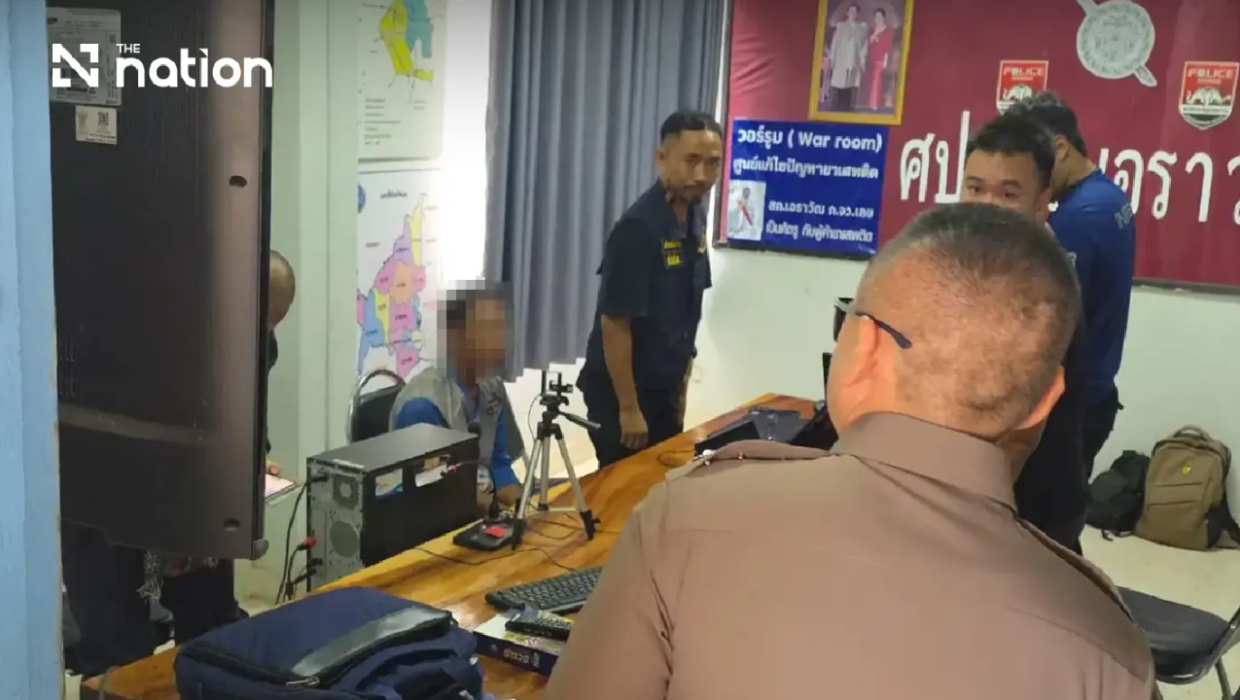
Thai police investigators in Loei province have taken a husband and wife into custody as part of an expanding inquiry into what authorities believe is a sophisticated cross-border drug smuggling operation. The arrests follow the detention of a Thai Airways flight attendant at Melbourne Airport, where Australian authorities discovered roughly one kilogram of heroin concealed in her luggage. The woman, identified in Thai media reports as Mina, triggered a chain of investigations that has now reached back to Thailand's northeast region, revealing what officials suggest is a coordinated network operating across multiple countries.
The cascade of events began when Thai authorities sought to identify who had dispatched the parcel that ultimately reached the flight attendant in Australia. Working backward from the Melbourne seizure, investigators gradually constructed a picture of a supply chain involving individuals at different points along the trafficking route. This methodical approach has become increasingly common in Southeast Asian law enforcement as drug trafficking organisations employ increasingly complex methods to evade detection. The strategy of using multiple intermediaries at various stages of the journey is designed to compartmentalise knowledge and minimise exposure for those higher up in the operation.
On Thursday, July 2, officers from Chiang Khan Police Station moved in on a residential property in That subdistrict of Loei's Chiang Khan district after receiving intelligence linking the occupants to the investigation. However, the suspects were not present at the initial address. Police then learned that Athit, aged 43, and Thatsaphon, aged 42, had taken work as rubber tappers in nearby Erawan district, a rural occupation that provides convenient cover for individuals seeking to avoid scrutiny while remaining mobile. This combination of economic activity and geographic mobility is typical of how criminal networks exploit the labour patterns of rural Thailand.
Investigators from the Office of the Narcotics Control Board and coordinating police units eventually located Athit at Wat Tham Pha Mak Ho temple in Wang Saphung district, where he was working on repairs to the temple roof. The discovery at an ostensibly legitimate workplace underscores how trafficking networks exploit the relatively fluid employment patterns in rural areas, where individuals move between temporary jobs without raising suspicion. Police brought him to Erawan Police Station for questioning, where Athit reportedly acknowledged his role in the operation during the initial interrogation phase.
According to police records of the preliminary inquiry, Athit admitted to being paid to send parcels to Bangkok on six separate occasions. The parcels transited through a parcel service based in Chiang Khan, with three dispatched from that location, two from Ban That in That subdistrict, and one from Erawan district. For each delivery completed, Athit allegedly received 8,000 baht, equivalent to approximately US$240. The remuneration, whilst modest by international standards, represents a significant incentive in rural Loei where daily wages for agricultural labour typically range from 200 to 400 baht. The most recent parcel in this series was reportedly sent on June 28, 2026, suggesting the operation had been running for several months at the time of discovery.
Authorities subsequently apprehended Thatsaphon, Athit's wife and a Lao national, after locating a black Mitsubishi Triton pickup truck bearing Loei registration plates parked in a rubber plantation in the Pha In Plaeng subdistrict of Erawan district. The vehicle's presence in that remote location, combined with other investigative leads, prompted police to bring her in for questioning as well. During her initial interrogation at Erawan Police Station, Thatsaphon denied any knowledge of or involvement in the drug operation, though her arrest suggests authorities believe she possessed relevant information or played an active role in the logistics of the operation.
Both detainees are now undergoing formal questioning by the Office of the Narcotics Control Board as investigators attempt to map the full extent of the network. The focus of this expanded inquiry is to identify individuals at all levels of the operation—those who ordered shipments, provided financial support, arranged logistics, and assisted in execution. This hierarchical approach reflects a broader law-enforcement strategy in the region of prosecuting not merely couriers and low-level operatives, but the organisational structure behind them. The involvement of Thatsaphon, a Lao national married to a Thai national, also highlights how transnational drug networks exploit cross-border family and community ties to facilitate operations.
According to the Secretary-General of the Office of the Narcotics Control Board, the case demonstrates the operational methods employed by international narcotics organisations seeking to move drugs whilst minimising risk to their core members. By distributing tasks across multiple individuals in different locations and countries, these networks create redundancy and compartmentalisation that makes it difficult for law enforcement to trace the complete operation. The official emphasised that successful investigation of such networks depends critically on cooperation between Thai and foreign law-enforcement agencies, a factor that proved crucial in identifying the links connecting Melbourne, Bangkok, and rural Loei.
The breakthrough in this case reflects an increasing willingness among Southeast Asian nations to coordinate on drug trafficking investigations, particularly when the trafficking involves citizens or territory belonging to multiple countries. The flow of information from Australian authorities about the Melbourne seizure to Thai investigators, combined with Thai intelligence-gathering about the parcel sender, demonstrates the operational possibilities when countries share information proactively. However, the reliance on such cooperation also reveals the limitations of purely domestic law enforcement, particularly in regions where trafficking networks deliberately exploit weak points in international information-sharing protocols.
Moving forward, the Office of the Narcotics Control Board has committed to intensifying its investigation and pursuing legal action against all identified participants in the operation. The agency plans to strengthen bilateral and multilateral cooperation frameworks with foreign law-enforcement counterparts, with the explicit goal of intercepting shipments before they leave Thailand, disrupting established transport routes, and tracing and freezing financial flows associated with the operation. These measures align with the Thai government's broader drug-suppression policy, which emphasises interdiction at source and dismantling the organisational structures behind trafficking operations rather than focusing exclusively on street-level enforcement.
For Malaysia and other Southeast Asian nations, this case illustrates a persistent vulnerability in the region's borders and law-enforcement capacity. Thailand's location as a transit point for drugs originating from the Golden Triangle and destined for markets in Australia and beyond means that Kuala Lumpur and other regional capitals face similar challenges in detecting and interdicting narcotics before they leave the region. The case also demonstrates how criminal networks exploit rural employment patterns and cross-border family networks to move contraband, a tactic that poses challenges for countries seeking to modernise their border security and law-enforcement approaches. As these investigations continue, they may reveal further insights into how international trafficking organisations structure their operations to minimise exposure.

