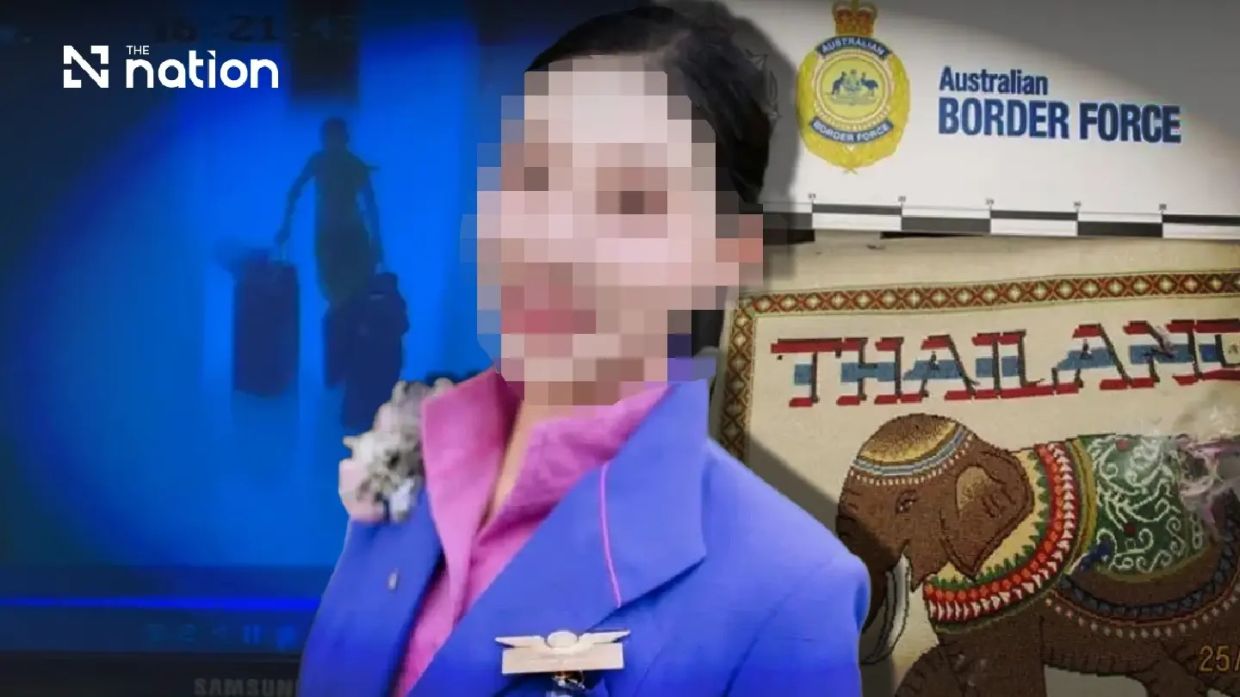
Thai narcotics authorities are expanding an investigation into a flight attendant arrested with 900 grammes of heroin at Melbourne Airport, with mounting evidence suggesting she may have been manipulated by an international smuggling network rather than knowingly participating in drug trafficking. The Office of the Narcotics Control Board (ONCB) has positioned her as a detainee rather than an accused person while Thai authorities coordinate with Australian police to build a defence case, signalling official scepticism about her culpability.
The emerging picture paints a sophisticated operation that exploits the travel routines of airline workers. According to Areepak Ngernbamroong, deputy secretary-general of the ONCB, the smuggling ring uses social media avatars to bombard flight attendants and frequent international travellers with offers of quick money for carrying parcels across borders. This recruitment method suggests the network operates on a scale that requires constant supply of couriers, rather than relying on a handful of known accomplices. The approach targets a vulnerable population: employees whose international mobility makes them valuable to traffickers but who may lack street-level awareness of criminal networks.
The Bangkok connection reveals an operation with considerable sophistication and resources. Related arrests in the Thai capital led to seizures exceeding 26 kilogrammes of heroin, a quantity substantial enough to indicate this is no small-time operation. The Department of Special Investigation (DSI) has assumed control of the Bangkok cases, a jurisdictional decision that reflects official assessment that Thailand is dealing with a transnational criminal organisation rather than isolated smugglers. The involvement of a Lao couple in the distribution chain further suggests cross-border coordination, with different criminal actors specialising in separate roles within the supply chain.
At the Australian end, investigators have identified the intended recipient of the heroin shipment as an individual known as Dear, a Thai national of genuine identity who has resided in Australia for approximately a decade. Thai authorities remain uncertain about Dear's legal status in Australia, whether as a temporary resident or naturalised citizen. The Australian Federal Police have taken the lead in mapping the full extent of Dear's network and identifying the ultimate destinations for the confiscated narcotics. That Dear has allegedly received similar shipments through the same courier mechanism on multiple previous occasions suggests an established operational pattern rather than spontaneous or opportunistic smuggling.
The flight attendant's account to authorities contains details that potentially exonerate her of intentional involvement. Her boyfriend told investigators that she opened and inspected the elephant-patterned bags delivered by a courier before packing them into her luggage, finding nothing suspicious inside. The suitcase then passed through Thai airport security screening without detection. This sequence suggests either the heroin was inserted after the inspection or that the woman genuinely believed she was transporting legitimate merchandise. The involvement of her boyfriend as a witness also indicates she did not behave like someone knowingly smuggling drugs, as she made no attempt to hide her activities from a close family member.
The payment arrangement raises questions about her level of complicity. Australian police reportedly uncovered a figure of 8,800 baht (approximately US$264) on a mobile phone during their investigation. However, Thai investigators have not yet confirmed this amount through bank records or identified the source. Earlier reports suggested two transfers of 1,700 baht each, one upon receipt of goods and another when an airline ticket became available, totalling just 3,400 baht. Bank account checks have not revealed these transactions, and the relatively modest sums involved do not align with payments typically offered to knowing accomplices in large-scale drug trafficking operations. The discrepancies in payment evidence underscore why authorities have not yet formally charged the woman.
The courier who delivered the parcel, a male rider working for a delivery service, provided statements that further complicate assumptions about the flight attendant's culpability. He reported having made similar deliveries three or four times previously but claimed this was his first delivery to this particular woman. If substantiated, this detail suggests the smuggling network maintains lists of regular recipients and makes calculated decisions about introducing new participants into the system, rather than operating haphazardly. His prior deliveries imply the network had established channels operating undetected, making the busting of this particular shipment a matter of chance interception rather than investigative breakthrough.
The Golden Triangle context illuminates the scale of the challenge facing Southeast Asian authorities. The border regions of northern Thailand, Laos, and Myanmar remain the world's primary opium production zones. Historically, traffickers moved narcotics into Thailand through the northern frontier, but increased interdiction efforts there have prompted networks to shift operations eastward. The north-eastern border regions, particularly around Nakhon Phanom, Bueng Kan, Loei, and Nong Khai where the Mekong River is relatively narrow, have become preferred routes. The geographical challenge of policing such extensive waterways, combined with the involvement of Lao actors in distribution networks, illustrates why transnational coordination remains essential but insufficient.
The shift from border-based trafficking to international air travel represents an evolution in smuggling strategy. Rather than attempting to move bulk quantities across land borders where detection risks have increased, networks now embed smaller shipments in the luggage of unsuspecting airline personnel. This approach spreads risk across multiple couriers while maintaining plausible deniability for each individual participant. A single flight attendant carrying heroin poses less conspicuous a target than a truck filled with contraband. The recruitment of workers through social media deception represents a cost-effective way to generate supply of human mules without building large criminal organisations in destination countries.
Thailand's legal framework and diplomatic coordination with Australia will shape the flight attendant's prospects. By positioning her as a detainee rather than an accused party, ONCB officials have preserved her legal defences while investigations continue. Thai authorities have provided evidence to Australian counterparts specifically to support her in legal proceedings, a gesture indicating official assessment that inadequate evidence of intentional participation exists. The participation of Thai diplomatic missions suggests the government views her as a potential victim of criminal exploitation rather than a knowing participant in trafficking.
For Malaysia and other Southeast Asian nations, this case exemplifies the sophisticated methods now employed by major drug trafficking networks. The recruitment of airline workers through social media deception could easily extend to Malaysian carriers and personnel. The involvement of multiple nationalities and the coordination across borders demonstrates that traditional law enforcement approaches focused on individual arrests prove insufficient. The case also illustrates the complications faced by judicial systems when victims of trafficking schemes find themselves facing drug charges in foreign jurisdictions, raising questions about how regional legal frameworks address such scenarios.
The ongoing investigation will determine whether the flight attendant becomes formally charged or permitted to return home. Regardless of outcome, the case has exposed operational methods likely replicated across multiple smuggling routes and airlines throughout the region. The heroin seized at Melbourne may represent merely one shipment in a far larger operation, with the network continuing to target other vulnerable workers through false online personas. Thai authorities' emphasis that this case may constitute only one operational line of a larger Golden Triangle-connected organisation suggests the confiscation in Australia disrupted limited flows in what remains a vast smuggling enterprise.

