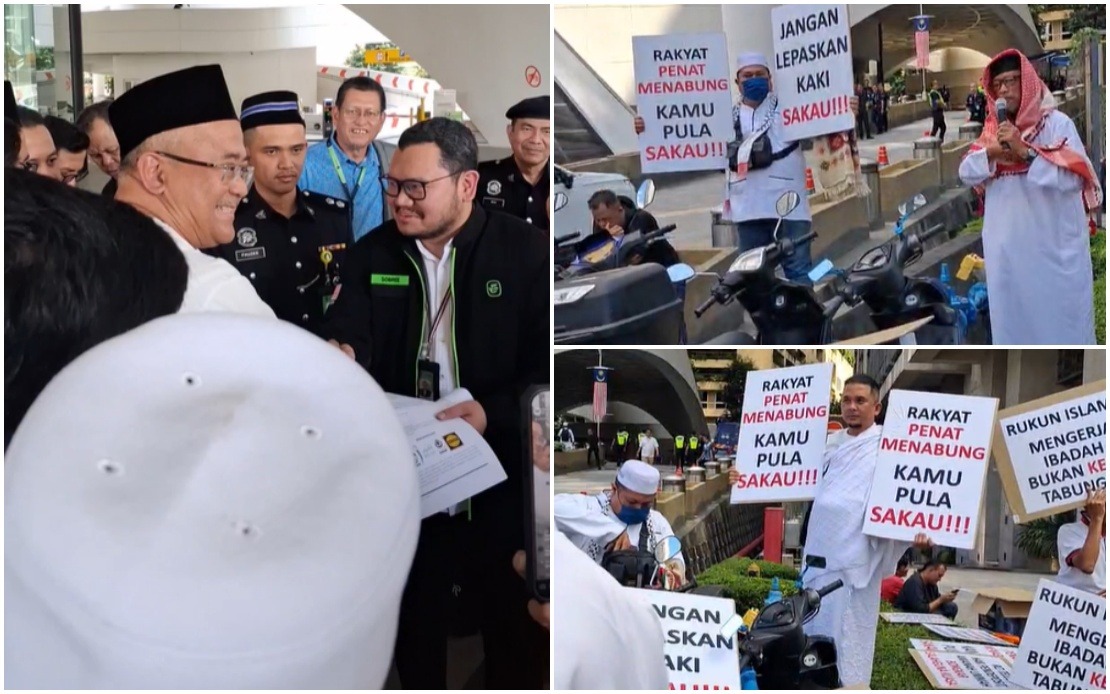
The head of MADANI has made an emphatic call for complete autonomy in prosecuting the findings of the Royal Commission of Inquiry into Lembaga Tabung Haji, insisting that authorities be allowed to pursue investigations and court cases without obstruction from political actors. Speaking at a solidarity gathering in front of Menara TH in Kuala Lumpur, Amir Zuhair Abdull Khalid underscored that the accountability process must follow established legal channels and that no party should seek to influence the outcome through backdoor pressure or interference with investigating agencies.
The RCI report, which examined governance and management practices spanning 2014 to 2020, has uncovered serious irregularities warranting formal legal action. Amir Zuhair expressed support for the Prime Minister's commitment to pursuing wrongdoing while simultaneously warning that the investigation and prosecution machinery must operate free from political manipulation. He specifically cautioned against attempts to pressure the Malaysian Anti-Corruption Commission, the primary enforcement body tasked with examining the alleged misconduct identified in the inquiry.
This issue carries profound significance beyond routine political controversy because it strikes at the heart of institutional trust and the stewardship of funds belonging to millions of Muslim depositors who have placed their savings with Tabung Haji in good faith. The deposits represent retirement savings, pilgrimage funds, and financial security for vulnerable populations, making the integrity of the institution non-negotiable. The RCI's work has exposed governance failures that demand not just public acknowledgment but decisive legal consequences to restore confidence in the system and deter future mismanagement.
The inquiry revealed troubling patterns including allegations of political interference in the organisation's governance structures and the appointment of board members who lacked appropriate qualifications or independence. These findings suggest a systemic problem where political considerations may have compromised fiduciary responsibilities. Such structural failures undermine the institution's capacity to serve its constituents effectively and raise questions about accountability mechanisms within Malaysia's statutory bodies more broadly.
Amir Zuhair has articulated an important principle: determinations of guilt or innocence cannot be made in the court of public opinion or through political posturing, but must emerge through proper investigation, evidence-gathering, and judicial proceedings. He acknowledged that those facing potential charges will naturally protest their innocence, but stressed that only courts equipped with full evidentiary materials and bound by rules of procedure can render legitimate verdicts. This approach reflects a commitment to due process while refusing to countenance institutional capture or selective enforcement.
The call for non-interference takes on added weight given historical patterns where high-profile investigations have sometimes stalled or been compromised by political pressure. Malaysia's experience with institutional accountability has not always been smooth, with some cases fading from public attention or resolutions appearing suspiciously convenient. Maintaining investigative independence therefore becomes a test of institutional maturity and the government's genuine commitment to the rule of law rather than rule by political convenience.
A coalition of Islamic civil society organisations, including HIKAM and affiliated groups such as WADAH, IKRAM, HALUAN, and ABIM, has formalised ten specific demands arising from the RCI findings. These demands extend beyond symbolic action and encompass concrete requirements: initiating legal proceedings against those found culpable, recovering misappropriated losses and assets, implementing the RCI's formal recommendations, and sustaining governance reforms under the MADANI administration. This multi-faceted agenda reflects recognition that investigations alone are insufficient; systemic reform must follow to prevent recurrence and rebuild institutional credibility.
For Malaysian depositors, particularly among lower and middle-income Muslim families who rely on Tabung Haji for major life expenses, the investigation's outcome carries practical importance. Recovered assets could potentially be restored to affected account holders, and reforms could strengthen protections for future contributors. The investigation thus functions both as accountability mechanism and as an opportunity to strengthen financial safeguards for vulnerable constituencies whose savings had been exposed to mismanagement.
The transparency imperative articulated by MADANI leadership also resonates with broader Malaysian governance discussions. Citizens increasingly expect public institutions to operate with accountability and to subject high-level wrongdoing to genuine legal processes rather than informal settlements. The TH investigation has become emblematic of whether Malaysia's institutions can credibly police themselves and hold powerful individuals responsible, or whether political connections continue to provide effective immunity.
Regional observers will be watching this case closely, as governance failures within statutory bodies and questions about political interference in enforcement represent challenges common across Southeast Asia. Malaysia's handling of this investigation could provide valuable lessons about institutional resilience and the practical possibilities for independent accountability in developing democracies. The stakes extend beyond restoring public confidence in Tabung Haji to demonstrating whether institutional reform is genuinely possible when political will exists.
Moving forward, the investigation's credibility will depend on sustained commitment to independence and transparent progress reporting. Public trust requires not just statements of intention but visible steps: clear timelines for prosecutions, comprehensive disclosures about findings, and demonstrable separation between investigative processes and political considerations. The coming months will test whether Malaysia's institutions can meet these demanding but essential standards.

