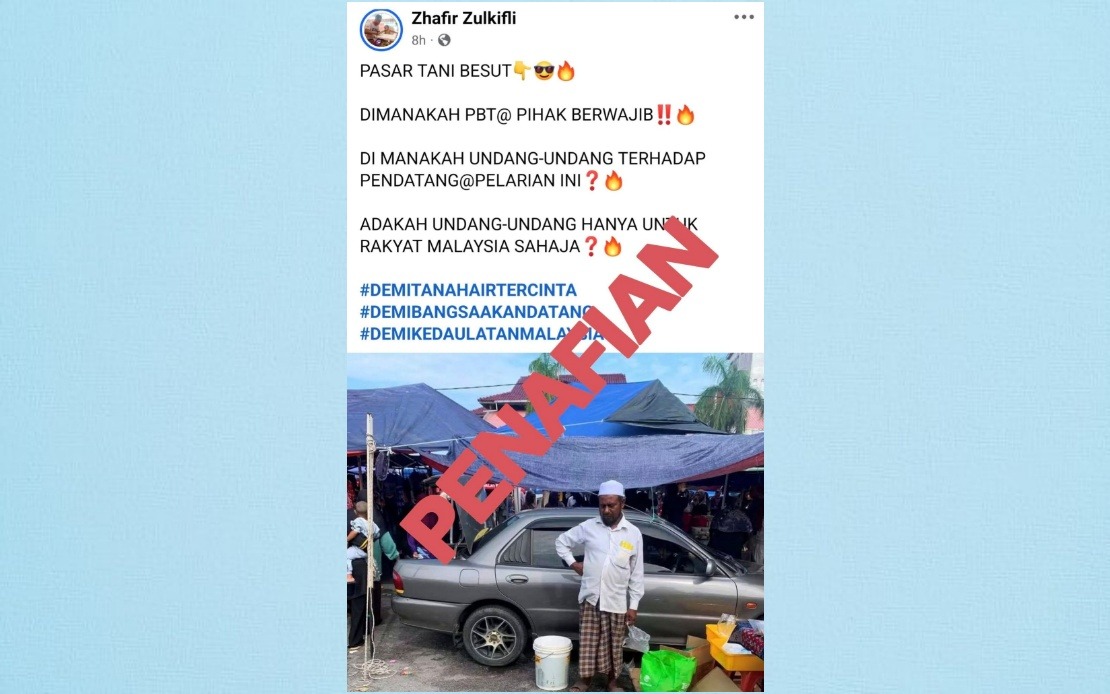
The Terengganu branch of the Federal Agricultural Marketing Authority (FAMA) has moved to counter misinformation spreading through Facebook, clarifying that allegations of unauthorised foreign traders operating at its farmers' markets lack factual foundation. The agency released a statement addressing a viral social media post from yesterday that purportedly showed a foreign national vending vegetables at a morning market in Besut, a concern that has resonated with local communities increasingly vigilant about informal market regulations.
According to FAMA Terengganu's official response, the incident referenced in the disputed Facebook post actually occurred at Kuala Besut Morning Market, an establishment that falls entirely outside the agency's purview and management structure. This distinction proves critical in understanding the regulatory landscape governing agricultural markets in Terengganu, where multiple market operators function with varying oversight arrangements. The authority emphasised that it maintains direct supervision over only two designated farmers' markets within the Besut district, each operating on specific schedules designed to serve local agricultural commerce efficiently.
The two FAMA-supervised markets in Besut operate with distinct schedules to facilitate farmer participation and consumer access. Jerteh Farmers' Market functions every Thursday between 7 am and 1 pm, providing a weekly platform for local agricultural producers. Meanwhile, Alor Lintang Farmers' Market serves the community on Saturdays during the same hours, ensuring market availability throughout the week. These controlled environments, FAMA stressed, adhere to stringent vetting procedures regarding vendor eligibility and citizenship requirements.
The viral post in question represents a broader pattern of misinformation that circulates across Malaysian social media platforms, often lacking verification before reaching thousands of users. The speed at which unconfirmed claims regarding foreign participation in domestic market activities can proliferate underscores challenges facing government agencies tasked with market regulation and oversight. FAMA's decision to issue a formal clarification demonstrates institutional awareness that permitting such allegations to circulate unchallenged could undermine public confidence in market management systems and regulatory frameworks.
For Malaysian agricultural traders and smallholder farmers, maintaining market access integrity remains economically significant. These farmers' markets represent crucial distribution channels for local producers to reach consumers directly, bypassing conventional wholesale intermediaries and capturing retail margins. Any suggestion that non-citizens could access these reserved platforms threatens both the economic sustainability of licensed farmers and the policy objectives underlying agricultural marketing authorities' establishment across Malaysian states.
Terengganu's context reflects broader Southeast Asian concerns regarding informal market regulation and the movement of goods through undocumented trade channels. The state, positioned along Malaysia's east coast with significant agricultural production and important port facilities, attracts diverse economic activity that sometimes operates beyond formal regulatory frameworks. Distinguishing between regulated FAMA facilities and informal morning markets becomes essential for policymakers assessing whether existing oversight mechanisms adequately protect domestic agricultural interests.
The incident also highlights the asymmetry between market perception and regulatory reality in contemporary Malaysia. Social media platforms facilitate rapid information dissemination without corresponding verification mechanisms, creating environments where uncertainty about government oversight can flourish. FAMA's requirement to issue formal denials of unsubstantiated claims reflects this digital information environment where official narratives must compete for credibility against unverified allegations presented through populist framing.
From a regulatory standpoint, FAMA's response indicates confidence in existing vendor screening procedures at its managed facilities. The authority's willingness to publicly reference specific operational details—market names, operating days, and hours—suggests systems in place capable of documenting trader participation and enforcing citizenship requirements. This transparency contrasts with the informal morning market sector, where oversight mechanisms remain considerably less formalised and documentation requirements potentially more elastic.
The broader implications for Malaysia's agricultural marketing sector warrant attention as market modernisation and formalisation efforts continue across states. Terengganu FAMA's clarification underscores tensions between expanding market accessibility and maintaining regulatory boundaries protecting designated beneficiary groups. As agricultural marketing authorities navigate pressures for economic openness against protectionist impulses, distinguishing legitimate regulatory enforcement from xenophobic sentiment becomes increasingly consequential for policy credibility and international commercial relations.
Moving forward, the incident suggests value in proactive communication strategies from government agencies addressing agricultural sector concerns. FAMA's rapid response prevented misinformation from calcifying into public perception, but the episode illustrates how quickly regulatory agencies must react to social media allegations affecting their operational legitimacy. For Malaysian readers invested in agricultural policy and market structure, this episode demonstrates ongoing tensions between informal and formal market sectors, and the continuing challenges authorities face in maintaining regulatory clarity within increasingly digitised public discourse environments.

