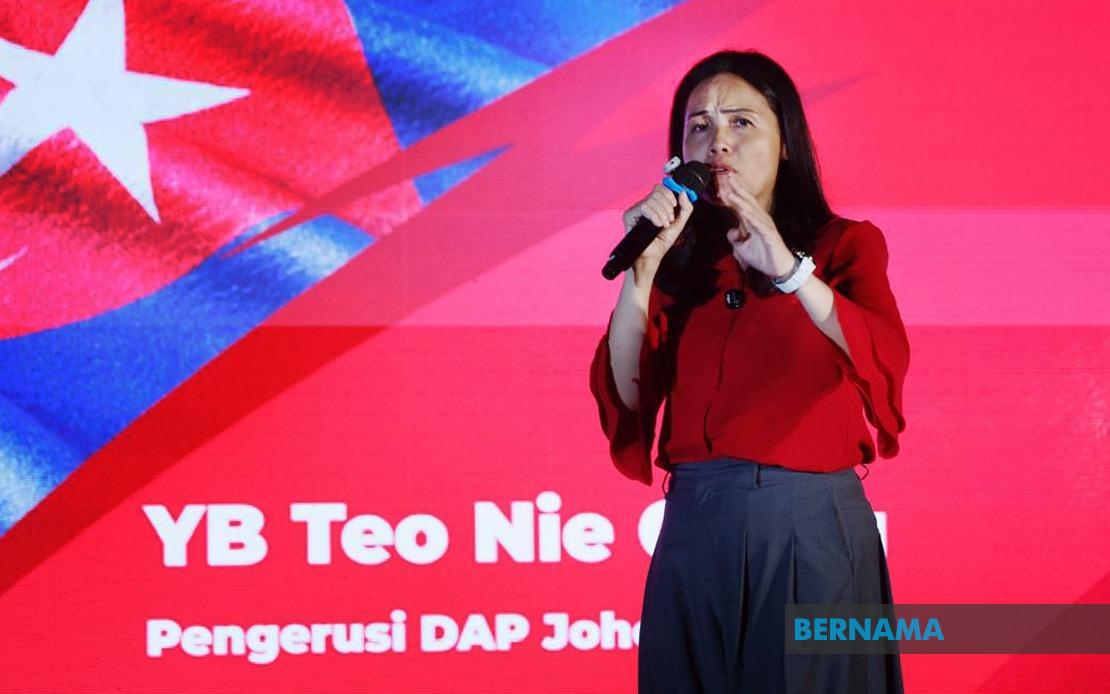
In a pointed critique delivered at a Paloh rally on Monday night, Johor DAP chairman Teo Nie Ching raised fundamental questions about the rationale underpinning the state government's controversial decision to establish positions for appointed state assemblymen, a move she fears could compromise the transparency central to democratic governance. Her remarks, made as the Pakatan Harapan coalition campaigns ahead of Saturday's general election, reflect growing unease among opposition figures about institutional changes that sidestep the traditional electoral process.
Teo, who serves concurrently as National DAP Wanita chairman and Deputy Communications Minister, articulated concerns that appointed assembly members would circumvent the essential accountability mechanism of voter scrutiny. Rather than being elected through the ballot box, these individuals would enter the legislature through an appointment process, potentially severing the democratic link between representatives and their constituents. This mechanism, she argued, raises legitimacy questions that the state administration has not adequately addressed.
The Johor State Legislative Assembly formally approved the amendments on May 7, authorising the appointment of up to five additional assemblymen ostensibly to strengthen the legislature's operational capacity and institutional balance. However, Teo's intervention suggests that elements within Pakatan Harapan view this expansion with suspicion, particularly given the political context in which it was enacted. The timing coincides with Johor's shifting political alignments following the previous general election, when governing coalitions underwent substantial reconfiguration.
Teo pointedly questioned who these appointees would actually be, hinting at strategic considerations beneath the surface. She specifically referenced the significant assistance the Johor government has received from PAS, a key coalition partner, suggesting that the appointment mechanism might become a tool for distributing political patronage among allied parties. This speculation touches on a persistent tension within Malaysia's unity governments—the potential for institutional reforms to mask factional interests rather than genuinely strengthening democratic institutions.
Calling for comprehensive public explanation from state authorities, Teo emphasised that accountability must remain paramount regardless of administrative convenience. Her demand for transparency reflects broader anxieties about how appointed positions might be deployed strategically to favour certain political constituencies or individuals, particularly those who may have failed to secure electoral mandates. Without clear criteria and public justification, she argued, such mechanisms invite cynicism about the authenticity of democratic processes.
Despite her criticism of this specific policy, Teo mounted a spirited defence of the Unity Government's broader reform trajectory, particularly highlighting education initiatives that she characterized as foundational systemic improvements. She pointed to guaranteed matriculation programme placements for all SPM students achieving ten A-grades, irrespective of socioeconomic background, as evidence that meaningful structural change is occurring despite the government's obvious imperfections. This initiative represents a deliberate attempt to democratize access to higher education pathways.
Educational access for students holding the Unified Examination Certificate similarly benefited from policy expansion under the current administration, addressing longstanding inequities affecting Chinese-medium school graduates. Teo specifically highlighted the allocation increase for Chinese independent schools, which rose substantially to RM20.16 million this year compared to just RM12 million in 2019—a 68 percent increase that demonstrates quantifiable commitment to educational pluralism. These concrete figures anchor her argument that the Unity Government has translated reform rhetoric into budgetary reality.
While acknowledging that the current administration cannot claim perfection, Teo framed incremental reform as inherently superior to systemic inertia. She positioned the government's achievements within a longer historical timeline, recognising that institutional change operates slowly and requires sustained commitment across multiple electoral cycles. This pragmatic acknowledgment—that democracy constitutes a marathon rather than a sprint—offers implicit justification for voters to maintain confidence in the current coalition despite inevitable shortcomings and controversial policies like the appointed assemblyman mechanism.
Teo's dual posture—criticizing specific institutional decisions while defending the government's overall reform agenda—reflects the complex positioning Pakatan Harapan must navigate as a coalition managing competing interests across multiple states and levels of government. The appointment mechanism in Johor exemplifies precisely the kind of governance decision that generates internal coalition tensions: politically expedient in the short term but potentially damaging to the unity government's democratic credibility if perceived as opportunistic or exclusionary.
With approximately 2.7 million voters expected to participate in Saturday's election to select 56 state representatives, Teo's intervention demonstrates that intra-coalition disputes remain live issues for campaign messaging. While maintaining public unity, DAP elements are clearly registering concerns about the direction of state-level governance, using pre-election rallies to signal to voters that oversight and accountability within the coalition continue functioning. This internal dialogue, conducted publicly, becomes part of the broader campaign narrative about which coalition better represents voters' interests.
The appointment controversy also intersects with broader Malaysian concerns about institutional integrity and representative democracy. As states and the federal government increasingly experiment with institutional modifications, public figures like Teo play an important role demanding explanation and justification rather than accepting administrative convenience at face value. Her challenge reflects a persistent tension in Malaysian democracy between pragmatic governance and principled adherence to democratic norms.

