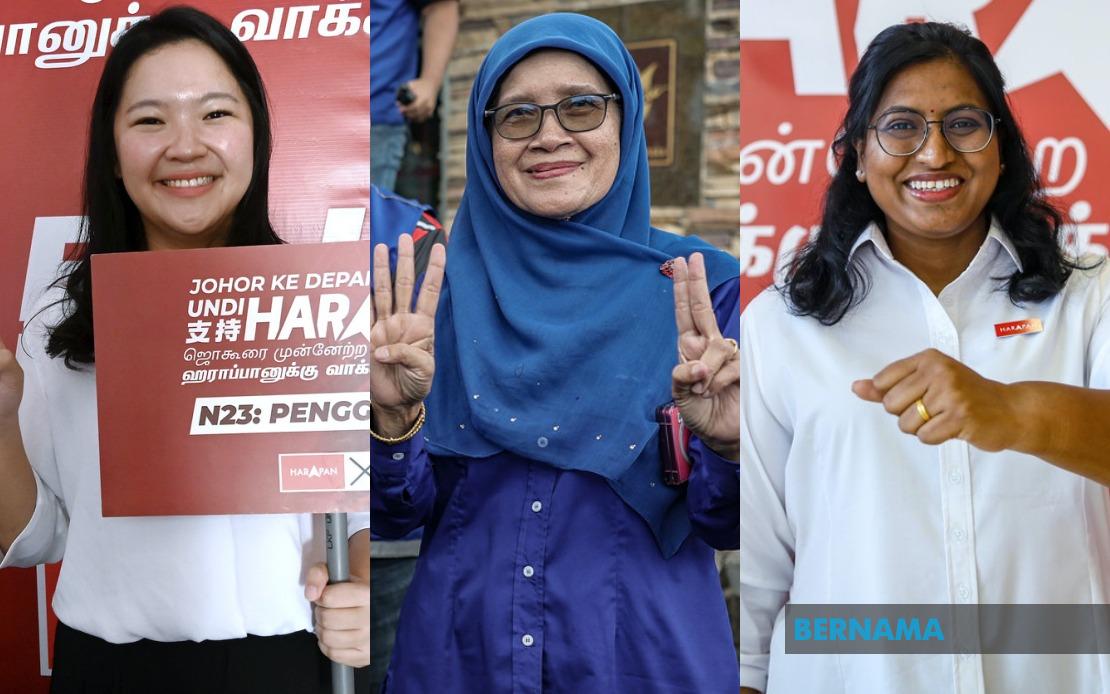
Women candidates demonstrated resilience and voter confidence in the Johor state election, with ten of the 34 female contenders successfully securing assembly seats. The results reflect a modest but meaningful presence of women in electoral politics within Malaysia's second-largest state by population, though their representation remains proportionally limited. This outcome carries significance not only for Johor's legislative composition but also for broader discussions about gender inclusion in Malaysian politics at a time when several states are reviewing their approach to women's political participation.
Barisan Nasional's dominance extended to its female candidates, who captured seven of the ten winning positions. Nadhirah Afiqah Abdull Rahim made a successful electoral debut by securing the Serom seat with a commanding majority of 9,406 votes, demonstrating that first-time female candidates can perform effectively at the ballot box. Her win was particularly noteworthy as she served as Ledang Puteri UMNO chief, indicating that party grassroots positions can serve as springboards for electoral success. The BN victory was built on diverse female representation, spanning candidates from different backgrounds and geographical constituencies across Johor.
Nor Rashidah Ramli's triumph in Parit Raja represented one of the coalition's most significant female victories, where she garnered 19,572 votes for a commanding majority of 13,576. This represented a substantial improvement on the 2022 state election outcome, when the same seat was won by a margin of just 4,219 votes, illustrating that BN's female candidates benefited from a swing in voter sentiment. Her ability to navigate a three-cornered contest and substantially increase the winning margin suggests voter confidence in her incumbency and legislative performance over the preceding term.
Alwiyah Talib's achievement in Endau marked her third consecutive electoral victory in the seat, cementing her status as one of Johor's most durable female representatives. Despite facing a four-cornered contest involving candidates from Perikatan Nasional, the Malaysian Orang Asli Party, and Pakatan Harapan, Alwiyah prevailed with a majority of 3,041 votes, demonstrating the resilience of incumbent advantage in multi-candidate races. Her sustained electoral success across three election cycles suggests effective constituency engagement and constituent services that transcend normal partisan fluctuations.
The remaining BN female victors extended across demographically diverse constituencies. Norlizah Noh secured the Johor Lama seat with a resounding majority of 16,344 votes, defeating both Perikatan Nasional and a notably young Pakatan Harapan candidate. Fauziah Misri achieved a landslide victory in Penawar with a majority exceeding 15,000 votes, while Hasrunizah Hassan not only retained Pulai Sebatang but substantially increased her winning margin from the previous election, gaining an additional 6,325 votes. Chan San San's capture of the Johor Jaya seat represented a noteworthy upset, as the constituency had been regarded as a stronghold for the Democratic Action Party, and her victory with 35,971 votes signals a significant shift in voter preferences at that particular location.
Packatan Harapan's three victorious female candidates demonstrated the opposition coalition's capacity to retain or build support through women representatives. Felicia Poh Rui Ling, aged 28, successfully defended the Penggaram seat in her maiden electoral contest, defeating her Barisan Nasional opponent by 4,137 votes in a direct contest. Her youth and victory suggest that PH voters value fresh female candidates who can articulate contemporary political perspectives. Chu Poh Yee retained the traditionally opposition-held Mengkibol seat, securing a majority of 4,213 votes against a Barisan Nasional challenger, demonstrating the durability of PH support in certain constituencies regardless of candidate gender.
Kartiyaini Jeyapalan, a lawyer representing Skudai, successfully navigated the most complex electoral contest among winning female candidates, facing opposition from Barisan Nasional, Bersama Malaysia, and Parti Sosialis Malaysia. Her majority of 15,280 votes indicates that Skudai voters overwhelmingly endorsed her retention, likely reflecting her professional credentials and incumbent performance. The three PH victories, while numerically smaller than the BN tally, came from diverse constituencies and demonstrated that the opposition coalition can effectively mobilise female voter support in selected locations.
The participation of 34 women candidates, representing nearly twenty percent of the total field of 172 contenders, reflects ongoing efforts to expand female representation in Malaysian electoral politics. However, this proportion remains substantially below parity with the general population, raising questions about whether party structures adequately encourage female candidacies or whether other barriers continue to limit women's entry into electoral competition. The contrast between the 34 women candidates and the 138 male candidates underscores the persistence of gender imbalances in political recruitment, even in states where some parties have made explicit commitments to women's advancement.
The election outcomes require contextualisation within Barisan Nasional's overwhelming victory, which yielded 48 of 56 contested assembly seats. This commanding result meant that electoral opportunities for opposition women candidates were inherently constrained by the coalition's superior performance across most constituencies. The fact that Pakatan Harapan captured just eight seats overall limited the numerical ceiling for female opposition representatives, regardless of candidate quality or voter enthusiasm. This structural reality suggests that discussions about gender balance in legislatures must account for broader shifts in partisan voting behaviour and coalition electoral fortunes.
For Malaysian political observers, the Johor results present both encouraging and cautionary lessons. The presence of accomplished female representatives across multiple constituencies, their ability to secure substantial majorities, and instances of increased support margins compared to predecessors suggest that voter acceptance of female candidates has matured considerably. Yet the modest overall proportion of women contenders and their concentration within the dominant governing coalition raises questions about systemic barriers to female political participation. States reviewing their approach to gender representation in politics might examine whether Johor's experience reflects ceiling effects that can only be surmounted through deliberate party policies mandating or encouraging increased female candidacies.
The election also demonstrates variation in female candidates' electoral performance across different geographical and social constituencies within Johor. Urban areas such as Johor Jaya showed capacity for political upset victories, while rural and semi-urban constituencies sustained incumbent female representatives across multiple election cycles. This geographic variation suggests that female candidates' electoral viability is not uniform across Johor but depends on local political dynamics, constituency demographics, and individual candidate factors including incumbency status and professional credentials. Future elections will determine whether the progress evidenced in this cycle consolidates into sustained female political participation or represents a temporary phenomenon dependent on specific electoral conditions.

