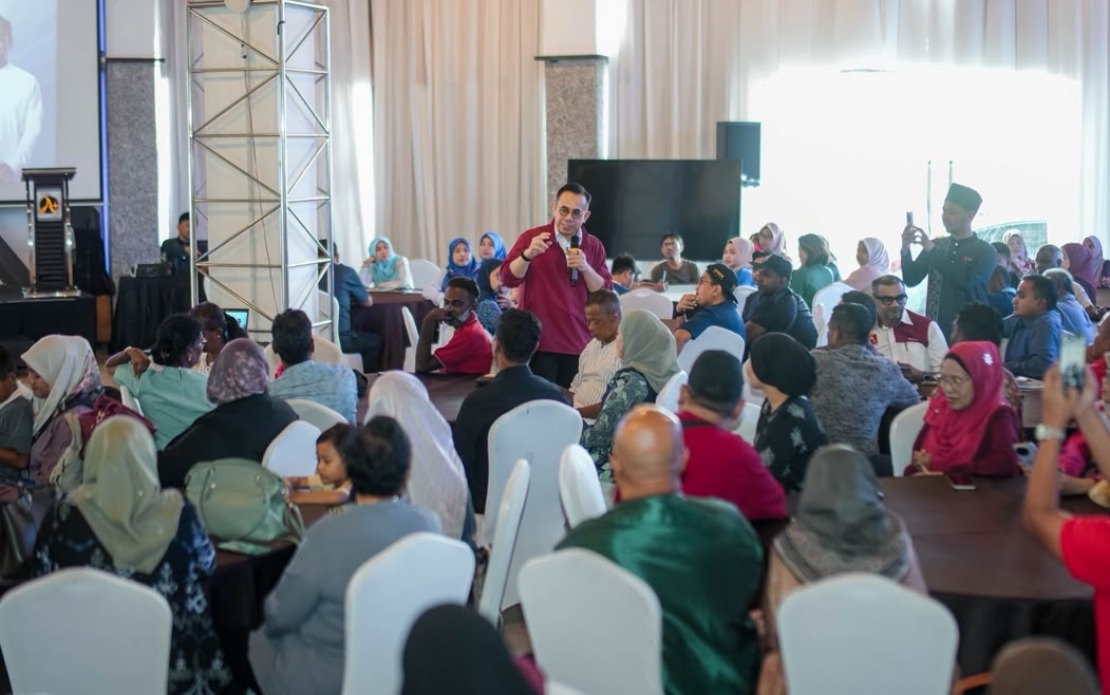
TEKUN Nasional, Malaysia's microfinance institution, has channelled RM36 million in financing to around 1,500 entrepreneurs in Negeri Sembilan by the end of June this year, part of broader nationwide efforts to democratise access to business capital. Entrepreneur Development and Cooperatives Minister Steven Sim Chee Keong disclosed the figures during a visit to Seremban, revealing that the national disbursement reached RM540 million across 25,600 entrepreneurs during the identical timeframe. These figures underline the scale of TEKUN's operations three decades after its establishment as a catalyst for small business development across Malaysia's diverse communities.
The minister's announcement comes alongside a strategic recalibration of TEKUN's operational processes, signalling recognition that speed and efficiency matter as much as capital availability for struggling entrepreneurs. Sim has mandated that all financing decisions on applications up to RM100,000 must be communicated within seven days, irrespective of approval or rejection outcomes. For micro-loans not exceeding RM20,000, the Ministry of Entrepreneur Development and Cooperatives (KUSKOP) is working toward a 24-hour decision window. These compressed timelines address a persistent complaint within Malaysia's entrepreneurial ecosystem: the frustration of delayed approvals that force business owners into limbo and jeopardise time-sensitive opportunities.
Beyond accelerating decisions, the minister has simultaneously stressed the necessity of rapid fund disbursement following approval. His reasoning is pragmatic: entrepreneurs require access to capital swiftly, and bureaucratic delays between approval and actual fund transfer undermine the entire purpose of the financing scheme. This dual focus—faster approvals coupled with expedited disbursement—represents an attempt to create a friction-free pathway from application to operational deployment, acknowledging that entrepreneurs operating in competitive markets cannot afford extended waiting periods.
A critical element of Sim's policy thrust involves depoliticising the financing process entirely. He explicitly stated that TEKUN applications require no political endorsement, party support letters, or intermediation by elected representatives or party figures. Each application must undergo professional, transparent evaluation grounded solely on applicant eligibility and business viability, regardless of an applicant's racial background, religious affiliation, or political alignment. This pronouncement, while ostensibly procedural, carries substantial weight in Malaysian politics, where patronage networks and political connections have historically mediated access to government resources and financing schemes.
The minister's colourful phrasing—declaring that entrepreneurs "wearing blue, green, or red" deserve equal consideration—underscores his intention to break the cycle wherein business owners felt compelled to seek political patrons or rely on third-party intermediaries to secure financing. By vowing to eliminate the "culture" of forced political dependence, Sim is attempting to reposition TEKUN as an institution governed by objective criteria rather than factional loyalty. Whether this aspirational vision can be sustained amid Malaysia's competitive political environment remains an open question, but the public commitment signals a determination to shift institutional culture.
Sim's visit to Seremban served partly as a feedback-gathering exercise, providing a platform where entrepreneurs could articulate their direct experiences with TEKUN's application, approval, and repayment cycles. Such engagement allows the ministry to identify operational bottlenecks and service delivery gaps grounded in real-world experience rather than theoretical assumptions. This practitioner feedback loop is essential for refining processes that bureaucrats or desk-bound policymakers might otherwise overlook.
The ministry has simultaneously broadened financing access for underrepresented communities through targeted allocation increases. The Indian Community Entrepreneur Development Scheme (SPUMI) has received a funding uplift from RM30 million to RM50 million, while the Indian Community Entrepreneur Financing Package (MUDRA) commands RM220 million in total financing for the current fiscal year. These enhancements reflect an acknowledgment that certain demographic groups historically faced greater friction in accessing entrepreneurial capital and that deliberate corrective measures are warranted.
Sim's framing of this financial inclusion work deliberately transcends communal boundaries, positioning microenterprise development as fundamentally a Malaysian competitiveness challenge rather than an ethnic affairs matter. His assertion that "all local businesses compete as Malaysian companies on the international stage" reframes entrepreneurship development from a social welfare or political patronage issue into an economic imperative. If Malaysian enterprises are to succeed globally, he argues, they must do so collectively and inclusively; domestic entrepreneurial competition among Malaysians is less significant than the unified competitiveness of Malaysian firms against international rivals.
This rhetorical framing carries implications for how TEKUN's mission is understood within Malaysia's political discourse. Positioning microfinance as an inclusive economic strategy rather than a racially demarcated welfare scheme potentially shields the programme from recurring tensions around bumiputera preferences, affirmative action, and resource distribution along communal lines. However, the establishment of community-specific schemes like SPUMI and MUDRA simultaneously maintains targeted programming, suggesting the ministry is attempting to balance universalist principles with recognition of specific group disadvantages.
For Malaysian entrepreneurs, particularly those operating in Negeri Sembilan and other states where TEKUN's penetration is deepening, these policy shifts offer practical improvements in access speed and legitimacy. The prospect of decisions within seven days or even 24 hours removes uncertainty that previously constrained business planning. The depoliticisation messaging, whether fully effective or not, provides some protection against demands for political intermediation or patronage. Entrepreneurs can increasingly reference objective criteria rather than factional networks as the basis for financing decisions.
The RM36 million deployed in Negeri Sembilan reflects sustained capital activity, though the relatively concentrated distribution across 1,500 entrepreneurs suggests average loans in the RM24,000 range, indicating TEKUN's focus remains on true microfinance rather than larger small business financing. This aligns with the aggressive timelines for approval, as smaller applications naturally warrant faster processing. The national figure of RM540 million across 25,600 entrepreneurs similarly indicates average disbursement around RM21,000, confirming TEKUN's positioning as a grassroots, microfinance institution serving Malaysia's informal and semi-formal entrepreneurial base.
Looking forward, the efficacy of these reforms will be measured not merely by approvals issued within seven days but by whether entrepreneurs actually perceive the process as merit-based, depoliticised, and accessible without political patronage. Building institutional trust requires consistency between declared policies and actual implementation across TEKUN's nationwide network. Minister Sim's public commitments create benchmarks against which civil society and entrepreneurial associations can subsequently evaluate institutional performance, adding accountability mechanisms to what traditionally operated as a relatively opaque bureaucratic domain.

