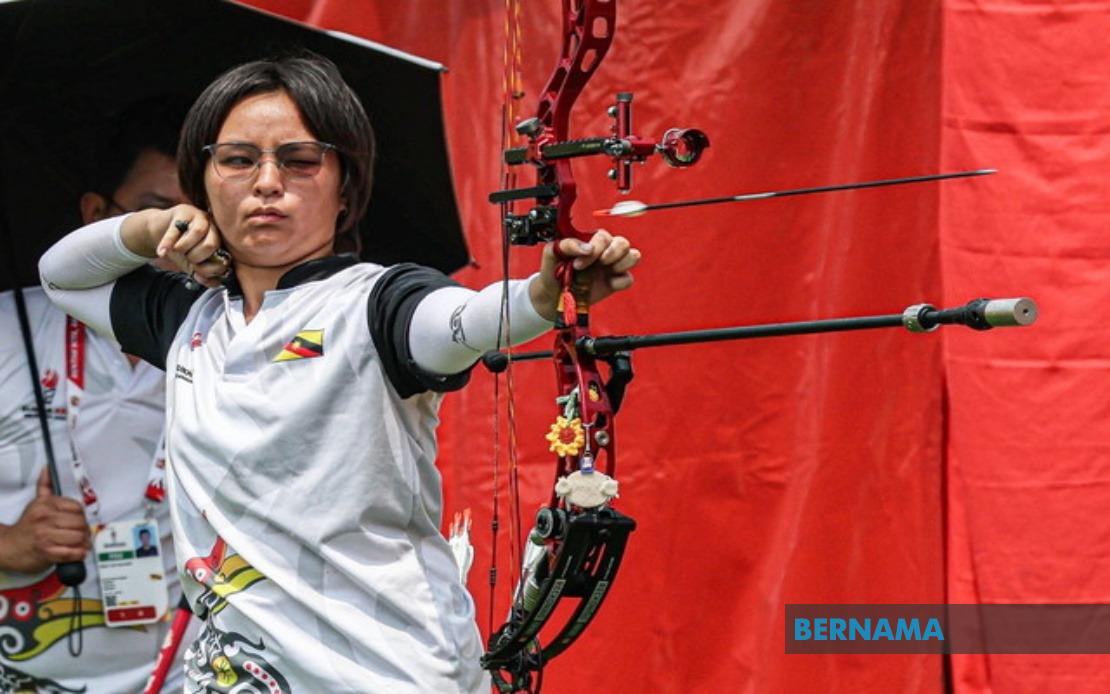
The decision to abandon the recurve bow for compound equipment has already vindicated itself for Sarawak's Wee Yee Qi, who captured two gold medals at the SUKMA 2026 archery competition at the National Institute of Valuation (INSPEN) Stadium in Bangi today, marking a triumphant maiden appearance for the 17-year-old archer at the biennial Games.
Wee Yee Qi's first success came in the mixed team final, where she partnered with Eason Lau Hui Wan to overcome Kedah's pairing of Muhammad Zaim Ahmad and Ili Nabihan Shafizan in a tightly contested match. The Sarawak duo edged their opponents 151-150, demonstrating the precision and composure required in compound archery where accuracy at distance determines outcomes. The narrow margin underscored the calibre of competition at Malaysia's premier multi-sport gathering, where every point carries significance.
The Miri-born archer then immediately added to her medal haul in the women's team event, completing a partnership with Aira Nadirah Aizuddin and Nur Zara Aisyah Khairul Fadly. The Sarawak trio mounted a remarkable recovery to defeat Terengganu 217-213, overturning a deficit that had accumulated over the opening three ends of their final match. This comeback victory highlighted both individual skill and the capacity for team cohesion under pressure, as the three athletes coordinated their performances to secure the decisive advantage in the final end against Terengganu's Airazalia Azrai, Nur Shafiena Mohd Shuhamri and Putri Aqiera Issandra Ismayuddin.
Yee Qi attributed her rapid success to the unwavering support of her coaching staff, who have shepherded her competitive journey and exposed her to diverse tournament environments that build experience beyond domestic competition. She emphasised that her six-year involvement in archery began with talent identification at school, an experience that sparked genuine passion for the discipline. The backing of her family has reinforced this commitment, creating the foundation necessary for sustained athletic development and progress.
The transition from recurve to compound represents a strategic recalibration after Yee Qi found herself unable to achieve competitive breakthroughs using the traditional bow format. This switch, undertaken late in the previous year, reflects an increasingly common pattern among developing archers who recognise that different disciplines suit different physical attributes and technical strengths. Compound archery, which employs a levering system of pulleys, demands different muscle engagement and sight alignment compared to recurve, potentially offering better compatibility with her particular biomechanics and competitive temperament.
Speaking immediately after her victories, Yee Qi acknowledged the instrumental role her coaches have played in orchestrating this transition and managing her progression through various competitive levels. She expressed gratitude for their guidance and the opportunities they have created for her to test herself against quality opposition. This developmental pathway, from school talent identification through provincial and national competition to SUKMA appearance, represents the intended progression for young Malaysian sporting talent.
Despite her early success, Yee Qi recognises the importance of academic priorities, directing her immediate focus toward the Sijil Pelajaran Malaysia (SPM) examination scheduled for November. This balanced approach to talent development—integrating education with athletic pursuit—reflects a mature perspective from the teenager. Following completion of these examinations, she intends to reconcentrate her energies on archery, with aspirations toward senior national team selection and representation of Malaysia at international forums.
Selangor provided the bronze medal contingent in the mixed team competition, with pairing Muhammad A'rif A'fiq Suhaimi and Nur Alyaa Nazurah Fadzil Fairuz defeating Sabah's Hiew Ichin and Catherine Looi Mei Qi Abdullah 154-152 in the third-place playoff. The Selangor women's team, comprising Amira Batrisyia Mohamad Azizul Rahman, Nur Alya Sofrina Mohd Sarif and Nur Alyaa Nazurah Fadzil Fairuz, similarly claimed bronze after their contest against other contenders concluded 219-212 in their favour.
Yee Qi's emergence holds particular significance for Sarawak's archery programme, as consistent medal performance at SUKMA strengthens the state's overall Games standing and demonstrates capacity to develop competitive talent across diverse sports. Her double gold at a debut appearance signals that the state's investment in talent identification and coaching infrastructure is generating returns. For Malaysian archery broadly, the visibility provided by SUKMA success helps elevate the sport's profile among potential recruits and sponsors, supporting the longer-term development pipeline.
The compound archery format in which Yee Qi competes continues to expand globally, with increasing integration into international competition structures. Malaysia's development of technical expertise in compound archery positions the nation competitively within this growing discipline, particularly important given regional competition from neighbouring nations developing their own compound programmes. Yee Qi's success at this formative stage of her career provides encouragement that sustained commitment to this technical discipline can yield results at successive competition levels.

