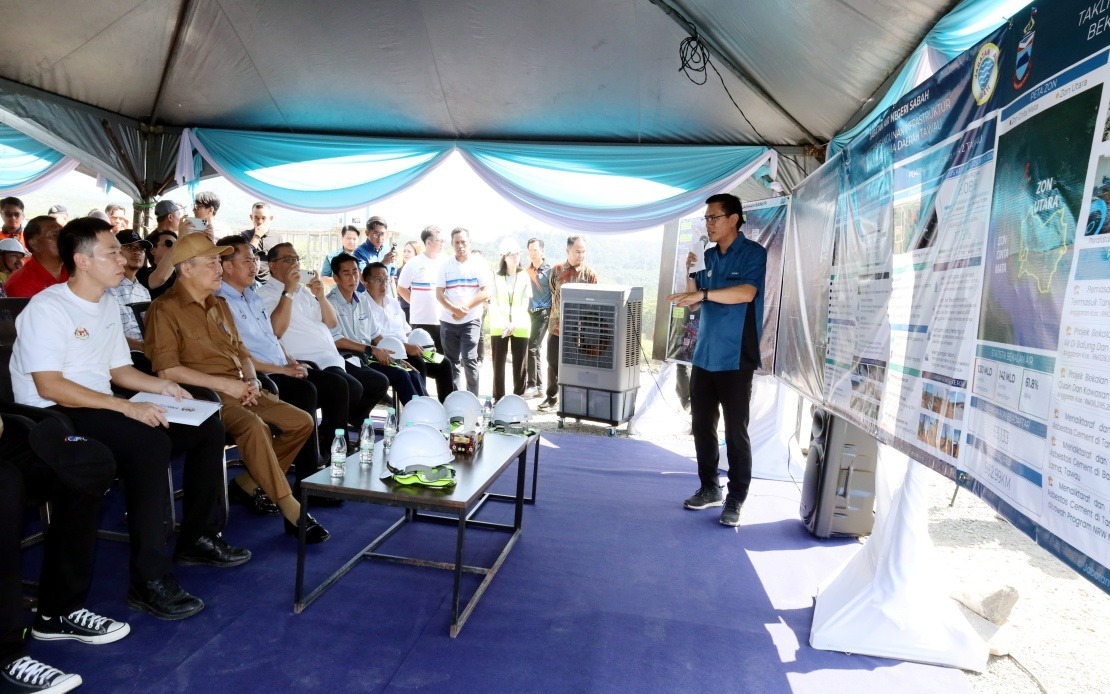
Tawau residents facing decades of water supply constraints may finally see relief before 2028, as a major infrastructure initiative to transform the Sabah city's water security enters its final phase. The RM450.5 million Tawau Water Supply Scheme Phase III represents one of the state's most ambitious hydraulic engineering ventures, designed to eradicate shortages that have plagued the East Malaysian municipality and surrounding communities for generations.
Sabah Chief Minister Datuk Seri Hajiji Noor provided an encouraging update during a site inspection, confirming that despite the contractor's request for additional time, the megaproject remains targeted for operational completion before the close of 2027. This timeline carries considerable weight for a region where water scarcity has become embedded in daily life, affecting residential consumption and limiting industrial expansion. The Chief Minister's assertion that the administration inherited rather than created this problem appears designed to deflect criticism from previous governance, though the current state government's commitment to fund resolution demonstrates political willingness to tackle inherited infrastructure deficits.
The engineering blueprint encompasses three critical components working in tandem to transform Tawau's water architecture. A freshwater dam with a storage capacity of 30 million cubic metres will serve as the scheme's backbone, accumulating sufficient reserves to stabilise supply throughout seasonal fluctuations. Complementing this storage facility, 11.6 kilometres of large-diameter pipeline infrastructure—rated at 700 millimetres capacity—will convey untreated water across distribution networks connecting three separate treatment plants operating under a unified operational framework.
As of late July, the Tawau Dam construction had achieved nearly three-quarters completion, marking tangible progress despite Malaysia's tropical construction challenges including monsoon weather and logistical complexities in Sabah's terrain. Project manager Rodney Tinggas indicated that the dam will simultaneously address flooding vulnerabilities affecting downstream settlements, transforming what appears as purely supply infrastructure into a multipurpose water management intervention. This dual-benefit design reflects sophisticated hydraulic planning, as controlled water storage inherently reduces catastrophic discharge during heavy rainfall events.
The Cinta Mata 2 Water Treatment Plant, representing the largest capital investment within this phase at RM299.9 million, embodies the technological advancement underlying Sabah's water modernisation strategy. Designed to process 30 million litres daily through contemporary filtration and purification systems, this facility alone will more than double Tawau's current daily treatment capacity when operational. Combined with existing plants, the three-facility constellation will collectively produce 161 million litres daily—substantially exceeding the documented demand gap between current production (130 million litres) and verified consumption needs (142 million litres).
The statistical improvement this programme will deliver extends beyond simple supply augmentation. With 53,133 registered water accounts across Tawau's jurisdiction, the current shortfall of 12 million litres daily creates systematic undersupply affecting thousands of households and businesses simultaneously. The new infrastructure will not merely close this gap but provide strategic surplus capacity for population growth, industrial development, and infrastructure redundancy—essential safeguards for continuous service provision even during maintenance cycles or equipment failures.
Cinta Mata 2's scheduled completion in July 2028 represents a phased activation approach, with preliminary systems online while final optimisation continues. This staggered commissioning strategy reduces implementation shock and permits operational staff to develop proficiency with sophisticated treatment technologies before full-capacity demands activate. The treatment plant's design capacity of 30 million litres addresses approximately 42,000 consumers in Tawau's core municipality and adjacent settlements, representing targeted population service planning rather than speculative infrastructure.
Financial flexibility embedded within Sabah's commitment carries implications for project resilience. The Chief Minister's conditional pledge to fund additional investment if technical assessments warrant expansion suggests recognition that initial cost estimates may prove conservative given construction realities in Malaysia's eastern regions. Water supply projects frequently encounter geological surprises, equipment procurement delays, or scope modifications as underground surveys reveal site-specific conditions unforeseen during planning phases. Retaining budgetary capacity for contingencies reflects mature infrastructure management practice.
The collaboration between Sabah State Water Department (JANS) and the Department of Irrigation and Drainage (DID) establishes dual governmental oversight appropriate for projects involving both water supply management and hydrological manipulation. These agencies bring complementary expertise—JANS providing operational water service perspectives while DID contributes hydraulic engineering and flood management specialisation. This institutional coordination reduces the fragmented decision-making that has historically impaired Malaysian infrastructure development.
For Malaysian and Southeast Asian readers observing Sabah's governance trajectory, this project illuminates the state's capacity for large-scale infrastructure delivery despite geographic isolation and resource constraints. Tawau's chronic water shortage had become emblematic of Sabah's development challenges, influencing business investment decisions and residential migration patterns. Resolving this constraint positions the city for renewed economic vitality, particularly for agricultural processing industries and port-dependent commerce dependent on reliable utility access.
The 74 per cent completion milestone on dam construction suggests the project has surmounted critical implementation phases including excavation and foundation works. The transition toward structural and mechanical installation typically involves fewer force-majeure vulnerabilities than foundational earthmoving, potentially increasing completion probability confidence. However, Malaysian infrastructure projects have historically experienced delays during final system integration and testing phases, when technical complexities often emerge despite construction progress.
Tawau's transformation through this investment extends beyond engineering accomplishment into symbolic demonstration of developmental equity within Malaysian federalism. Sabah frequently articulates grievances regarding resource allocation relative to peninsular states, making visible progress on major state infrastructure projects carries political significance beyond utilitarian water supply benefits. The Chief Minister's emphasis on proactive governance despite inherited problems frames development as contemporary administrative competence rather than historical disadvantage.

