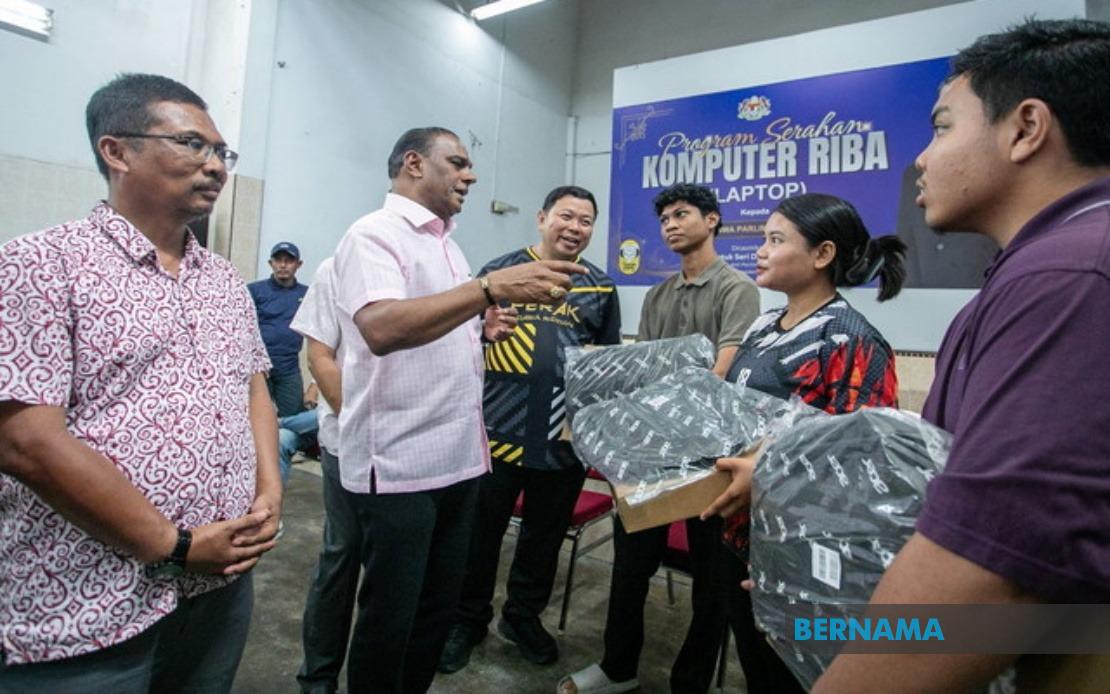
A parliamentary initiative in Perak has equipped 45 university students from economically disadvantaged backgrounds with laptops, underscoring the growing recognition that digital devices have shifted from luxury items to educational essentials in Malaysia's increasingly technology-dependent learning environment. The distribution, conducted by Tapah Member of Parliament Datuk Seri M. Saravanan, marks another year of the Tapah Parliamentary Constituency Student Laptop Handover Programme, which has cumulatively supported more than 1,000 students since its founding in 2008. This year's recipients span multiple qualification levels, including 30 diploma students, five pursuing certificates, four in matriculation programmes, and three undergraduate degree candidates, alongside single recipients each from SPM, STPM, and foundation-level courses, reflecting the scheme's breadth across Malaysia's educational ladder.
Saravanan's framing of the initiative highlights a fundamental shift in how education accessibility is understood domestically. Where laptops once represented discretionary purchases for middle-class families, they now function as prerequisites for academic participation, particularly as universities increasingly embed digital submissions, online collaboration tools, and cloud-based learning platforms into their curricula. For B40 households—those earning less than RM4,850 monthly—acquiring such equipment remains a substantial burden that can directly impede educational progression. The MP's emphasis that students from low-income families should not be disadvantaged by technological barriers speaks to a growing consensus among Malaysian policymakers that bridging the digital divide is essential for inclusive educational outcomes.
The selection methodology employed by the Tapah scheme demonstrates institutional rigour in targeting assistance toward genuine need. Rather than relying solely on self-reported applications, the vetting committee engages multiple verification channels, including the District Education Office and local community leaders, to cross-reference eligibility claims. This multi-stakeholder approach reflects lessons learned in earlier assistance programmes where inadequate verification sometimes resulted in resources reaching unintended beneficiaries. For Malaysian readers familiar with similar initiatives—particularly those expanded under the government's B40 assistance umbrella—such methodological transparency offers reassurance that public resources directed toward low-income support are allocated according to merit-based criteria.
One dimension of particular significance in Saravanan's remarks concerns the educational advancement of Orang Asli youth from the Tapah constituency. The MP's observation that the past two decades have witnessed Orang Asli individuals entering professional fields as doctors, lawyers, and other specialists represents measurable progress on an issue historically characterised by severe disparities in educational attainment and professional representation. While Malaysia has made incremental gains in Indigenous educational enrollment, systemic barriers—ranging from geographic isolation in rural constituencies to lower baseline literacy levels and socioeconomic constraints—continue to limit pathways for Orang Asli advancement. The appearance of such students in higher education programmes, particularly technical and professional tracks like public administration and early childhood education, suggests that targeted interventions can generate intergenerational momentum within historically underrepresented communities.
The lived experience of recipients like Aidil Iskandar Ramlan, an 18-year-old from a security guard's household preparing for diploma studies in public administration at UiTM Raub, illustrates the concrete household economics at stake. For Aidil's family, avoiding an expenditure of RM2,000 to RM4,000 on a functional laptop directly reduces financial strain during a critical period when educational investments compete with basic living costs. His statement that parental resources previously stretched across security and housing needs now extend more equitably across educational support underscores how such programmes operate as stabilising forces within vulnerable household budgets. The same principle applies to Ea Endry Iana Aslan, 19, whose forthcoming early childhood education studies at FELCRA College would have imposed comparable financial pressure on her family had the laptop not been provided.
From a policy perspective, the longevity of the Tapah scheme—operating continuously since 2008 across sixteen years and multiple changes in national government—suggests a degree of political consensus around laptop provision for disadvantaged students. Unlike initiatives vulnerable to partisan fluctuation, this constituency-level programme has proved durable, indicating that individual MPs from different political backgrounds recognise the underlying legitimacy of narrowing technological access gaps. For Malaysian constituencies where similar disparities exist, the Tapah model offers a replicable framework that operates within existing parliamentary resource structures rather than requiring new legislation or substantially expanded budgets.
The diversity of educational pathways represented among this year's cohort—spanning diplomas, certificates, degrees, and preparatory qualifications—reflects a deliberate policy choice to support progression across Malaysia's entire tertiary education ecosystem rather than concentrating resources exclusively on degree-level studies. Diploma programmes, which feed substantial proportions of Malaysia's technical and service workforce, receive particular emphasis with 30 of 45 places. This distribution aligns with labour market realities, where diploma graduates often transition more rapidly into employment than degree holders, meaning laptop access for diploma students carries especially high returns in terms of employability and earning potential.
The integration of educational technology into Malaysian universities has accelerated markedly over the past five years, a trajectory likely to intensify as institutions expand virtual and hybrid learning modalities. Students without reliable access to computing devices face escalating disadvantage as submission deadlines, collaborative project platforms, and examination systems increasingly migrate online. The Tapah programme thus operates within a narrowing window where the provision of physical hardware remains critical; failure to ensure such access at the B40 level risks creating permanent educational bifurcation between households with technology resources and those without.
Looking forward, the sustainability of such initiatives depends on securing consistent funding and political commitment as constituencies compete for limited parliamentary resources. The scheme's effectiveness in reaching over 1,000 beneficiaries over sixteen years demonstrates that modest per-recipient expenditure, when sustained consistently, accumulates into substantial aggregate impact. Extending similar frameworks across other constituencies where B40 concentrations are high could amplify systemic benefits, particularly in states like Sabah, Sarawak, and peninsular constituencies with significant rural or Indigenous populations. For Malaysian policymakers considering expansion of digital inclusion efforts, the Tapah experience offers practical evidence that targeting determined according to local knowledge, administered through established institutional channels, and sustained across political cycles, can effectively narrow technological access barriers that otherwise perpetuate educational inequality.

