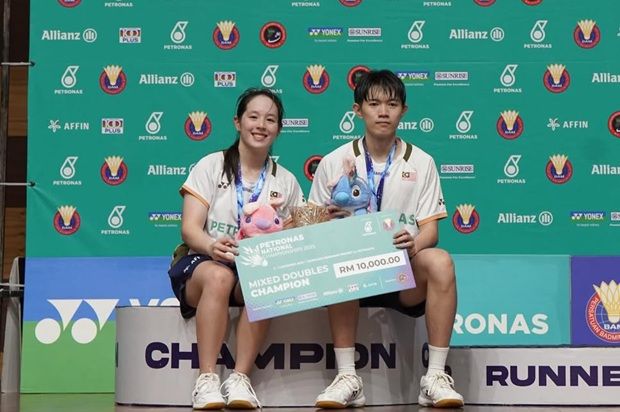
Clarissa San approaches her maiden appearance at the Japan Open, one of badminton's marquee tournaments, armed with straightforward counsel from her new mixed doubles partner: maintain composure and savour the experience. The 20-year-old Malaysian shuttler will compete at the prestigious BWF World Tour event next week following an unexpected pairing with Chen Tang Jie, who steps in after Toh Ee Wei's anterior cruciate ligament injury forced the latter into rehabilitation at a Melbourne facility.
The opportunity emerged from adversity when Ee Wei's serious knee injury created an opening in Malaysia's mixed doubles lineup. Rather than remaining sidelined, the national badminton association moved swiftly to pair the emerging Clarissa with Tang Jie, a seasoned competitor who brings both experience and pedigree to the partnership. For Clarissa, this represents a significant leap in tournament stature. The Selangor-born player acknowledged the magnitude of competing at such a high-profile stage and expressed genuine enthusiasm about sharing the court with an established player of Tang Jie's calibre.
Tang Jie and mixed doubles head coach Nova Widianto have adopted a consistent message in their preparations: fear serves no purpose at the Japan Open. During training sessions and briefings, both figures have reinforced the importance of staying grounded and focusing on enjoyment rather than external pressure. Clarissa recalled their counsel, noting that every day brings reminders to resist anxiety and approach each match with a mindset oriented toward pleasure and learning. This psychological framework reflects a deliberate coaching philosophy aimed at preventing a young player from becoming overwhelmed by the tournament's prestige.
Clarissa's realistic self-assessment reveals maturity beyond her years. She has explicitly stated that holding high expectations for her debut would be counterproductive, instead framing her primary objective as translating months of training work onto match courts. The technical and tactical elements refined during preparation sessions form her benchmark for success rather than trophy aspirations. She acknowledged the considerable ground remaining for improvement across various facets of mixed doubles play but expressed confidence in Tang Jie's willingness to guide her through mistakes and challenging moments. The mentorship dynamic she describes—whereby Tang Jie functions simultaneously as experienced colleague and older brother figure—appears designed to create psychological safety alongside competitive rigour.
Opportunities for learning will materialise rapidly, as the partnership faces a demanding schedule beyond the Japan Open. Clarissa and Tang Jie will compete in approximately three or four additional tournaments following this debut, providing accumulative experience across different opponents and conditions. Rather than viewing the Japan Open as an isolated event, Clarissa frames it as the opening chapter of a longer journey with her partner. This perspective aligns with contemporary badminton development philosophy that emphasises gradual progression and sustained partnership building.
Their opening matchup pits them against Taiwan's Yang Po-hsuan and Hu Ling-fang, a pairing that presents a meaningful but navigable challenge for this newly formed Malaysian combination. The draw neither grants an easy entry nor overwhelms with extreme difficulty, offering a reasonable platform for Clarissa to acclimate to the tournament atmosphere and establish patterns with Tang Jie. Taiwan's mixed doubles scene has produced competitive players, ensuring the opening round will demand focused execution rather than serving as a mere formality.
Malaysia's mixed doubles contingent extends beyond the headline partnership. Jimmy Wong and Cheng Su Yin will contest against Japan's Yuichi Shimogami and Sayaka Hobara in their opening round, facing the additional challenge of competing against a host nation's home advantage. Independent players Goh Soon Huat and Shevon Lai Jemie will encounter American opponents Chen Zhi Yi and Francesca Corbett, presenting a cross-continental clash of styles and approaches. Wong Tien Ci and Lim Chiew Sien face perhaps the tournament's sternest early test, drawing China's fifth seeds Guo Xinwa and Chen Fanghui—a pairing whose seeding reflects considerable pedigree and previous success at major events.
The broader context of Malaysian mixed doubles development frames Clarissa's opportunity as significant beyond the immediate tournament. Injuries to established partnerships, such as Toh Ee Wei's ACL damage, create vacuums that talented younger players must fill. How Clarissa performs alongside Tang Jie will influence selection decisions for future tournaments and potentially shape Malaysia's doubles strategy through the remainder of the season. The Japan Open, therefore, functions as both an immediate competitive challenge and a potential inflection point in her career trajectory.
Coach Nova Widianto's emphasis on calmness and enjoyment reflects global badminton coaching trends that prioritise psychological resilience alongside technical proficiency. Young players at significant tournaments often self-destruct through anxiety rather than technical insufficiency. By explicitly addressing mindset and framing the experience as developmental opportunity rather than make-or-break moment, Widianto and Tang Jie position Clarissa for optimal performance relative to her current capability level. Whether she wins or loses early matches matters considerably less than whether she learns, executes training concepts, and builds confidence alongside her partner.
Clarissa's approach throughout this period demonstrates professional maturity that bodes well for her progression within Malaysian badminton. Rather than allowing newcomer nerves or inflated expectations to cloud judgment, she has adopted grounded objectives and acknowledged the learning curve inherent in competing at premier events. Her willingness to absorb guidance from both coach and partner, coupled with realistic self-assessment, suggests the foundations for sustained improvement and eventual mastery of mixed doubles at the highest level are already forming.

