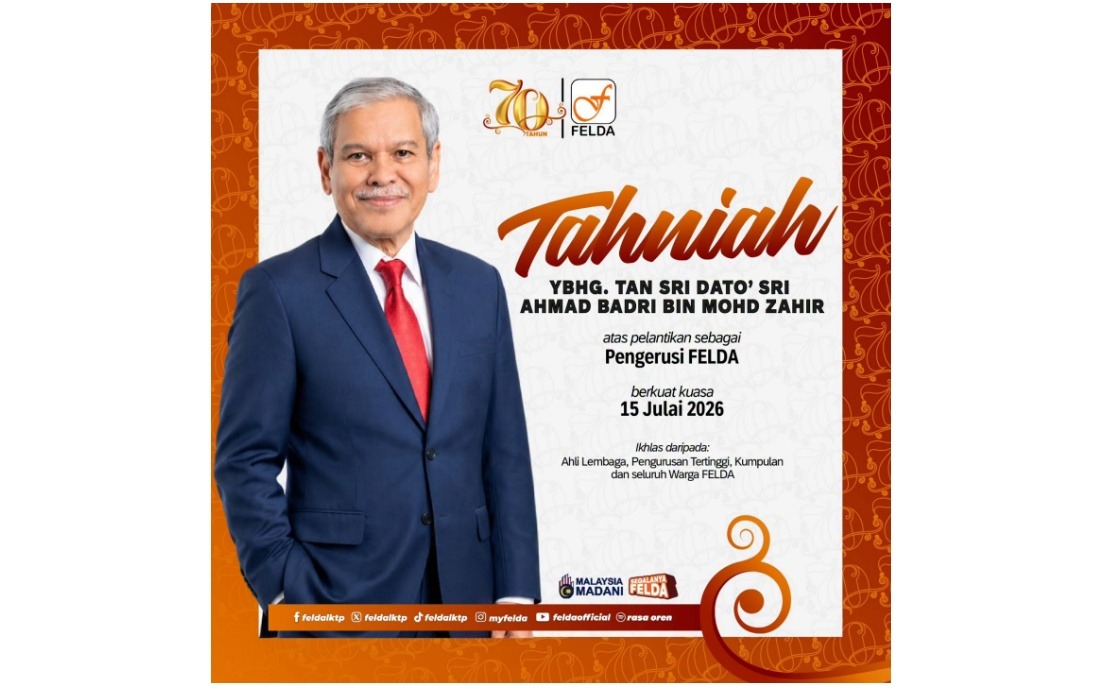
The Federal Land Development Authority (FELDA) has appointed Tan Sri Ahmad Badri Mohd Zahir as its new chairman, signalling a significant leadership transition for the organisation that oversees Malaysia's sprawling network of agricultural settlements. The appointment, announced on July 15, positions an experienced administrator at the helm of an agency responsible for managing the livelihoods of more than three million settlers across the country. FELDA's decision reflects a deliberate strategy to inject fresh institutional leadership into an organisation facing mounting pressures to improve productivity, governance standards, and financial sustainability in an increasingly competitive agricultural sector.
Ahmad Badri brings substantial credentials to the role, having spent over three decades navigating Malaysia's public and corporate bureaucracies. His professional journey commenced in 1989 when he joined the Ministry of Finance, providing him with foundational understanding of government fiscal policy and economic architecture. This early grounding in financial administration would prove instrumental to his subsequent advancement through increasingly prominent positions within Malaysia's economic establishment. His trajectory reflects the kind of institutional continuity valued by policymakers seeking to maintain coherence across government-linked organisations and statutory bodies.
The appointment recognises Ahmad Badri's most visible achievement: his tenure as Treasury Secretary-General from 2018 to 2020, a role occupying the apex of Malaysia's financial bureaucracy. In that position, he would have gained intimate knowledge of macro-economic management, budget formulation, and inter-agency coordination at the highest levels. This experience proves particularly relevant given FELDA's ongoing struggles with financial restructuring, settler welfare provisions, and broader questions about the organisation's viability within contemporary agricultural markets. Understanding how to navigate complex fiscal constraints and competing budgetary priorities represents essential preparation for addressing FELDA's persistent challenges.
Beyond his Treasury background, Ahmad Badri has accumulated diverse leadership experience across Malaysia's institutional landscape. His chairmanship of the Employees Provident Fund, Asia's largest pension fund by membership, demonstrates competence in managing sprawling organisations with millions of individual stakeholders whose expectations demand careful attention. This EPF experience offers particular relevance to FELDA's settler base, where benefit allocation, welfare payments, and long-term financial security remain contentious issues. His familiarity with managing pension obligations and actuarial complexity could inform fresh approaches to FELDA settler benefits structure.
Ahmad Badri's board memberships span critical pillars of Malaysia's economic infrastructure, including prominent positions at Bank Negara Malaysia, Permodalan Nasional Berhad, and Tenaga Nasional Berhad. These appointments position him within networks of Malaysia's institutional elite and provide exposure to how government-linked companies navigate regulatory frameworks, governance expectations, and stakeholder management. His current role as chairman of RHB Bank Bhd places him at the centre of commercial banking operations, offering insight into agricultural financing mechanisms that directly impact settler welfare. Simultaneously, his chairmanship of the Malaysian Rubber Board connects him to agricultural commodity markets and farmer-focused policy implementation, directly transferring applicable knowledge to the FELDA context.
Educationally, Ahmad Badri's qualifications reflect pragmatic preparation for institutional leadership. His Master of Business Administration from the University of Hull suggests exposure to contemporary management theory and international business practice, while his undergraduate degree in Estate Management from Universiti Teknologi MARA (UiTM) provides specific grounding in land administration and property management principles directly applicable to FELDA's core operational activities. This educational combination—technical specialisation married to advanced business training—positions him well to understand both granular operational realities and broader strategic challenges confronting the organisation.
FELDA's statement emphasises that Ahmad Badri's leadership will reinforce governance and strengthen management performance across the organisation. These pronouncements signal institutional confidence that current governance deficiencies—persistent criticisms of FELDA's administrative efficiency and settler satisfaction—can be remedied through improved leadership quality and renewed management discipline. The appointment reflects official belief that FELDA's challenges stem substantially from institutional execution failures rather than fundamental structural or market-driven obstacles. Whether this diagnosis proves accurate will become apparent through observable changes in settler benefit delivery, financial performance metrics, and operational transparency over coming quarters.
The appointment carries significance beyond FELDA's immediate boundaries. As a government-linked statutory body managing rural livelihoods across diverse Malaysian geography, FELDA functions as crucial infrastructure supporting agricultural communities and rural economic stability. Leadership transitions at this level ripple through networks of contractors, service providers, state governments, and settler cooperatives dependent on FELDA's efficient administration. Ahmad Badri's appointment will likely catalyse procedural reviews, strategic reassessments, and reorganisation efforts aimed at demonstrating renewed institutional vitality to stakeholders questioning FELDA's contemporary relevance.
The appointment also reflects broader Malaysian governance patterns where senior public sector officials transition across multiple institutional leadership roles. This circulation of experienced administrators through different government-linked organisations serves to disseminate best practices and maintain continuity of management philosophy across the public sector ecosystem. Ahmad Badri's previous roles have provided exposure to transformation initiatives and organisational restructuring, experiences directly applicable to FELDA's acknowledged need for modernisation. His appointment signals official determination to inject contemporary management thinking into an organisation that sometimes struggles with operational inertia.
FELDA faces persistent challenges regarding settler welfare, financial sustainability, and competitive positioning within evolving agricultural markets. The organisation must balance profit imperatives against social obligations to settlers, manage extensive landholdings efficiently, and adapt to climate change impacts on agricultural productivity. Ahmad Badri's appointment provides opportunity to address these interlocking challenges through renewed institutional leadership. His background in finance, governance, and institutional management offers conceptual frameworks for approaching FELDA's structural problems, though successful implementation will depend on political support, adequate resource allocation, and willingness among stakeholder communities to embrace organisational change.
The statement emphasises FELDA's transformation agenda and commitment to sustainable, inclusive development aligned with national priorities. These aspirational framings suggest Ahmad Badri will inherit explicit mandates to modernise FELDA's operations, improve financial returns, and enhance settler welfare outcomes. Whether these goals prove mutually compatible—and at what cost to different stakeholder groups—will become apparent through policy decisions made during his tenure. His appointment represents Malaysian institutional confidence in experienced administrators' capacity to navigate complex organisational challenges, though real-world execution will ultimately determine whether this leadership transition produces substantive improvements in settler welfare and organisational effectiveness.

