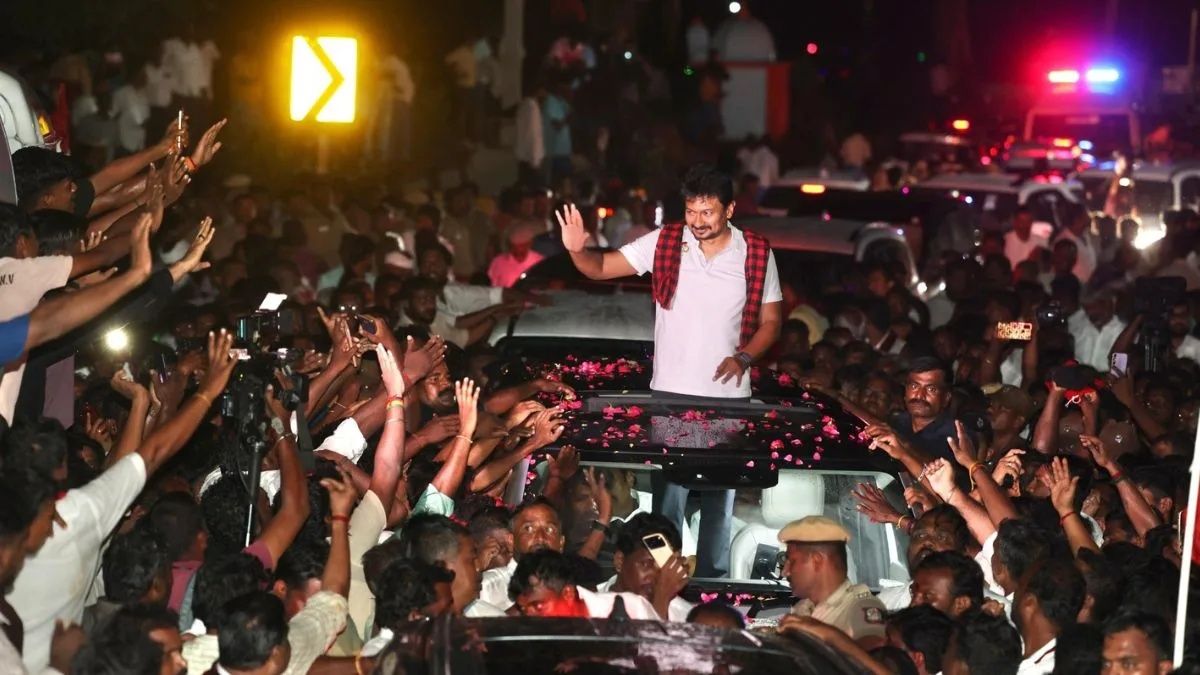
Tamil Nadu's Leader of Opposition Udhayanidhi Stalin walked free on station bail late Tuesday evening after several hours of police interrogation regarding comments he made at a political rally that were widely interpreted as containing sexual innuendo towards actress Trisha Krishnan. The former deputy chief minister's release came after his arrest from his Chennai residence, marking an escalation in tensions between the Opposition DMK and Chief Minister Vijay's ruling TVK party in the southern Indian state.
Outside the Sengipatti police station where Stalin had been held, thousands of DMK supporters gathered to celebrate his release, transforming the area into a political demonstration. Party workers chanted slogans critical of Chief Minister Vijay and his government, framing the arrest as a politically motivated action designed to suppress Opposition voices. The show of strength underscored the deep factional divisions currently roiling Tamil Nadu politics, with the DMK using Stalin's detention as a rallying point for its base.
At a press conference immediately following his release, Stalin denied that his remarks carried any improper connotation or disrespectful intent. He characterised the government's action as a diversion tactic to shift public attention away from substantive policy failures, particularly in handling the contentious Cauvery water dispute with Karnataka and opposition to the proposed Mekedatu dam project. Stalin insisted that his words had been misinterpreted and that his primary concern throughout the speech had been advocating for farmer interests and water security for Tamil Nadu.
The controversy originated during a DMK-organised protest in Thanjavur district where Stalin was addressing issues related to interstate water-sharing disputes. When a supporter in the crowd shouted the name of Trisha—a popular Tamil film actress known to be associated with Chief Minister Vijay—Stalin paused and then remarked, "Wherever water comes, whether it comes or not, water should come there." The remark drew knowing laughter from the crowd, and critics argued that the phrasing constituted a double entendre referencing the actress's name rather than genuine agricultural policy discussion.
The TVK government moved swiftly to escalate the matter, filing a formal police complaint and approaching the National Commission for Women with allegations that Stalin's language amounted to verbal harassment and the objectification of a woman. This strategy reflected the ruling party's broader approach of using legal mechanisms to challenge Opposition politicians, framing the issue through a gender-rights lens that complicated the Opposition's narrative around political persecution. The government's intervention with the women's commission suggested an attempt to preempt criticism that might otherwise come from women's rights advocates.
For Malaysian observers, the incident reveals the intensely personalised nature of South Indian politics, where policy disputes frequently become entangled with attacks on individuals' character and family connections. The willingness of political actors to weaponise legal frameworks—including gender-protection mechanisms—to neutralise opponents reflects patterns seen elsewhere in the region where institutional instruments serve partisan purposes. Stalin's arrest demonstrated that even senior Opposition figures remain vulnerable to sudden detention during tense political climates.
The episode also underscores the volatile status of regional film celebrities in Tamil Nadu's political ecosystem. Trisha's alleged proximity to Chief Minister Vijay made her name itself a flashpoint, and her invocation at a farmers' rally transformed what might have remained a local protest into a statewide controversy. This convergence of cinema and politics, peculiar to Tamil Nadu's political culture, created an opening that the TVK government exploited to shift discourse away from substantive governance questions toward allegations of moral impropriety.
Staling's insistence that he faced political persecution rather than legitimate legal accountability follows a familiar pattern in Indian Opposition politics, where leaders routinely contest the neutrality of police and judicial actions. His framing of the government as a "circus" rather than a legitimate state institution reflected the DMK's broader delegitimisation strategy, positioning the TVK as an illegitimate actor undeserving of democratic respect. Yet such rhetorical strategies, while resonating with core supporters, risk alienating swing voters who may view both sides as engaged in destructive political gamesmanship.
The incident illustrates how quickly Indian political controversies can pivot from substantive policy debates to character attacks and legal confrontations. Stalin's extended interrogation and arrest, despite his eventual release on bail, sent a warning signal to other Opposition figures about the risks of speaking provocatively, even if their statements ostensibly concern agricultural or environmental policy. The implied message—that even ambiguously phrased remarks can trigger legal consequences—may have a chilling effect on political speech within the state.
For regional observers, the Tamil Nadu situation demonstrates how democratic contests in India's states operate in zones of considerable legal and political ambiguity. When police and women's commissions become tools in factional disputes, the institutions nominally designed to protect vulnerable groups risk losing credibility. The outcome of Stalin's legal proceedings and any subsequent charges could significantly influence whether such tactics become normalised in Tamil Nadu politics, potentially shaping the tone of future electoral contests throughout the state.

