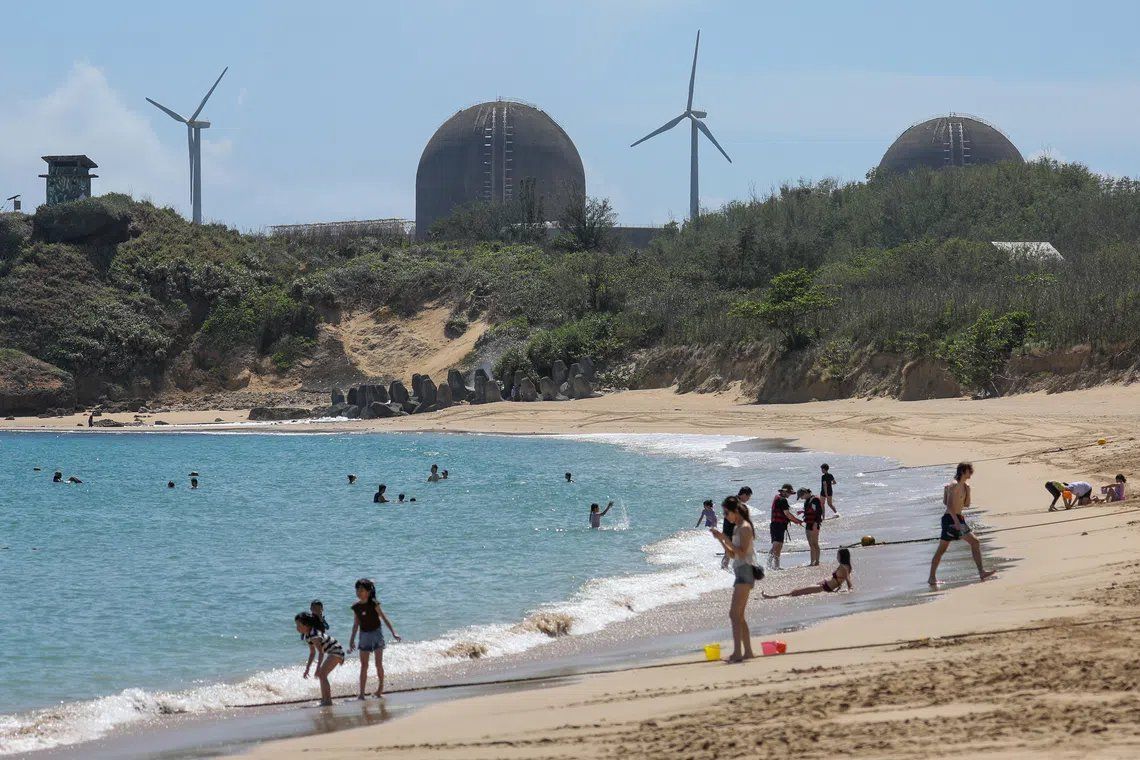
Taiwan's upcoming referendum on nuclear energy, scheduled to coincide with November's local elections, exemplifies how direct democracy mechanisms have become tools for partisan advantage rather than genuine vehicles for citizen deliberation. The ballot measure asks whether Taiwan should abandon its "Nuclear-Free Homeland" policy to address electricity supply concerns, public health, national defence, and artificial intelligence industry development. Yet this nuclear question represents just one of three proposed referendums submitted to Taiwan's Central Election Commission this year, revealing deeper currents of political calculation beneath what appear to be straightforward policy choices.
The nuclear referendum is notably the fourth time Taiwanese voters have been asked to decide on atomic energy policy within eight years, with the previous vote occurring merely a year ago in August 2023. This frequency raises substantive questions about whether genuine shifts in public opinion or energy circumstances warrant such repeated consultations, or whether cyclical electoral considerations are driving the agenda. The Central Election Commission approved only the nuclear measure while rejecting two other proposals—one regarding corporal punishment for serious crimes and another on traffic fine allocation—demonstrating that not all proposed referendums receive equal institutional support, though the rejected measures reveal the breadth of issues political actors wish to put directly to voters.
Examiners of Taiwan's political landscape contend that the strategic calculations underlying these referendums often eclipse their stated policy objectives. Qi Dongtao, senior research fellow at the East Asian Institute at the National University of Singapore, emphasizes that electoral positioning represents at least as significant a motivation as substantive policy concerns. Opposition parties, particularly the Kuomintang and Taiwan People's Party, apparently believe that issues including crime prevention and energy independence appeal to ideologically conservative voters whose mobilization during local elections could shift closely contested races. Historical precedent supports this tactical reasoning: during the 2018 local elections, when ten national referendums appeared alongside ballots for local officials, the Kuomintang achieved notably strong performance, suggesting that higher turnout among conservative-leaning voters correlates with opposition party success.
The November elections carry particular significance for Taiwan's political trajectory, determining winners for eleven thousand and fifty-one local public offices including county magistrates and other officials across the island. While domestic issues traditionally dominate these campaigns, political scientists recognize these contests as meaningful indicators of national sentiment heading toward Taiwan's presidential elections, scheduled for completion by 2028. Opposition parties perceive referendums as mechanisms to inject galvanizing issues into the electoral discourse, allowing them to present themselves as champions of particular causes—such as Singapore-style law-and-order governance—while characterizing the Democratic Progressive Party as obstructing tough policies. Chong Ja Ian, associate professor at NUS, notes that the Kuomintang deliberately invokes Singapore's reputation for security and prosperity to argue that stricter criminal penalties reflect prudent governance being frustrated by the ruling party and existing legal frameworks.
Taiwan's referendum framework underwent substantial liberalization in 2017, fundamentally altering the landscape for direct democracy initiatives. Previously, referendums required fifty percent voter turnout to achieve validity, a threshold that caused former president Chen Shui-bian's 2004 cross-strait relations referendums to fail despite commanding overwhelming support among those who voted. Current rules require only that affirmative votes exceed negative votes and that "Yes" votes constitute at least twenty-five percent of the total electorate, dramatically lowering the barrier for passage. This institutional shift unleashed a surge in referendum proposals, transforming what had been relatively rare exercises into regular features of Taiwan's electoral calendar. The consequence, observers warn, is that referendums increasingly function as extensions of party competition rather than expressions of fundamental democratic judgment on major constitutional or policy questions.
The temporal compression surrounding these votes compounds concerns about democratic deliberation. Lin Jia-he, associate professor at National Chengchi University's College of Law, points out that the 2026 referendum was announced on August twenty-eighth and scheduled for voting on November twenty-eighth—a three-month window insufficient for rigorous public examination of "complex and diverse" energy policy questions. Switzerland, by contrast, typically allocates three to five years from initial proposal through final vote, permitting comprehensive government and public discussion. Taiwan's accelerated timeline prevents voters from meaningfully engaging with technical questions regarding energy combinations, supply security, and industrial implications, instead reducing complex policy choice to simplified binary votes conducted amid electoral tumult focused primarily on local officials.
The nuclear referendum specifically addresses legitimate energy concerns that may have evolved since the previous vote. Global oil supply disruptions following the Strait of Hormuz closure and surging electricity consumption driven by artificial intelligence development represent plausible reasons why public sentiment on nuclear energy could have shifted. Taiwan's geographic vulnerability and dependence on energy imports create genuine security considerations that rationally inform energy policy debate. Yet the simultaneous staging with local elections, combined with the political parties' obvious strategic interests in mobilizing particular constituencies, inevitably taints the legitimacy of the referendum as an impartial assessment of energy requirements. Policy substance becomes inseparable from electoral calculation, rendering it impossible for voters to determine whether their genuine preferences on energy are being solicited or whether they are being mobilized for unrelated local contests.
Public awareness of these dynamics has generated growing skepticism about Taiwan's referendum culture. Sean Chang, a thirty-nine-year-old public relations professional from Taipei, observes that while referendums initially carried noble intentions, they have devolved into "tools for each political party to manipulate public opinion." Chang participated in the 2018 voting that featured ten questions alongside local elections but subsequently abandoned close attention to such measures, fatigued by the necessity of evaluating each issue through multiple political lenses. His experience reflects broader citizen disengagement with what political elites present as direct democracy opportunities but which voters increasingly perceive as manufactured exercises in partisan mobilization.
Qi Dongtao articulates the fundamental democratic concern: when political parties routinely employ referendums as weapons in competitive contests, direct democracy transforms from an instrument for addressing truly consequential questions requiring popular authorization into another battlefield for partisan struggle. Properly conceived, referendums should address matters of genuine constitutional or fundamental policy significance where particular reasons justify seeking direct democratic input rather than relying on representative institutions. Taiwan's current practice of holding multiple contentious referendums within compressed timeframes during electoral periods suggests that institutional protections against such weaponization remain inadequate. The lower threshold for passage, combined with the absence of meaningful cooling-off periods between proposal and vote, enables political actors to weaponize direct democracy mechanisms for electoral advantage.
The implications of this referendum pattern extend beyond Taiwan's immediate domestic politics. Southeast Asian democracies wrestling with how to structure citizen participation mechanisms face cautionary lessons from Taiwan's experience. Direct democracy instruments, when insufficiently constrained by institutional safeguards, can degrade into vehicles for partisan mobilization rather than expressions of genuine popular sovereignty. Taiwan's trajectory suggests that simply lowering barriers to referendums without establishing robust deliberative periods, temporal separation from elections, or thresholds requiring substantial majorities can transform potentially valuable democratic tools into instruments that complicate rather than clarify popular will. As regional democracies continue developing their institutional frameworks, Taiwan's nuclear referendum and broader referendum expansion offer important examples of how technical procedural changes can produce consequences differing markedly from their original democratic aspirations.

